

iPhone camera lens replacement: Save money with smart choices
TL;DR:
- Replacing just the outer glass lens is sufficient if internal image quality is unaffected.
- Full module replacement is needed only if internal components or camera performance are faulty.
- Using quality third-party parts can be cost-effective if sourced from reputable suppliers, avoiding unnecessary expenses.
Replacing an iPhone camera lens sounds simple until you realise there are two entirely different repairs people confuse under that single label. One involves swapping a small piece of protective glass on the outside of the phone. The other means replacing the entire camera module inside the device. The price gap between these two options is enormous, and choosing the wrong one can cost you significantly more than necessary. For DIY fixers and professional technicians alike, understanding exactly what the repair entails, what parts to source, and how to complete the job correctly makes the difference between a smart fix and an expensive mistake.
Table of Contents
- Understanding the types of iPhone camera repairs
- How much does iPhone camera lens replacement actually cost?
- Choosing the right parts: Genuine vs third-party options
- Step-by-step: Replacing your iPhone camera lens safely
- Why most people overspend on iPhone camera repairs
- Find the right parts for cost-effective iPhone camera repairs
- Frequently asked questions
Key Takeaways
| Point | Details |
|---|---|
| Lens vs module choice | Only replace the module if image problems persist after replacing the lens glass. |
| Cost breakdown | Lens-only parts typically cost £7–£30, while full camera modules start at £80. |
| Stick to high-quality parts | Using genuine or proven high-grade lenses ensures durability and camera clarity. |
| DIY repair is achievable | Most lens-only repairs can be performed with basic tools and correct guidance. |
Understanding the types of iPhone camera repairs
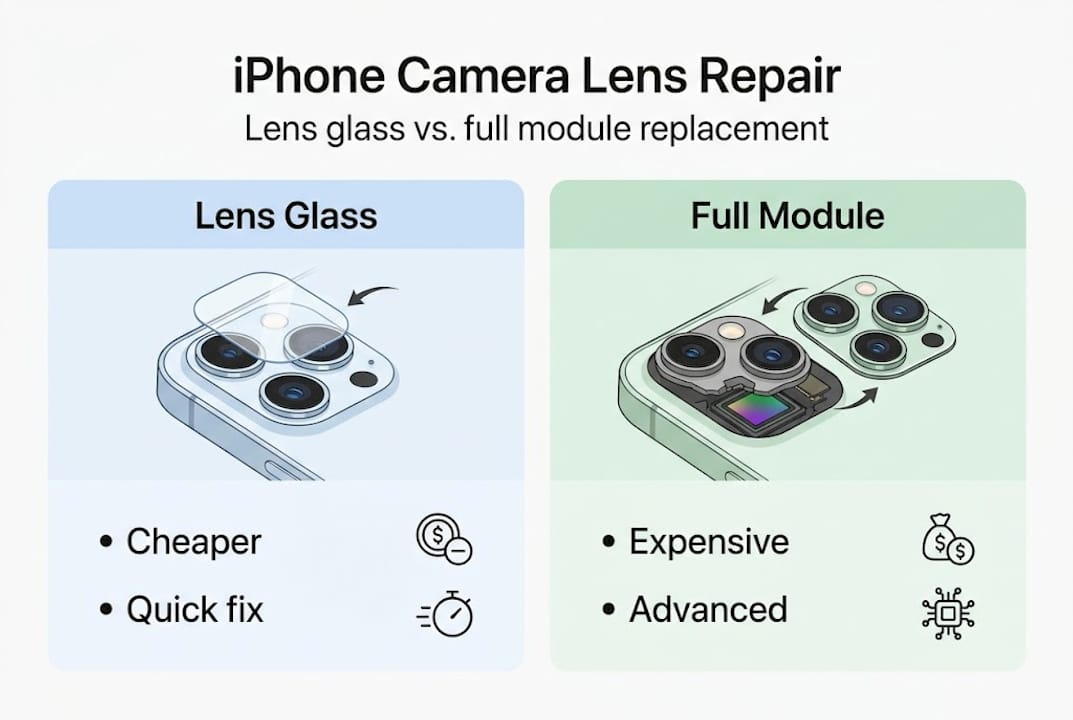
Not every cracked or scratched camera lens requires a full module swap. That distinction alone can save you between £50 and £150 depending on your iPhone model. So before ordering parts or booking a repair, it is worth understanding precisely what each repair type involves.
Lens-only replacement addresses damage to the small glass cover that sits over the camera opening on the rear panel. This piece protects the actual lens elements inside the module. If your photos still look sharp and clear but the glass itself is cracked or deeply scratched, a lens-only fix is almost certainly all you need. The glass cover can be removed with heat, a suction cup, and a thin prying tool, making it accessible even to confident beginners.
Full camera module replacement is a different matter entirely. The module contains the actual image sensor, autofocus components, optical image stabilisation (OIS) hardware, and the lens array. If your photos are blurry regardless of whether the glass is cracked, if autofocus stutters or fails completely, or if the camera app shows a black screen or error, the module itself has likely failed. As noted in Apple’s own guidance, external lens damage alone does not necessarily indicate module failure. You should only replace the full module when internal image quality problems persist without any obvious external cause.
Material quality and its impact on results
The material of the replacement lens glass matters more than most people expect. Here is a quick comparison of the common options you will encounter:
| Material | Durability | Clarity | Typical cost |
|---|---|---|---|
| OEM-grade sapphire | Excellent | Excellent | £15–£30 |
| High-grade optical glass | Good | Very good | £10–£20 |
| Standard glass | Moderate | Moderate | £7–£15 |
| Plastic | Poor | Poor | £3–£8 |
Sapphire glass, used on many genuine Apple parts, is significantly harder than standard glass. It resists scratches far better and maintains optical clarity over time. Plastic substitutes might look fine in the first week but can develop micro-scratches that scatter light and degrade photo quality noticeably. Our camera glass cost guide covers these material differences in greater detail, including which options suit specific iPhone generations.
“If images remain clear and the only visible damage is external cracking, a lens-only repair is sufficient. A full module replacement becomes necessary when image quality is compromised regardless of the exterior condition.” Apple Self Service Repair documentation reinforces this approach, recommending genuine parts for iPhones from iPhone 12 onwards to maintain full functionality and pass the parts authenticity check in Settings.
Pro Tip: Before ordering any parts, run the camera through a proper test. Take photos in different lighting, check video recording, and test portrait mode if your model supports it. If everything looks clear except for a visible crack on the glass, you almost certainly only need the outer lens.
When it comes to authorised versus alternative repair options, the key is understanding what you are trading off. Apple authorised providers guarantee genuine components and maintain your warranty status, but their prices reflect that. Independent technicians using quality third-party parts can deliver excellent results at considerably lower cost, provided they source from reputable suppliers. Our DIY repair guide walks through the full process for both audiences.
How much does iPhone camera lens replacement actually cost?
With the repair types clearly defined, the practical cost question becomes much easier to answer. Costs break down across three broad categories: parts only, parts with labour at an independent repair shop, and Apple authorised service.
Part costs in the UK
- Outer lens glass only: £7 to £30, depending on material quality and iPhone model
- Full rear camera module: £80 and upwards, often £120 to £200 for recent Pro models
- Adhesive and sealing materials: £2 to £5 additional if not included with the lens
For older models like the iPhone X or iPhone 11, lens glass parts tend to sit at the lower end. For newer models with multiple camera systems, the complexity and precision required push prices higher. You can find a detailed breakdown of costs for a specific model in our iPhone 12 camera glass costs breakdown, which reflects typical UK retail pricing for 2026.
Labour costs at independent repair shops
Independent repair centres in the UK typically charge between £25 and £70 for a camera lens replacement, depending on the model and the shop’s location. London-based shops generally sit at the higher end of that range. For a full camera module swap, labour can climb to £50 to £120 on top of the part cost.

Apple authorised service costs
Apple’s own pricing for out-of-warranty camera repairs is considerably higher. For recent models, you can expect to pay £100 to £300 or more depending on the device. Apple recommends genuine parts via Self Service Repair or authorised providers for iPhone 12 and later, specifically to ensure safety, correct function, and to pass the parts authenticity check that now appears in the Settings app. That check does not affect camera function directly, but some users prefer to avoid the notification.
What drives the price up or down?
- iPhone model: Newer Pro models with LiDAR and multiple sensors cost more to source parts for
- Part quality: OEM-grade sapphire glass costs more but lasts significantly longer
- Supplier reputation: Trusted suppliers with quality checks cost slightly more but carry far fewer failures
- Warranty on parts: Parts with a warranty attached typically reflect slightly higher quality and confidence
The real savings come from correctly identifying which repair you actually need. Paying £150 for a full module when a £15 lens glass and twenty minutes of careful work would have resolved the issue is the most common and most avoidable mistake in this space.
Choosing the right parts: Genuine vs third-party options
Once you know what repair you need and what it should cost, the next critical decision is where to source your parts. This is where many DIY buyers and even some technicians make costly errors.
Why Apple flags non-genuine parts
From iPhone 12 onwards, Apple’s iOS includes a parts authenticity check. If a non-genuine camera module is detected, a notification appears in Settings under General > About. For lens glass alone, this check is typically not triggered since the glass is passive and contains no electronics. However, replacing a full camera module with a non-genuine part will almost certainly trigger the notification. This does not disable the camera, but it is worth knowing before you commit to a module replacement using third-party components. Apple’s genuine parts recommendation is explicit on this point for iPhone 12 and later devices.
Evaluating third-party alternatives
Quality third-party parts are a practical reality for the repair industry. The key is knowing how to distinguish good from bad. Here is a numbered checklist to apply before purchasing:
- Check the material specification clearly listed by the supplier (sapphire, optical glass, or generic glass)
- Look for quality inspection processes that the supplier applies before dispatch
- Verify compatibility with your specific iPhone model number, not just the name
- Confirm warranty or return terms in case the part arrives defective
- Read feedback from other technicians who have used the supplier before
Poor-quality substitutes carry real risks beyond just the look. Blurry photos caused by imprecise optical tolerances, premature breakage from inferior hardness, and loss of weather sealing from adhesive that does not bond correctly are all documented issues with low-grade parts. A high-quality glass lens sourced from a reputable UK supplier avoids these failure modes entirely.
Pro Tip: For lens glass replacements specifically, OCA (Optically Clear Adhesive) pre-applied to the lens is a significant advantage. It removes one variable from the repair process and ensures a clean, bubble-free bond every time.
Red flags to watch for when sourcing parts:
- No material specification listed in the product description
- Unusually low price with no warranty or return policy
- No compatibility confirmation for your specific model
- Seller with limited trading history or no technical background
Step-by-step: Replacing your iPhone camera lens safely
Now that you understand what to buy and where to get it, here is how to approach the repair itself without causing additional damage.
Tools you will need
- Heat gun or precision heat pad (set to 60–70°C maximum)
- Suction cup and thin plastic prying tool
- 99% isopropyl alcohol and lint-free wipes
- OCA pre-applied replacement lens glass
- Anti-static wrist strap
- Precision tweezers
The replacement process
- Power down the device completely before starting. Never work on a live phone.
- Apply gentle heat to the camera area for 30 to 45 seconds. This softens the adhesive without damaging the module below.
- Use a suction cup to create lift, then carefully slide a plastic spudger around the perimeter of the cracked lens to separate it from the adhesive ring beneath.
- Remove all adhesive residue from the camera opening using isopropyl alcohol and a lint-free cloth. Do not allow liquid to enter the module area.
- Align the new lens glass precisely over the camera opening. Most pre-cut replacement glass includes alignment notches for this reason.
- Press firmly and evenly around the perimeter for 30 to 60 seconds to activate the OCA adhesive seal.
- Power on and test immediately. Open the camera app and check all lenses if your model has multiple cameras.
Checking for a successful repair
After reassembly, run a thorough test. Take photos in good light and low light. Check video at 4K if supported. Use portrait mode and zoom functions. If everything performs as expected, the repair is complete. Our repair tips for camera issues cover troubleshooting steps if problems persist after the lens swap.
If issues remain after lens replacement:
- Persistent blur likely indicates module damage rather than lens damage
- Autofocus failure after a clean lens swap points to module or flex cable issues
- Black screen or crash in the camera app suggests a hardware or software fault unrelated to the lens
Pro Tip: Always wear an anti-static wrist strap during disassembly. Static discharge can damage the image sensor or OIS components even through brief contact, and the resulting fault will not always appear immediately.
Why most people overspend on iPhone camera repairs
After years of supplying parts to both professional technicians and confident DIYers across the UK, a pattern becomes very clear. The single biggest cost driver in iPhone camera repairs is not the part price or the labour rate. It is misdiagnosis.
Users see a cracked lens and assume the worst. Repair shops, sometimes without sufficient examination, quote a full module replacement. The result is a £150 to £250 bill for a problem that a £15 glass and a heat gun would have sorted in under half an hour. That is not a knock on every repair shop, but it is a real and documented tendency in the market.
There is also a persistent myth that third-party parts are always inferior. In our experience, quality aftermarket lens glass from a reputable supplier performs identically to the original in everyday use. The difference shows under extreme scrutiny, particularly with macro photography, but for the vast majority of users it is completely imperceptible. Understanding your actual needs, as laid out in our in-depth repair guide, will always give you better value than defaulting to the most expensive option. Spend on what is broken. Not on what is not.
Find the right parts for cost-effective iPhone camera repairs
At Buy2fix, we supply a broad range of compatible iPhone camera lens glass and full camera modules for both DIY buyers and professional repair technicians throughout the UK. Every part goes through quality checks before dispatch, and we offer free UK mainland shipping along with a 30-day return policy on eligible items. Whether you need a pre-applied OCA lens glass for a straightforward swap or a full replacement module for a more involved repair, you can browse by iPhone model to find the right match. Our repair blog also provides model-specific guidance to support your decision at every step. Explore our full range of iPhone repair parts and get the job done right the first time.
Frequently asked questions
Can I replace just the iPhone camera lens or do I need a full module?
You can replace only the outer lens glass if your images remain clear and there is no internal module damage; as confirmed in Apple’s repair guidance, a full module replacement is only needed when image quality itself is compromised.
Is it safe to use third-party camera lens parts?
Quality third-party lens glass sourced from trusted suppliers is safe and performs well in everyday use, though Apple recommends genuine parts for iPhone 12 and later to ensure full functionality and avoid authenticity notifications.
How much does it cost to replace an iPhone camera lens in the UK?
Replacement lens glass typically costs £7 to £30 for the part alone, with independent labour adding £25 to £70; full module replacements start from £80 for the part and can exceed £200 for Pro models.
Will a non-genuine lens affect my iPhone’s camera performance?
A poor-quality lens can cause blur, inaccurate colour, or loss of optical clarity, and replacing the camera module with a non-genuine part on iPhone 12 and later may trigger a parts authenticity warning in Settings.
Recommended
Let customers speak for us
I ❤️ love it, it's absolutely amazing I'm sooo happy 😊

Great

I saw this item and it was just what I was looking for. I found it here but not in Amazon or e-bay. However, it was in UK, I was surprised to find that they were able to ship it to the US. Excellent company, would do business with again

This is great for when out and about, to sharpen either coloured pencils, or watercolour pencils….would order again.

Great items would bye again

I have purchased several items from this store before. Recently, I encountered an issue with my latest order. After reporting the problem to customer support, they were consistently attentive and made every effort to resolve the situation. Upon investigation, they acknowledged the issue and promptly fixed it. This experience has increased my level of trust in this store.
Thank you so much. I'm so happy.

très bien

BC70 Car Bluetooth 5.0 FM Transmitter Radio Adapter Dual Display Wireless Handsfree Call MP3 Music Player QC3.0 PD USB Charger

A quite sturdy cover, if you are looking for full protection and a more business-like style, this cover perfectly fulfills its purpose.
The shipping was fast, and it was delivered in perfect condition.

For LG TV Bluetooth Handheld Infrared Voice Multi-Function Remote Control(AKB75855501)

Tusen tack för bästa service och produkt som jag vänlig önskar dig tack

Works correctly and no issues so far

Took a while to get here but it was all good, watch looks brand new after replacement

What a fantastic 👏🏻 stylish case that has helped my phones temperature in the heatwave!!
Perfect 👌🏻 also it's cool as f##k
