

What is an LCD television? Your 2026 buying guide
TL;DR:
- LCD televisions use liquid crystals controlled by electrical signals to modulate light from an LED backlight, forming images on screen. They dominate the market due to their affordability, brightness, and reliability, with “LED TV” serving as a marketing term for LED-backlit LCD models. Different panel types like IPS and VA affect viewing angles and contrast, making the right choice important for viewers’ preferences.
An LCD television is a flat-panel display that forms images by controlling light through electrically manipulated liquid crystals, illuminated by an LED backlight. The term LCD stands for Liquid Crystal Display, and this technology sits at the heart of nearly every mainstream TV sold today. Whether you are browsing Samsung, LG, Sony, or Hisense sets in a UK retailer, you are almost certainly looking at an LCD television. Understanding what that means gives you a real advantage when comparing specs, panel types, and price points before you spend your money.
What is an LCD television and how does it differ from other displays?
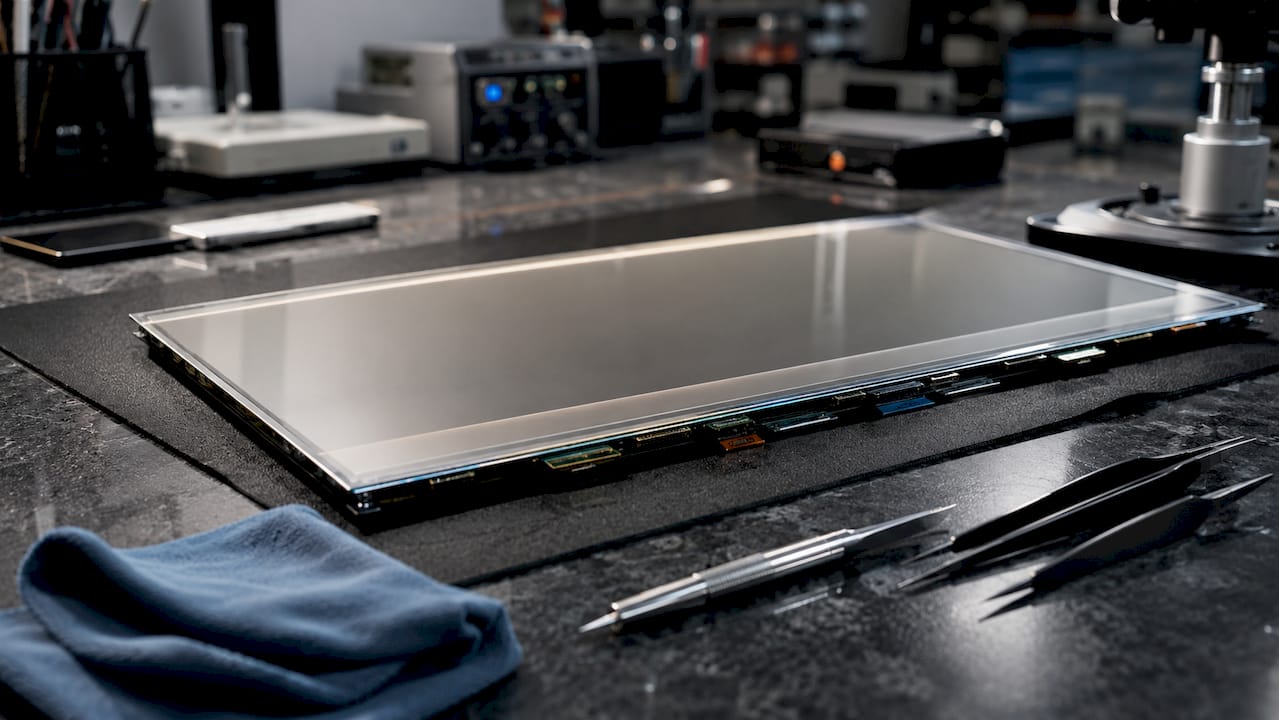
An LCD television uses a layer of liquid crystals sandwiched between two glass panels to control how much light passes through to your eyes. Liquid crystals are not self-emissive. They do not produce their own light the way a candle or an OLED pixel does. Instead, they act as microscopic shutters, twisting or aligning in response to electrical signals to block or allow light from a backlight source behind them.
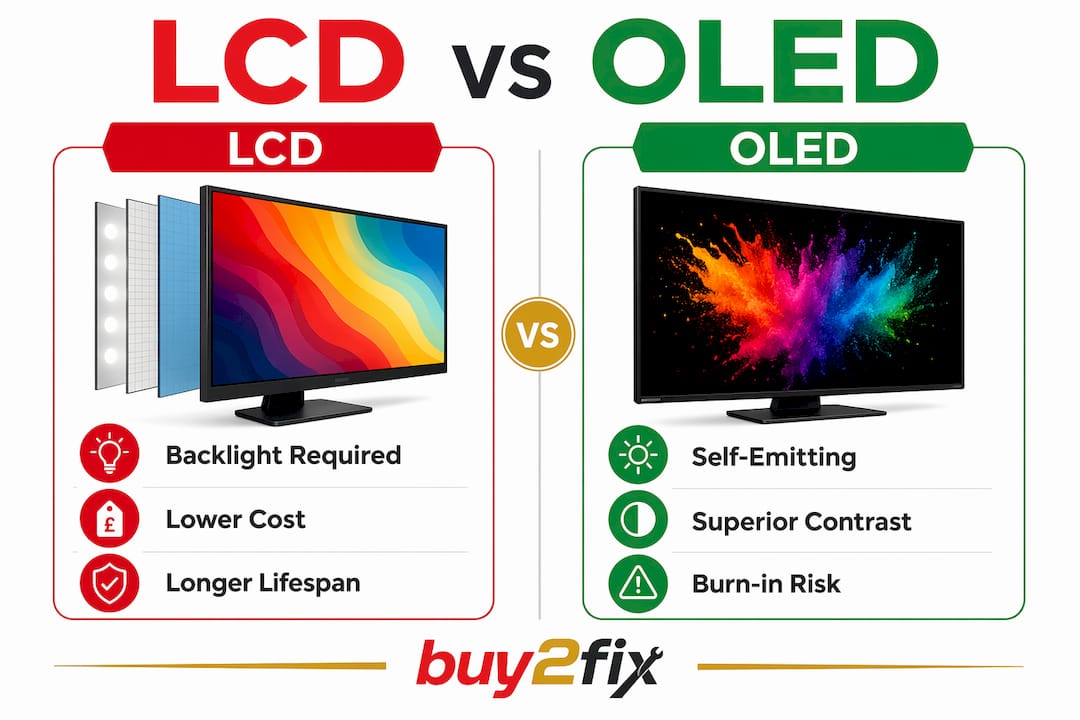
This is the fundamental distinction between LCD and OLED televisions. OLED displays offer superior contrast because each pixel generates its own light and can switch off completely. LCD pixels cannot go fully dark because the backlight is always present behind them. That said, LCD technology dominates the global TV market because it is affordable, bright, and reliable in a way that OLED currently cannot match at every price point.
The liquid crystal layer itself is paired with polarising filters and colour filters. White light from the LED backlight passes through the first polariser, then through the liquid crystal layer, then through red, green, or blue colour filters, and finally through a second polariser before reaching your eye. The combination of these layers produces the full-colour image you see on screen.
How does an LCD television work to produce images?
Understanding the image-forming process in an LCD TV requires looking at several layers working together in sequence.
- The LED backlight sits at the rear or edges of the panel and floods the display with white light. This is the primary light source for the entire image.
- The first polariser filters the backlight so that only light vibrating in one direction passes through.
- The TFT layer contains millions of thin-film transistors, one per pixel. Each pixel includes a TFT and capacitor forming a circuit that holds the pixel’s voltage between refresh cycles. This precise control is what makes sharp, stable images possible.
- The liquid crystal layer responds to the voltage applied by each transistor. Depending on the voltage, the crystals twist to varying degrees, controlling how much polarised light passes through.
- Colour filters assign red, green, or blue to each sub-pixel. Every full pixel on your screen is made up of three sub-pixels in these colours, and their combined intensity produces the colour you see.
- The second polariser blocks any light that has not been correctly modulated by the liquid crystals, sharpening the final image.
Local dimming technology adds another layer of control by dividing the LED backlight into independent zones. In dark scenes, zones behind shadowed areas dim or switch off entirely, producing deeper blacks and better perceived contrast. This is one of the most significant advances in LCD picture quality over the past decade.
Pro Tip: When comparing LCD TVs, look for “full-array local dimming” rather than “edge-lit local dimming.” Full-array sets place LEDs across the entire back of the panel, giving far more precise control over brightness zones.
LCD vs LED TVs: what is the actual difference?
This is the question that trips up more buyers than any other. The honest answer is that LED TV is a marketing term for an LED-backlit LCD television. There is no separate display technology called LED TV. Every set sold under that label is, at its core, an LCD television.
Here is why the confusion exists. Before approximately 2012, LCD televisions used Cold Cathode Fluorescent Lamps (CCFL) as their backlight source. When manufacturers switched to LED backlighting, they wanted to signal the improvement to consumers. The term “LED TV” was born as a marketing shorthand. CCFL-backlit LCD production ceased around 2012, so every LCD television manufactured since then uses LED backlighting by default.
LED backlighting offers several clear advantages over the old CCFL approach:
- Energy efficiency: LEDs consume significantly less power than CCFL tubes for equivalent brightness.
- Slimmer panels: LEDs are physically smaller, enabling the ultra-thin TV designs common today.
- Longer lifespan: LEDs outlast CCFL tubes and maintain brightness more consistently over time.
- Local dimming capability: LEDs can be controlled in zones; CCFL tubes cannot.
- Faster response to brightness changes: LEDs switch on and off almost instantaneously.
| Feature | CCFL-backlit LCD | LED-backlit LCD (modern) |
|---|---|---|
| Backlight type | Fluorescent tubes | Light-emitting diodes |
| Energy use | Higher | Lower |
| Panel thickness | Thicker | Thinner |
| Local dimming | Not possible | Available (full-array or edge-lit) |
| Still manufactured? | No (ceased ~2012) | Yes, all current models |
For a deeper look at how these terms relate to each other, the Buy2fix guide on LED LCD displays is worth reading before you shop.
What are the main types of LCD panels and how do they affect performance?
Not all LCD panels are built the same way. The three dominant panel technologies are TN (Twisted Nematic), IPS (In-Plane Switching), and VA (Vertical Alignment). Each involves a different arrangement of liquid crystals, and each produces a noticeably different viewing experience.
- TN panels are the oldest and cheapest to manufacture. They offer fast response times, which made them popular in PC gaming monitors. For television use, TN panels are largely obsolete because their viewing angles are poor. Colours shift and wash out when you move even slightly off-centre.
- IPS panels arrange liquid crystals horizontally and rotate them in-plane when voltage is applied. IPS panels offer better colour reproduction and viewing angles compared to TN panels. This makes IPS the preferred choice for living room TVs where viewers sit at different positions around the room. LG uses IPS technology across much of its LCD range under the “NanoCell” branding.
- VA panels align crystals vertically and tilt them when activated. VA panels produce deeper blacks and higher native contrast ratios than IPS, making them strong performers in dark room viewing. The trade-off is narrower viewing angles compared to IPS, though wider than TN.
Panel type significantly affects customer satisfaction due to viewing angle and colour reproduction differences. This is not a minor spec-sheet detail. Sit at a 45-degree angle from a VA panel and you will notice colour shift. Sit in the same position from an IPS panel and the image holds up far better.
Pro Tip: If your TV will be watched by multiple people sitting at different angles, prioritise an IPS panel. If you watch mostly in a dark room from directly in front, a VA panel’s contrast advantage is worth the narrower viewing angle.
The Buy2fix guide on LCD panel types covers these differences in practical detail, including how panel choice affects repair and replacement decisions.
What are the advantages and limitations of LCD televisions?
LCD televisions remain the dominant display technology for good reasons, but they are not without genuine trade-offs.
Advantages of LCD TVs:
- Affordability. Large-scale Generation 10.5 fabrication plants produce multiple LCD panels per glass sheet, driving manufacturing costs down significantly. A 65-inch LCD TV costs a fraction of an equivalent OLED.
- High brightness. LCD panels with LED backlights can achieve very high peak brightness levels, making them well suited to bright living rooms and HDR content.
- No burn-in risk. Burn-in occurs when static images permanently damage display pixels. LCD pixels do not degrade in this way, making LCD TVs a safer choice for gaming, news channels, or any use case with static on-screen elements.
- Long lifespan. LED backlights are durable. A well-maintained LCD TV can deliver reliable performance for well over a decade.
- Wide model range. From budget 32-inch bedroom sets to flagship 85-inch mini-LED models, LCD technology covers every price bracket.
Limitations of LCD TVs:
- Black level performance. Because the backlight is always present, LCD TVs struggle to produce true black. Even with local dimming, some light bleeds into dark areas, a phenomenon called “blooming.”
- Contrast ratio. OLED displays offer superior contrast because self-emissive pixels switch off completely. LCD contrast ratios, while improving, cannot match OLED in this respect.
- Viewing angle limitations. VA panels in particular show colour and brightness shifts at wider angles. IPS panels are better but still not as consistent as OLED across extreme viewing positions.
The gap between LCD and OLED is narrowing. Mini-LED backlighting uses thousands of tiny LEDs in a full-array configuration, enabling far more precise local dimming zones. Samsung’s Neo QLED range and LG’s QNED series both use mini-LED to push LCD contrast performance closer to OLED territory. For most buyers, a well-specified LCD TV with full-array local dimming delivers excellent picture quality at a price that OLED cannot compete with.
For a detailed side-by-side comparison, the Buy2fix article on LCD vs OLED differences breaks down exactly where each technology wins and loses.
Key takeaways
An LCD television uses liquid crystals and LED backlighting to produce images, and this technology underpins nearly every mainstream TV sold in 2026.
| Point | Details |
|---|---|
| LCD is the dominant TV technology | Nearly all mainstream TVs, including those labelled “LED TV,” use LCD display technology. |
| LED TV is a marketing label | “LED TV” refers to an LED-backlit LCD, not a separate display type. CCFL backlights ceased production around 2012. |
| Panel type shapes your viewing experience | IPS suits wide-angle viewing; VA suits dark room contrast; TN is largely obsolete for TVs. |
| Local dimming improves contrast | Full-array local dimming delivers better black levels than edge-lit designs by controlling backlight zones independently. |
| LCD beats OLED on price and brightness | LCD TVs offer no burn-in risk, higher brightness, and far lower cost, making them the practical choice for most households. |
Why I think the LCD vs LED confusion is the industry’s worst-kept secret
I have spent years watching people walk into electronics shops and walk out with a TV they do not fully understand. The “LED TV” label is the single biggest source of that confusion, and frankly, it was designed that way. Manufacturers knew that “LED” sounded more advanced than “LCD” in 2009, so they leaned into it. The label stuck, and now consumers in 2026 are still asking whether LED TVs are better than LCD TVs, not realising they are asking about the same thing.
What I find genuinely interesting is that the real choice has never been LCD versus LED. The real choice is between panel types and backlight configurations. A VA panel with full-array local dimming will outperform an IPS panel with edge-lit backlighting in a dark room, regardless of what the box says on the front. That is the conversation buyers should be having.
The other thing I would push back on is the assumption that OLED has made LCD irrelevant. Mini-LED LCD sets from Samsung and LG are producing contrast performance that would have seemed impossible five years ago. For bright rooms, gaming, and sports viewing, a flagship LCD TV is still the smarter buy for most people. OLED earns its premium in very specific conditions. For the average UK living room, a well-chosen LCD television with the right panel type and backlight configuration is more than enough.
If you are mounting your new set, a quality adjustable ceiling TV mount can make a real difference to viewing angles, particularly with VA panels where positioning matters more.
— Adewale
Find LCD televisions and display parts at Buy2fix
Buy2fix stocks a broad range of consumer electronics and display components suited to both buyers and repair professionals. Whether you are sourcing a replacement LCD screen for a device you already own or looking for guidance on display technology before a purchase, the Buy2fix team has the product knowledge to help. The Buy2fix electronics catalogue covers LCD screens, repair parts for major brands including Samsung, LG, and Sony, and accessories to support your setup. Free UK mainland shipping, a 30-day return policy, and warranty support on eligible items make Buy2fix a dependable starting point for anyone navigating the LCD TV market in 2026.
FAQ
What does LCD stand for in a television?
LCD stands for Liquid Crystal Display. It refers to the layer of liquid crystals that controls light from an LED backlight to form the images you see on screen.
Is an LED TV the same as an LCD TV?
Yes. An LED TV is an LCD television with LED backlighting. The term “LED TV” is a marketing label, not a separate display technology. All modern LCD TVs are LED-backlit, as CCFL backlight production ceased around 2012.
Which LCD panel type is best for a living room TV?
IPS panels are generally best for living rooms because they maintain colour accuracy and brightness across wide viewing angles. VA panels offer better contrast but suit viewers who sit directly in front of the screen.
Do LCD TVs suffer from burn-in?
No. Burn-in is a risk associated with OLED and plasma displays, not LCD technology. LCD pixels do not degrade from displaying static images, making LCD TVs a reliable choice for gaming or news channels with persistent on-screen graphics.
What is local dimming on an LCD TV?
Local dimming divides the LED backlight into independent zones that can brighten or dim separately. Full-array local dimming places these zones across the entire back of the panel, producing deeper blacks and better contrast than edge-lit designs.
Recommended
Let customers speak for us
Well made part very strong easy to fit great value for the money

Well packed, with fast shipping :)

Exactly what the doctor ordered…great color, comfort, and durability. Trust this watch band!

Brilliant strap, second purchase, bought bracelet before. Excellent value. Thank you

Great item for splitting your Audio signal

Outstanding product!
Next level customer service.

Very satisfied but the delivery needs to get more faster...

Good price,quick delivery

Best phone case ever! This is my second one as I broke my first. Would defo recommend

Great fitting Apple Watch bands

For Apple Watch Ultra 3 / 2 / 1 49mm RedPepper Armor Metal Case Integrated Silicone Watch Band(Steel Black White)

Good price and quick postage

Perfect fit.

Absolutely necessary

Second Purchase and still a very happy customer. Keep up the good work.
