


News
LCD Screen Technology Explained: Key Types And Risks
Most British repair enthusiasts know that LCD screens power nearly every modern smartphone, but misconceptions still lead to costly mistakes. With over 90 percent of smartphone faults involving display issues, understanding liquid crystal display fundamentals is crucial for safe and efficient repairs. This article breaks down core technologies, common repair challenges, and practical tips so British DIY and professional technicians can work smarter with today’s advanced screens.
Table of Contents
- Liquid Crystal Display Fundamentals And Misconceptions
- Core Types Of LCD Technology In Devices
- How LCD Screens Function And Are Built
- Typical Faults, Repair Challenges, And Risks
- Comparing LCD With LED, OLED, And Alternatives
Key Takeaways
| Point | Details |
|---|---|
| Understanding LCD Technology | LCDs are not emissive displays; they modulate light through liquid crystals, making them energy-efficient compared to older technologies. |
| Panel Type Variations | Different LCD types (TN, IPS, VA, STN) have unique strengths, affecting colour accuracy, viewing angles, and response times. |
| Repair Challenges | Repairing LCD screens is complex due to vulnerabilities like dead pixels and backlight failures, requiring careful handling and expertise. |
| Comparison with Other Technologies | LCDs differ from LED and OLED, where the latter offers better contrast and colour but at higher costs; choose based on specific needs and conditions. |
Liquid crystal display fundamentals and misconceptions
Liquid Crystal Displays (LCDs) represent a sophisticated technology that transforms how we interact with digital screens. Unlike traditional display technologies, LCDs utilise a unique mechanism for creating visual information by manipulating liquid crystal properties.
At their core, LCDs are not emissive displays - a critical misconception among many consumers. Instead, they function through intricate light modulation, using liquid crystal molecules that can twist and align when electrical currents are applied. These molecules act like microscopic shutters, controlling light passage through polarised filters to generate images. The backlight provides illumination, while the liquid crystals determine which portions of that light become visible.
The fundamental structure of an LCD involves several key components: a liquid crystal layer sandwiched between two polarising filters, colour filters, and thin-film transistors that precisely control each pixel’s light transmission. Modern LCDs can achieve remarkable colour accuracy and response times by manipulating these elements with incredible precision. This technology has revolutionised display design across smartphones, televisions, computer monitors, and countless electronic devices.
Understanding LCD technology reveals why these screens are significantly more energy-efficient and compact compared to older display technologies like Cathode Ray Tubes (CRTs). By modulating existing light rather than generating it directly, LCDs consume less power and generate less heat.
Pro tip: When examining an LCD screen, look for uniform backlighting and pixel responsiveness to assess its overall quality and potential wear.
Core types of LCD technology in devices
Liquid Crystal Display (LCD) technology encompasses several distinct types, each engineered to address specific performance requirements across different electronic devices. Fundamental LCD classifications reveal a complex landscape of display technologies tailored for various applications.
The primary LCD variants include Twisted Nematic (TN), Super Twisted Nematic (STN), In-Plane Switching (IPS), and Vertically Aligned (VA) displays. TN panels were the earliest commercially successful design, characterised by lower manufacturing costs and faster response times. However, modern devices increasingly favour IPS and VA technologies, which offer superior viewing angles and colour reproduction. Thin-film-transistor LCD technology has further revolutionised display performance, enabling more precise pixel control and enhanced image quality across smartphones, televisions, and computer monitors.
Each LCD type presents unique strengths and limitations. TN panels remain popular in budget devices due to their low production costs, while IPS displays dominate professional and high-end consumer markets by providing exceptional colour accuracy and wider viewing perspectives. VA panels excel in contrast performance, making them ideal for multimedia devices and gaming monitors that require deep black levels and high dynamic range.

The evolution of LCD technology continues to push boundaries, with manufacturers constantly refining transistor designs, pixel structures, and light-modulation techniques to improve display performance, energy efficiency, and visual fidelity.
Pro tip: When selecting a device, examine the LCD panel type to understand its potential performance characteristics across different usage scenarios.
The following table summarises the main types of LCD panel technologies and their distinguishing characteristics:
| Panel Type | Viewing Angle Quality | Response Time | Typical Use Cases |
|---|---|---|---|
| TN | Narrow | Fast | Budget monitors, gaming |
| IPS | Wide | Moderate | Graphic design, premium devices |
| VA | Moderate | Moderate | Multimedia, high-contrast monitors |
| STN | Narrow | Slow | Simple screens, calculators |
How LCD screens function and are built
LCD screens represent a sophisticated engineering marvel, comprising multiple precisely engineered layers that work in intricate harmony. LCD screen construction involves complex interactions between optical components designed to manipulate light with extraordinary precision.
The fundamental structure of an LCD screen includes several critical components: two glass substrates with transparent electrodes, typically made from indium tin oxide, sandwiching a liquid crystal layer. These substrates are equipped with patterned electrodes arranged in grid formations that enable pixel-level control. Material layer configurations include strategically positioned polarising filters oriented perpendicularly to each other, which play a crucial role in controlling light transmission.
When an electrical voltage is applied to specific electrode points, the liquid crystal molecules rotate, changing their light-polarising properties. This precise molecular manipulation allows each pixel to modulate light intensity and colour, effectively creating the visual images we see on screens. The backlight source provides illumination, while the liquid crystal layer acts as a sophisticated light valve, selectively blocking or allowing light passage depending on the applied electrical signals.
The sophistication of LCD technology lies in its ability to create complex images through microscopic molecular movements, transforming electrical signals into visual representations with remarkable accuracy and speed. Modern manufacturing techniques continue to refine this process, improving resolution, colour depth, and energy efficiency.
Pro tip: When examining an LCD screen, observe how different voltage levels create variations in pixel transparency and colour intensity.
Typical faults, repair challenges, and risks
LCD screens present a range of complex failure mechanisms that challenge even experienced repair technicians. Display technology failure rates reveal nuanced vulnerabilities across different electronic devices, with several critical fault categories emerging consistently.
The most prevalent LCD screen issues include dead pixels, backlight failures, colour distortion, and driver circuitry problems. These faults often manifest through subtle visual irregularities: horizontal or vertical lines across the display, unresponsive touch regions, or complete screen blackouts. Repair study findings highlight significant barriers to effective repair, including increasingly complex manufacturing designs that deliberately limit component accessibility and replacement.
Technical risks during LCD screen repair are particularly pronounced. Potential complications include short-circuit dangers, irreversible damage to delicate electronic pathways, and static electricity risks that can permanently compromise sensitive transistor layers. Repair professionals must navigate these challenges with extreme precision, understanding that each intervention carries potential for further device deterioration. The microscopic nature of LCD components means even minor mishandling can render an entire screen assembly non-functional.
Understanding these risks requires comprehensive technical knowledge and meticulous approach. Modern LCD screens incorporate increasingly sophisticated design principles that prioritise miniaturisation and performance over straightforward repairability, making each intervention a calculated technical challenge.
Pro tip: Always use anti-static equipment and work in a controlled environment when attempting LCD screen repairs to minimise potential electronic component damage.
Comparing LCD with LED, OLED, and alternatives
Display technologies have evolved dramatically, with each technology presenting unique strengths and limitations. Display technology comparisons reveal a complex landscape of technological innovations that cater to different user requirements and device applications.
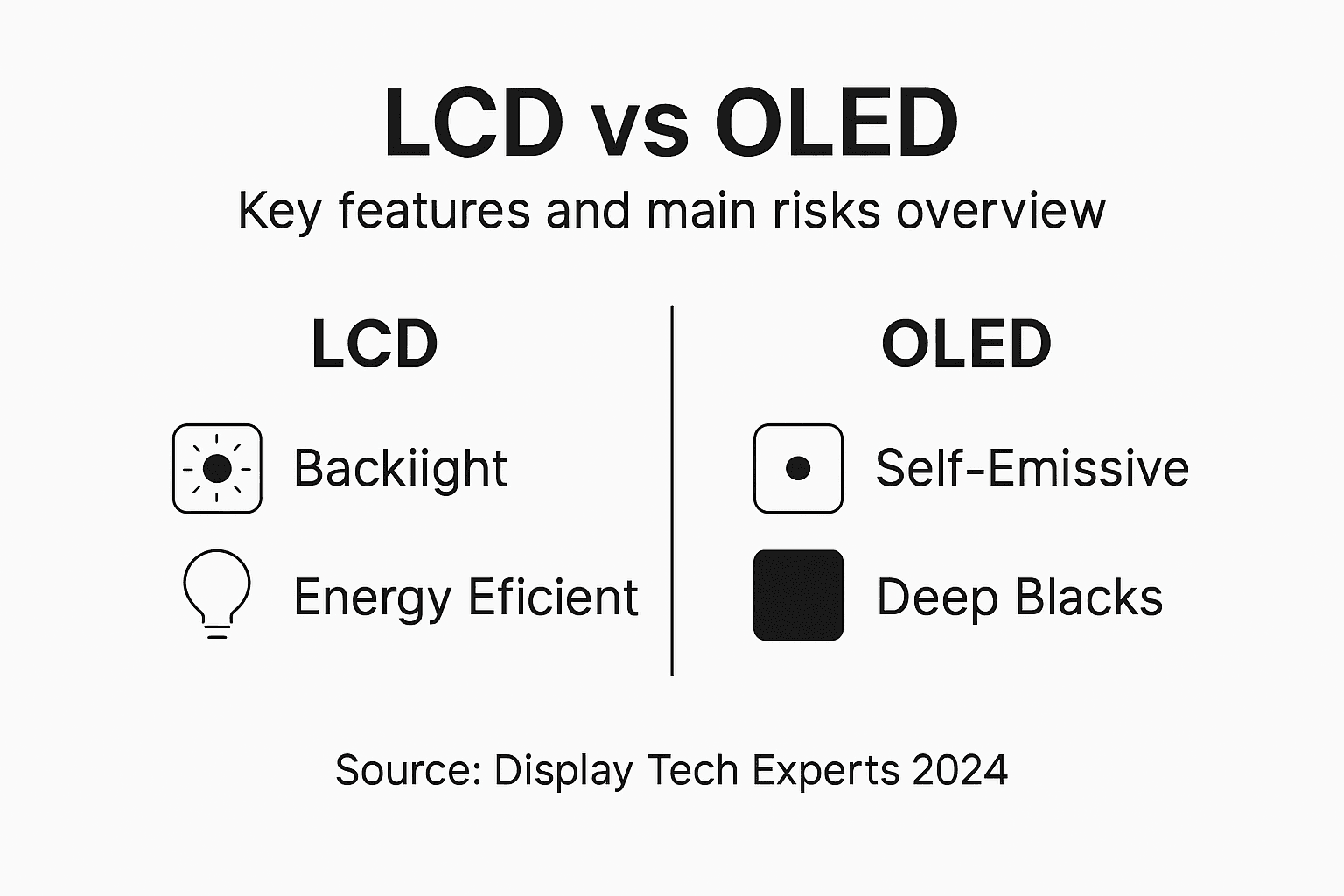
LCD technology differs fundamentally from emerging alternatives like OLED and LED. Traditional LCDs use a backlight and liquid crystal layer to modulate light, whereas OLED displays emit light directly through organic compounds. LED-backlit LCD technologies represent an evolutionary step, offering improved energy efficiency and picture quality compared to older CCFL-backlit screens. OLED displays distinguish themselves by providing superior contrast, deeper blacks, and wider viewing angles, albeit at a significantly higher production cost.
Each display technology carries distinct advantages and drawbacks. LED-backlit LCDs excel in brightness and energy conservation, making them ideal for high-illumination environments. OLED screens offer unparalleled colour reproduction and contrast but struggle with potential burn-in issues and shorter lifespans. Traditional LCDs remain cost-effective and reliable, providing consistent performance across diverse electronic devices from smartphones to industrial displays.
This table compares key features of LCD, LED-backlit LCD, and OLED displays to assist in choosing the optimal technology:
| Technology | Light Source Method | Notable Advantage | Major Consideration |
|---|---|---|---|
| LCD | Backlight (CCFL/LED) | Cost-effective, reliable | Limited contrast ratio |
| LED-backlit LCD | LED backlight | Brighter, energy-saving | Still needs liquid crystal |
| OLED | Self-emissive pixels | Superior contrast, thin form | Expensive, burn-in risk |
Emerging technologies like Micro LED promise to bridge existing technological gaps, potentially offering the best attributes of both LCD and OLED display systems. These innovations suggest a future where display technologies become increasingly adaptable, efficient, and tailored to specific user needs.
Pro tip: When selecting a display, consider the specific use case and environmental conditions to choose the most appropriate display technology.
Navigate LCD Screen Repairs with Confidence and Quality Parts
Understanding the intricacies of LCD screen technology and the risks involved in repairs can save costly mistakes. Whether dealing with common challenges like dead pixels or backlight failures, having the right components tailored for your device is essential. At Buy2fix, we specialise in supplying high-quality LCD screens and display assemblies, designed to meet the precise needs of both DIY enthusiasts and professional repair technicians.
Don’t let complex faults or delicate repair risks hold you back. Explore our extensive inventory of mobile phone and tablet repair parts to find the exact replacement you need, supported by our quality assurance and one-year warranty. Gain peace of mind and restore your device’s performance with trusted components from Buy2fix. Visit now and start your repair journey with confidence by browsing our selection of Mobile Phone Repair Parts and Tablet & Laptop Parts that cater to all major brands and models.
Frequently Asked Questions
What are the main types of LCD technology?
The primary types of LCD technology include Twisted Nematic (TN), In-Plane Switching (IPS), Vertically Aligned (VA), and Super Twisted Nematic (STN). Each type offers different performance characteristics suited for various devices and purposes.
How do LCD screens create images?
LCD screens create images by utilising a liquid crystal layer that manipulates light with electrical currents. The liquid crystals twist and align to control light passage through polarised filters, allowing for the formation of images on the screen.
What are common issues faced by LCD screens?
Common issues with LCD screens include dead pixels, backlight failures, colour distortion, and driver circuitry problems. These faults can result in visual irregularities such as unresponsive touch regions or complete screen blackouts.
How do LCD displays compare to OLED and LED technology?
LCD displays differ from OLED and LED technologies primarily in their light emission methods. LCDs use a backlight and liquid crystal layer, while OLEDs emit light directly from organic compounds. LED-backlit LCDs improve brightness and energy efficiency compared to traditional LCDs, but OLEDs offer superior contrast and colour reproduction.
Recommended
Let customers speak for us
item was packaged safely, no damage. it’s now October and since replacing it in January i’ve had no issues.

Great

They had what I was looking for ... ordering was easy, payment was easy, delivery was as promised.
-

Absolutely love this case! Heavy, sturdy and full coverage

Thank You! I really love it! 😊

For Garmin Forerunner 165 20mm Two Color Textured Silicone Watch Band(Teal)

For Samsung Galaxy S26+ 5G R-JUST Sliding Camera Life Waterproof Holder Phone Case(Black)

I ❤️ love it, it's absolutely amazing I'm sooo happy 😊

Great

I saw this item and it was just what I was looking for. I found it here but not in Amazon or e-bay. However, it was in UK, I was surprised to find that they were able to ship it to the US. Excellent company, would do business with again

This is great for when out and about, to sharpen either coloured pencils, or watercolour pencils….would order again.

Great items would bye again

I have purchased several items from this store before. Recently, I encountered an issue with my latest order. After reporting the problem to customer support, they were consistently attentive and made every effort to resolve the situation. Upon investigation, they acknowledged the issue and promptly fixed it. This experience has increased my level of trust in this store.
Thank you so much. I'm so happy.
