

Why genuine parts matter for DIY smartphone repairs
TL;DR:
- Using genuine parts ensures precise compatibility, reliable performance, and long-term safety for your device.
- Failure to use OEM components can lead to cascading failures, reduced longevity, and decreased resale value.
You pull apart your cracked iPhone, order a replacement screen from a marketplace listing that undercuts the genuine part by £40, fit it in an hour, and feel like a winner. Then, three weeks later, the touch response becomes erratic, Face ID stops working, and the battery starts draining twice as fast. This is not bad luck. This is exactly what happens when you fit a component that was never built to work with your device. Understanding why genuine parts matter could save you from a costly repeat repair and, more importantly, from breaking the very device you were trying to fix.
Table of Contents
- Key takeaways
- Why genuine parts matter: OEM versus aftermarket explained
- How genuine parts affect performance, longevity, and safety
- The real cost comparison: genuine versus aftermarket parts
- How to identify genuine parts and where to source them
- My honest view on cutting corners with repair parts
- Get genuine parts for your repair at Buy2fix
- FAQ
Key takeaways
| Point | Details |
|---|---|
| Genuine parts are built to exact tolerances | OEM components match the original specifications your device relies on for normal operation. |
| Calibration is non-negotiable | Features like Face ID and battery health reporting require system calibration after fitting genuine parts to function correctly. |
| Cheaper parts cost more long-term | Aftermarket parts that fail prematurely can trigger cascading hardware damage, multiplying your repair costs. |
| Genuine parts protect resale value | Documented repairs using OEM components reassure future buyers and maintain device value. |
| Sourcing matters as much as the part itself | Buying from a verified retailer with proper quality checks reduces the risk of counterfeit components. |
Why genuine parts matter: OEM versus aftermarket explained
When we talk about genuine parts, we mean components manufactured either by the original device maker or by a supplier working directly to that maker’s exact specifications. These are commonly referred to as OEM parts, short for original equipment manufacturer. Every dimension, material grade, and electrical characteristic is engineered to match what came out of the factory. Fitting one is as close to a factory repair as you can get outside of an authorised service centre.
Aftermarket parts are a different category entirely, and “aftermarket” covers an enormous range of quality. Some aftermarket components are decent approximations. Many are not. The core problem is tolerance. Smartphone components interact with one another at very fine margins. A display assembly that is fractions of a millimetre thicker than spec can put pressure on internal cables. A battery cell with slightly different discharge characteristics can confuse the device’s power management firmware. These are not theoretical risks. They are the kinds of failures that show up in reviews, forums, and repair shop queues every week.
Here is what separates a genuine part from a typical cheap aftermarket alternative:
- Material quality. Genuine displays use the same OLED or LCD panel grades specified during design. Aftermarket screens frequently use lower-grade panels with inferior colour accuracy, reduced brightness, and weaker touch sensitivity.
- Dimensional precision. OEM parts are machined or moulded to tolerances that ensure correct fit without stressing the chassis or adjacent components.
- Connector quality. Genuine flex cables and connectors are rated for the correct number of insertion cycles. Cheap alternatives often fail at the contact points within months.
- Tested compatibility. Genuine parts undergo rigorous testing to meet exact specifications before they reach the market, including electrical, thermal, and mechanical stress tests.
Pro Tip: If a part listing does not specify OEM origin and the price seems too good, assume it is aftermarket. The burden of proof is on the seller, not on you.
The importance of genuine parts becomes especially clear when you consider how tightly modern smartphones are integrated. The camera, display, Face ID sensor, and battery all share data with the main processor. Fitting a part that speaks a slightly different electrical language can throw off the whole system.
How genuine parts affect performance, longevity, and safety
This is where the consequences become concrete. A smartphone is not a collection of independent parts. It is a system. Every component is tuned to operate within precise parameters, and when one of those components is out of spec, the effects ripple outwards.
Take the battery as an example. Apple’s health reporting system reads cycle counts, impedance, and calibration data stored on the battery’s controller chip. Fit a third-party battery without the correct chip data, and iOS will display a “service recommended” warning indefinitely, even if the cell itself is perfectly functional. The same issue affects charge management; the device may not fast charge correctly, or it may cut off at unexpected percentages. Apple’s Self Service Repair programme addresses this directly by requiring calibration steps after battery replacement to restore full health reporting functionality.

Face ID is even less forgiving. The TrueDepth camera system is serialised to the logic board. A genuine replacement part from Apple carries the correct pairing data. A counterfeit or uncalibrated aftermarket part simply does not work, no matter how carefully you fit it.
Beyond functionality, there are real safety considerations. Genuine parts are tested for stress, heat, and usage durability, whereas cheap duplicate parts wear out faster and increase the risk of failure under normal operating conditions. A poorly manufactured battery that overheats is not just inconvenient. It is a fire hazard.
Consider the impact on long-term device life:
- Battery health preservation. OEM batteries hold their rated capacity closer to spec over more charge cycles than third-party cells, which often show significant degradation within six months.
- Display longevity. Genuine panels maintain colour accuracy and touch response consistently. Cheap alternatives frequently develop dead zones or bleed issues within weeks of fitting.
- Structural integrity. A genuine rear glass or chassis component distributes impact stress as intended. An ill-fitting aftermarket part can create micro-fractures at stress points that would not otherwise exist.
- Thermal management. Many genuine components include specific coatings or materials that assist heat dissipation. Aftermarket versions often omit these, leading to higher operating temperatures and accelerated wear on the processor and surrounding components.
The benefits of authentic parts extend well beyond the individual component. Fitting a genuine screen does not just give you a better display. It protects the device’s software features, its thermal performance, and its ability to function as designed for years to come.
The real cost comparison: genuine versus aftermarket parts
The upfront price difference is real. A genuine iPhone screen assembly will cost noticeably more than a budget aftermarket panel. For many DIY repairers, that price gap feels like the most important number on the page. It is not.
OEM parts outlast aftermarket equivalents by 30 to 50% in real-world use, and aftermarket parts regularly cause cascading failures that require additional repairs. Fit a cheap display and it fails in four months. Now you need a second display, possibly a new connector, and potentially a digitiser repair if the first part caused pressure damage to the underlying components. The £40 you saved on the first screen has now cost you three times as much.
| Factor | Genuine (OEM) parts | Aftermarket parts |
|---|---|---|
| Upfront cost | Higher | Lower |
| Expected lifespan | Matches original specification | 30 to 50% shorter on average |
| Warranty coverage | Manufacturer warranty included | Limited or none |
| Risk of cascading failure | Low | Significantly higher |
| Resale value impact | Positive; reassures buyers | Negative; raises concerns |
| System calibration compatibility | Full | Partial or none |
The warranty point is worth dwelling on. Genuine parts often include manufacturer-backed coverage that protects against consequential damage. If a genuine battery fails and damages the charging circuit, that consequential damage may fall under warranty. Aftermarket warranties almost universally exclude such coverage.
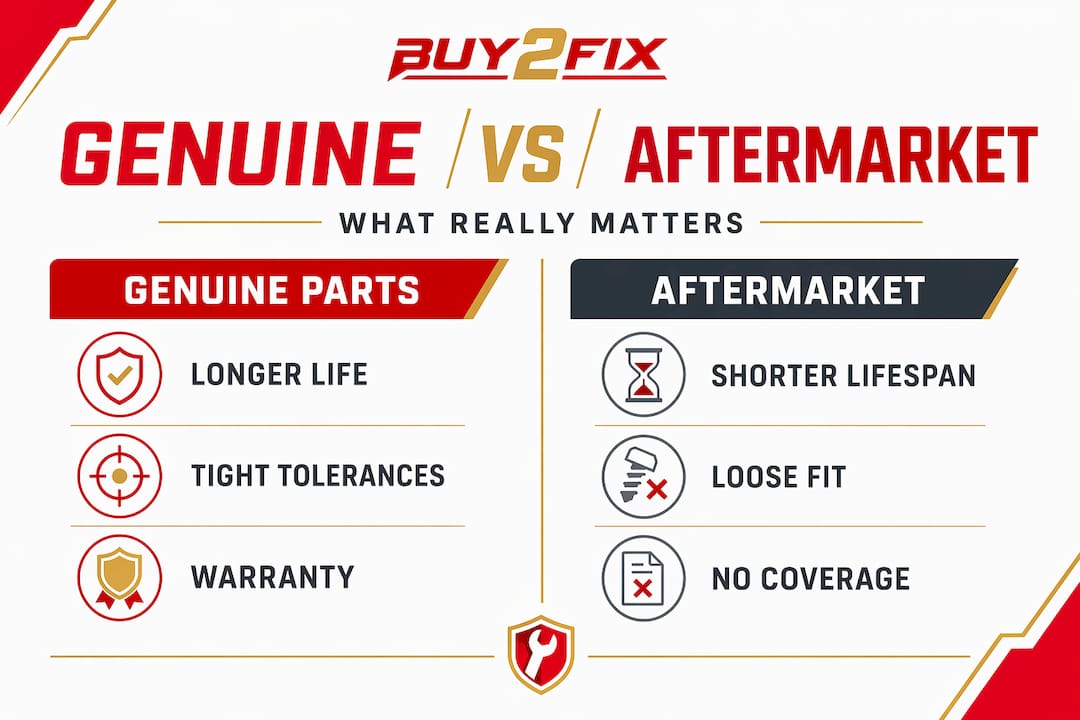
Resale value is another factor most DIY repairers overlook entirely. Using original equipment parts for your repair, and documenting that you did so, demonstrably increases what a buyer will pay for your device. Aftermarket repairs are treated as red flags by experienced buyers, who assume the cheapest possible option was taken. The importance of genuine parts to resale value is, in a practical sense, financial.
Pro Tip: Keep your receipts and product documentation when buying genuine parts. If you sell the device later, that paperwork is worth real money in buyer confidence.
How to identify genuine parts and where to source them
Knowing why you should use genuine parts is half the job. Knowing how to find them is the other half, and this is where a lot of DIY repairers go wrong.
Here are the most reliable indicators that a part is genuine:
- Official programme sourcing. Apple’s Self Service Repair programme ships genuine parts directly, provides official repair manuals, and supplies professional-grade tools for loan. This is the most reliable route for iPhone repairs.
- Packaging and labelling. Genuine Apple parts come in Apple-branded packaging with a part number that you can cross-reference on Apple’s own support pages. Missing, inconsistent, or poorly printed packaging is a warning sign.
- Serialisation markings. Many genuine components carry serial numbers or QR codes that can be verified. Counterfeit parts often replicate the appearance of these markings without the underlying data.
- Retailer transparency. A trustworthy seller will state clearly whether a part is OEM, specify the device compatibility in detail, and provide warranty information. Vague listings that describe parts as “compatible” or “high quality” without specifying origin should be treated with caution.
- Price positioning. If the price is significantly below what an OEM part typically costs, it is almost certainly not genuine. Genuine components have real manufacturing costs that cannot be compressed to bargain-bin pricing.
For identifying authentic components before you buy, always check the part number against official documentation, and only purchase from retailers who carry out quality checks before dispatch. The repair tools and manuals that accompany official repair programmes are not just convenient. They are part of the system that makes the repair work properly, particularly for the calibration steps that restore full device functionality after fitting.
My honest view on cutting corners with repair parts
I have seen the aftermath of cheap parts repairs more times than I can count, and the pattern is depressingly consistent. Someone saves £30 on a screen, fits it without issue, and feels confident. Then the problems start gradually, a slight lag here, a touch glitch there, until eventually the whole device becomes unreliable. By then, the money saved is long gone, spent on a second repair that costs more than the original genuine part would have.
What frustrates me most is not the initial decision. I understand the appeal of saving money. What frustrates me is the false economy of it. When you are investing time learning a repair, sourcing tools, and carefully disassembling a device worth several hundred pounds, using the cheapest available part is the one decision that undermines everything else you are doing right. The benefits of authentic parts are not marketing talk. They are the difference between a repair that lasts and one that fails.
My honest advice: treat the part as the most important variable in the whole process. Get the reduce wear and tear fundamentals right, follow the repair manual, use the correct tools, and then do not sabotage all of that work with a counterfeit component. Patience and quality at the parts stage is what separates a successful DIY repair from an expensive lesson.
— Adewale
Get genuine parts for your repair at Buy2fix
At Buy2fix, we supply replacement parts for iPhone, Samsung Galaxy, Huawei, Xiaomi, OPPO, and many more devices, and we carry out quality checks before anything leaves our warehouse. If you are planning a DIY repair and want to know you are fitting a component that will actually do the job, our genuine repair parts are listed with clear compatibility details and full warranty information.
We also publish practical repair guides on the Buy2fix blog, covering everything from step-by-step screen replacements to understanding which components require calibration after fitting. Whether this is your first repair or your fiftieth, you will find what you need here. Free UK mainland shipping, a 30-day return policy, and warranty support on eligible items mean you are not taking a risk when you order with us.
FAQ
What exactly are genuine OEM parts?
Genuine OEM parts are components manufactured to the original device maker’s exact specifications, either by the brand itself or an approved supplier. They match the original in every measurable way, including dimensions, materials, and electrical characteristics.
Will Face ID still work after a DIY screen replacement?
Face ID is not affected by a screen replacement, but it is affected by any repair involving the TrueDepth camera module. If you replace the screen assembly using a genuine Apple part and follow the official calibration steps, Face ID should continue to function normally.
Why do aftermarket parts cause cascading failures?
Aftermarket parts have looser tolerances than OEM components and can put stress on adjacent connectors, cables, and circuits. A poorly fitting display, for example, can damage the digitiser cable during reassembly, turning a single repair into multiple ones.
Do genuine parts really affect resale value?
Yes. Documented repairs using OEM components reassure buyers that the device has been maintained properly. Aftermarket repairs are often treated as evidence of cut-price maintenance and can reduce what buyers are willing to pay.
Where is the safest place to buy genuine smartphone parts in the UK?
Authorised retailers and official repair programmes are your safest options. For UK buyers, Buy2fix stocks quality-checked parts for major brands including iPhone and Samsung Galaxy, with clear product information and warranty support on eligible items.
Recommended
Let customers speak for us
BC70 Car Bluetooth 5.0 FM Transmitter Radio Adapter Dual Display Wireless Handsfree Call MP3 Music Player QC3.0 PD USB Charger

A quite sturdy cover, if you are looking for full protection and a more business-like style, this cover perfectly fulfills its purpose.
The shipping was fast, and it was delivered in perfect condition.

For LG TV Bluetooth Handheld Infrared Voice Multi-Function Remote Control(AKB75855501)

Tusen tack för bästa service och produkt som jag vänlig önskar dig tack

Works correctly and no issues so far

Took a while to get here but it was all good, watch looks brand new after replacement

What a fantastic 👏🏻 stylish case that has helped my phones temperature in the heatwave!!
Perfect 👌🏻 also it's cool as f##k

I love it!

The acid test of any company is how they respond when things go wrong. The Buy2Fix team were efficient in dealing with my emails and resolved the issue to my complete satisfaction

For Samsung Galaxy A26 SM-A266B Original Earpiece Speaker with Cable

Very good communication throught. Good product

Well made part very strong easy to fit great value for the money

Well packed, with fast shipping :)

Exactly what the doctor ordered…great color, comfort, and durability. Trust this watch band!

Brilliant strap, second purchase, bought bracelet before. Excellent value. Thank you
