

How to choose a phone accessory: UK buyer's guide
TL;DR:
- Most people spend too much time choosing phone accessories rather than buying efficiently and confidently.
- Assessment of your daily routine and needs helps select quality, certified products that match your device and habits.
- Prioritizing durability, compatibility, and modular options over flashy features ensures accessories last and perform consistently.
Buying a phone accessory should take ten minutes. Instead, most people spend an hour scrolling through dozens of listings, second-guessing compatibility, and ultimately gambling on something that arrives in the wrong size or stops working within a month. Knowing how to choose a phone accessory that genuinely fits your device, daily habits, and budget is a practical skill, and one that most buying guides skip over in favour of brand recommendations. This article gives you the framework to get it right the first time.
Table of Contents
- Assessing your phone accessory needs
- Choosing the right phone case for protection and usability
- Understanding screen protectors and their features
- Selecting chargers and mounts that match your daily routine
- Key mistakes to avoid when buying phone accessories
- Why practical simplicity wins in phone accessory choices
- Explore reliable phone accessories that suit your needs at Buy2fix
- Frequently asked questions
Key Takeaways
| Point | Details |
|---|---|
| Assess real needs | Identify your daily phone use and which accessories will genuinely add value without overspending. |
| Phone case fit matters | Choose cases made for your exact model with materials and reinforcement suited to your drop risk. |
| Choose certified chargers | Always buy Qi-certified chargers for safety and reliable wireless charging in the UK. |
| Test mounts over time | Mounts and grips may degrade; test one accessory thoroughly before buying multiples. |
| Simple works best | Prioritise durable, compatible, and tested accessories over gimmicks for a better long-term experience. |
Assessing your phone accessory needs
Before you browse a single product page, it pays to think honestly about how you use your phone. Do you commute daily, work outdoors, travel frequently, or spend most of your time at a desk? Your answers shape every accessory decision that follows. Someone who cycles to work in all weathers has completely different priorities from someone who works from home and mostly uses their phone for calls and banking.
Start with a short mental audit of your daily routine:
- Protection: Do you regularly drop your phone, work in dusty or wet conditions, or carry it loose in a bag with keys?
- Charging: Do you charge overnight on a bedside table, in the car, or throughout the day at a desk?
- Mounting and grip: Do you use your phone for navigation while driving, video calls at your desk, or hands-free listening?
- Productivity: Do you need a stylus, a stand, or a Bluetooth keyboard for work or study?
Once you have honest answers, choosing quality phone accessories becomes much easier because you are shopping for outcomes, not specifications. A budget-to-need approach means avoiding overpayment for specs you will never use, whilst prioritising safety-certified and compatibility-verified accessories first. There is little point paying for 45W fast wireless charging if your phone is capped at 15W and you only charge once a day.
Always look for relevant certifications. UKCA and CE marks on chargers, Qi certification on wireless pads, and MFi (Made for iPhone) logos on Apple-compatible accessories are signals that a product has been tested to a recognised standard. Without these, you are trusting a claim rather than a verified result.
Choosing the right phone case for protection and usability
A phone case is the accessory most people buy first and think about least. The result is a drawer full of cases that cracked, peeled, or simply did not fit properly around the charging port. To choose a protective case, confirm exact model compatibility first, then select shock-absorbing materials with reinforced corners and raised bezels.
Here is what to evaluate before buying:
- Exact model fit: “Fits iPhone 15” is not good enough. Check whether the listing specifies iPhone 15, 15 Plus, 15 Pro, or 15 Pro Max. Buttons, camera cutouts, and port alignments differ between models.
- Material and drop risk: Soft TPU (thermoplastic polyurethane) cases absorb shock well but offer less structural rigidity. Hard polycarbonate cases resist scratches but can crack under direct impact. Hybrid cases combine both layers for the most balanced protection.
- Raised edges: The bezel around the screen and camera module should sit slightly proud of the surface, so if the phone lands face-down, the glass does not make direct contact.
- Grip and bulk trade-off: A slimmer case is more comfortable in a pocket but protects less in a drop. Decide which compromise you can live with.
| Case type | Drop protection | Bulk | Best for |
|---|---|---|---|
| Slim TPU | Moderate | Low | Light daily use, pockets |
| Polycarbonate hard shell | Low to moderate | Very low | Scratch resistance, aesthetics |
| Hybrid (TPU + PC) | High | Moderate | Commuters, frequent drops |
| Rugged/armoured | Very high | High | Outdoor workers, construction |
| Wallet/folio | Moderate | High | Those who prefer one item |
Reading user reviews is more revealing than product descriptions. Look for comments about durability after three to six months, not just first impressions. Our phone case material guide goes deeper on which materials hold up under different conditions, and it is worth a read before committing.
Pro Tip: If your phone has a large camera module (common on Samsung Galaxy S series and iPhone 15 Pro models), check specifically that the case does not rock when placed flat. A camera bump that contacts the surface can damage the lens housing over time.
Check out these innovative phone case tips if you want to explore newer materials and modular designs that offer more flexibility without sacrificing protection.
Understanding screen protectors and their features
With a protective case sorted, the next layer of defence is your screen. This is where many buyers either over-invest or skip entirely, neither of which is ideal. Screen protectors vary widely in material, protection level, clarity, and privacy features, and tempered glass offers the best impact resistance and touch sensitivity for most users.
| Protector type | Impact resistance | Scratch resistance | Touch sensitivity | Clarity | Cost |
|---|---|---|---|---|---|
| Tempered glass | High | High | Excellent | High | £8–£20 |
| PET film | Low | Moderate | Good | Moderate | £2–£8 |
| Anti-glare film | Low | Moderate | Reduced | Reduced | £5–£12 |
| Privacy glass | Moderate | High | Good | Reduced at angles | £12–£25 |
Tempered glass is the clear winner for most people. It feels closer to the original screen, withstands knocks that would crack a film protector, and does not degrade touch response. PET film suits those who simply want dust and light scratch protection at minimal cost. Anti-glare versions help if you work outdoors often, though they do reduce the vibrancy of your display.
Privacy screen protectors are genuinely useful for public commuters or those who handle sensitive information at work. They narrow the viewing angle so that people beside you cannot read your screen. The trade-off is a noticeably dimmer screen when viewed straight-on.
Pro Tip: Before fitting a screen protector, clean the screen with the included alcohol wipe and apply in a low-dust environment, ideally a bathroom after running a hot shower for a minute to settle airborne particles. Most bubbles come from dust trapped during fitting, not from the protector itself.
Choosing quality phone accessories at the screen protector stage means paying attention to the adhesive type too. Full-adhesive tempered glass suits curved screens (common on Samsung Galaxy models), whilst frame-adhesive versions are easier to remove and refit.
Selecting chargers and mounts that match your daily routine
Beyond protection, the accessories that affect your daily comfort most are chargers and mounts. Getting these wrong means either a slow charge, a safety risk, or a phone that vibrates off the dashboard at every speed bump.
When choosing phone chargers, follow these steps:
- Check your phone’s maximum supported wattage. Most mid-range phones top out at 18W to 25W wired. Paying for a 65W charger delivers no speed benefit and costs more.
- Look for UKCA or CE certification on any mains charger. Uncertified chargers skip the thermal management that stops overheating.
- Verify Qi certification on wireless chargers. Certified Qi wireless chargers in the £25 to £35 price range deliver reliable, safe, and adequate performance for most UK users.
- Consider the form factor. A flat charging pad suits a bedside table. A stand-style charger is better for a desk where you want to see notifications whilst charging. A car charger should output at least 12W to keep your phone topped up during commutes.
- Account for case thickness with wireless charging. Most Qi chargers work through cases up to 3mm thick. Very thick rugged cases may interrupt wireless charging entirely.
For mounts, compatibility with your specific vehicle matters more than people realise. Suction cup mounts perform well on smooth glass but fail on textured or frosted dashboards. Clamp-style cup holder mounts need at least 12mm of internal diameter to seat correctly. Adhesive and grip quality degrades gradually due to heat and skin oils, so it is wise to test a single unit over a few weeks before buying in bulk.
For those who use their phones for navigation on longer journeys, pairing a quality mount with a dashcam setup can reduce dashboard clutter whilst improving visibility. Knowing your phone model precisely also matters here, since some mounts are sized to specific handset widths and will not grip oversized or unusually narrow models securely.

Pro Tip: Avoid mounting your phone directly above a heating vent. Prolonged heat exposure degrades both the battery and any adhesive mount faster than almost any other factor.
You can read more about how accessories affect performance to understand why the quality of your charger and mount has a real impact on your device over time.
Key mistakes to avoid when buying phone accessories
Knowing what to avoid is just as important as knowing what to look for. These are the errors that account for the majority of wasted spend and frustrating returns.
- Trusting “universal fit” claims without checking dimensions. Universal phone cases and mounts assume equal performance across different handsets, which is rarely true. A universal case that leaves your charge port half-covered or your camera partially blocked is worse than no case.
- Choosing thinness over function. Ultra-slim cases that block wireless charging, or ultra-thin grips that peel within weeks due to poor thermal management, are false economies.
- Relying solely on star ratings. A 4.5-star product with 2,000 reviews sounds convincing. But if the most recent 50 reviews complain about peeling adhesive or cracked corners after a month, that is the accurate picture of current quality.
- Buying uncertified chargers. This is the most consequential mistake. Cheap chargers without UKCA or CE marks skip overcharge protection and thermal cutoffs. The risk is not just a slower charge; it is potential damage to your battery or, in rare cases, a fire hazard.
- Ignoring your specific vehicle or environment for mounts. A mount that works perfectly in a standard saloon car may be completely unsuitable for a van with a deep cup holder or a car with air vent slats too narrow to clip onto.
Pro Tip: Before buying any new accessory category, search for that product plus “long-term review” rather than just “review.” Long-term reviews reveal whether the adhesive, hinge, or material holds up after real months of use, which first-impression reviews simply cannot tell you.
Find more practical advice on choosing reliable phone accessories that hold up over time rather than just looking good in the listing photos.
Why practical simplicity wins in phone accessory choices
Here is a perspective that most accessory marketing actively works against: the best phone accessories are not the ones with the most features. They are the ones that do one or two things well, every single day, without needing your attention.
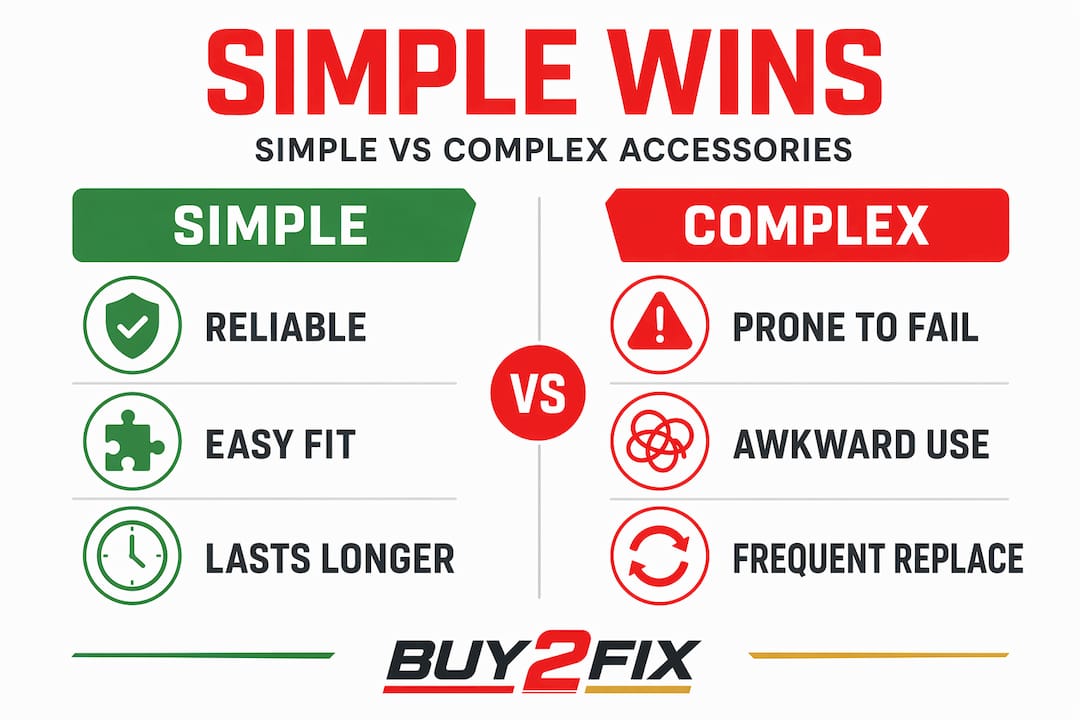
The best accessories over the past year have not gotten smarter. They have gotten simpler, sturdier, and more honest about their limits. That is not a coincidence. It reflects what actually survives daily use.
In the UK, where you might be charging in a cold car at 7am, dropping your phone on a wet pavement, or commuting on a packed train, the accessories that last are the ones built around durability and compatibility rather than specification lists. A £15 hybrid case from a brand with a UK returns policy and genuine user reviews will outperform a £9 “military-grade” listing from an unknown seller nine times out of ten.
We see this pattern repeatedly at Buy2fix: customers who buy once on spec and twice on experience. The first purchase is driven by the most impressive-sounding feature. The second purchase, made after the first breaks or disappoints, is quieter and more deliberate. It prioritises a warranty, a recognised certification, and reviews that mention longevity.
Modular thinking helps here. Rather than buying a single accessory that claims to do everything (case with built-in wallet, charger with built-in stand, grip ring with mount adapter), consider buying the best individual option for each need. Modularity means that when one accessory fails or your needs change, you replace one component instead of starting again entirely.
Look at top phone accessories for 2025 through this lens and you will find the most consistently well-reviewed options share a common thread: they are not trying to impress you with features. They are trying to stay out of your way whilst doing their job.
Explore reliable phone accessories that suit your needs at Buy2fix
Putting this guidance into practice is straightforward when you know where to look. At Buy2fix, we stock a curated range of phone accessories selected for UK consumers, covering cases, screen protectors, certified chargers, and mounts across major brands including iPhone, Samsung Galaxy, Huawei, Xiaomi, and OPPO. Every product goes through compatibility and quality checks before dispatch, so what you order is what the listing describes. With free UK mainland shipping, a 30-day return policy, and warranty support on eligible items, you can make your first purchase with confidence rather than crossing your fingers. Browse by your phone model to find accessories that are guaranteed to fit and built to last.
Frequently asked questions
How can I be sure a phone accessory fits my exact device model?
Always check the precise model number and generation in the product description, not just the brand name, and verify model compatibility via manufacturer information or retailer specifications rather than relying on general brand-level claims.
Are more expensive wireless chargers always better for my phone?
Not at all. Most phones charge efficiently at 20–27W, and certified Qi chargers in the £25 to £35 range deliver reliable, safe performance for the vast majority of UK users without the premium price tag.
What should I consider when buying a phone mount for my car?
Choose a mount suited to your specific dashboard or cup holder type, and look for suction cups that hold securely on clean glass for at least 72 hours or clamp mounts rated for your cup holder diameter, avoiding suction on textured or frosted surfaces.
Is a screen protector always necessary?
It is not mandatory, but a quality tempered glass protector provides strong impact resistance with minimal effect on touch sensitivity, which can save you from a costly screen repair after a single bad drop.
How long do adhesive-based phone grips usually last?
Adhesive grips typically last between 6 and 12 months with daily use, though heat exposure and skin oils accelerate degradation, so testing one grip before buying several is always the sensible approach.
Recommended
Let customers speak for us
Well made part very strong easy to fit great value for the money

Well packed, with fast shipping :)

Exactly what the doctor ordered…great color, comfort, and durability. Trust this watch band!

Brilliant strap, second purchase, bought bracelet before. Excellent value. Thank you

Great item for splitting your Audio signal

Outstanding product!
Next level customer service.

Very satisfied but the delivery needs to get more faster...

Good price,quick delivery

Best phone case ever! This is my second one as I broke my first. Would defo recommend

Great fitting Apple Watch bands

For Apple Watch Ultra 3 / 2 / 1 49mm RedPepper Armor Metal Case Integrated Silicone Watch Band(Steel Black White)

Good price and quick postage

Perfect fit.

Absolutely necessary

Second Purchase and still a very happy customer. Keep up the good work.
