

How to choose quality phone accessories: repair & retail
A £5 cable might seem like a bargain until it fails three months later, takes a customer’s device with it, and lands you with a return claim you could have avoided. Tested benchmarks show cheap cables last just 3 to 6 months compared to 2 or more years for certified alternatives, and 23 out of 53 tested cables failed basic safety checks. Whether you are a repair enthusiast sourcing parts for your own devices or a small business owner building a retail inventory, the accessories you choose directly affect device safety, customer trust, and your bottom line. This guide breaks down exactly what separates quality accessories from cheap imitations, and how to make smarter choices every time.
Table of Contents
- Why quality matters: function, safety, and value
- Core criteria: how to identify quality accessories
- Comparison: cheap vs certified accessories
- Accessory types: what to use for each need
- For small businesses: building a reliable accessory inventory
- Find quality accessories and repair parts at Buy2fix
- Frequently asked questions
Key Takeaways
| Point | Details |
|---|---|
| Quality impacts safety | Low-quality accessories put devices and user safety at risk, while certified items reduce returns and failures. |
| Material and fit matter | Always check model compatibility and prefer shock-absorbing, durable materials for cases and cables. |
| Certification is crucial | Look for CE, MFI, or USB-IF marks to ensure accessories meet safety and performance standards. |
| Invest for reliability | Small businesses should invest in trustworthy stock and tracking to minimise warranty claims and boost satisfaction. |
Why quality matters: function, safety, and value
The risks of low-quality accessories go well beyond a frayed cable. Poor components can cause overheating, corrupt charging circuits, and in worst cases, permanently damage a device’s motherboard. For repair businesses, that translates directly into warranty claims, refunds, and lost customers.
“Quality accessories are not just about performance. They are about protecting the device, the user, and your professional reputation.”
Here is why quality selection matters across the board:
- Device safety: Substandard cables and chargers can deliver inconsistent voltage, damaging batteries over time.
- Longevity: High-quality accessories extend device life by 18 to 24 months and reduce landfill waste significantly.
- Fewer returns: Businesses that prioritise certified accessories typically see warranty claims under 5%.
- Environmental impact: Longer-lasting accessories mean less frequent replacement, which supports reducing e-waste in phone repair and aligns with growing consumer expectations around sustainability.
Value is not simply about the lowest price. When you factor in return rates, replacement frequency, and customer satisfaction, certified accessories almost always win on total cost. Staying across accessories trends for 2025 also helps you stock what customers actually want, rather than what simply fills a shelf.
Now that we have established the real-world stakes, let us look at the specific criteria that separate reliable accessories from risky ones.
Core criteria: how to identify quality accessories
Not all accessories are labelled honestly. Packaging can look professional while hiding poor materials and zero safety testing. Knowing what to look for protects both your devices and your customers.
Fit and compatibility
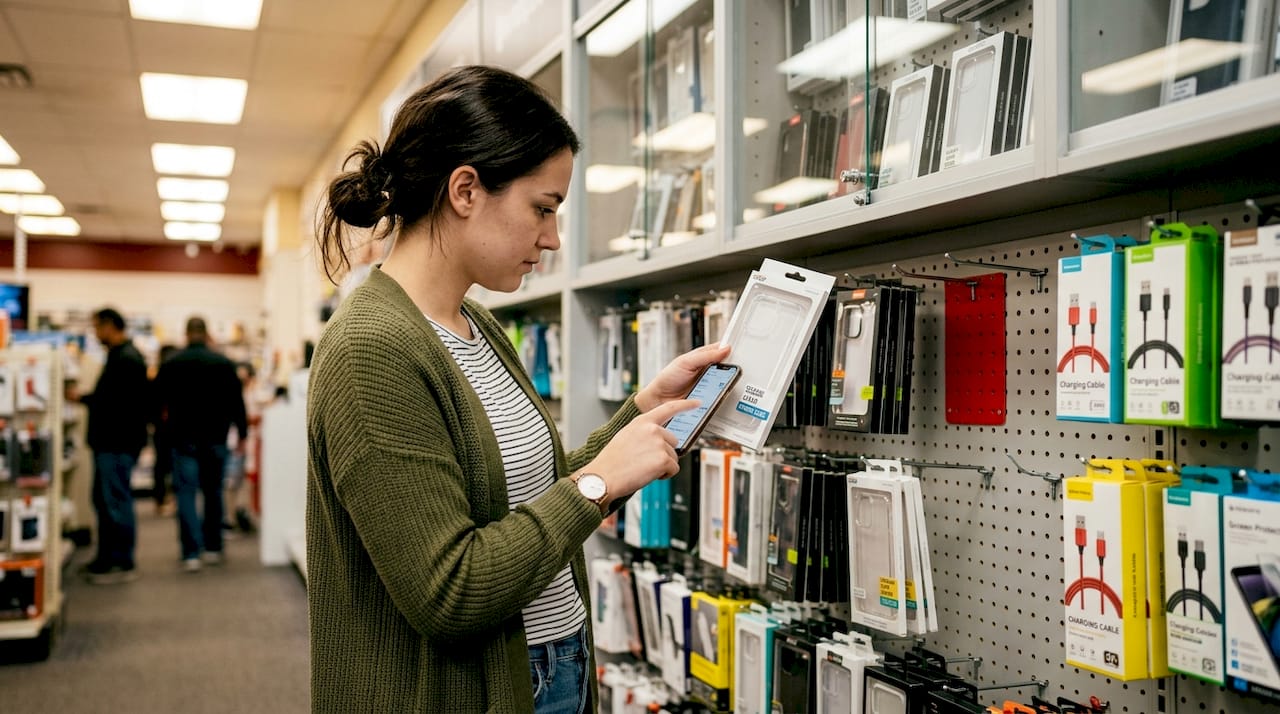
Always verify exact model compatibility before purchasing cases, screen protectors, or chargers. A case designed for an iPhone 15 will not align correctly on an iPhone 15 Pro due to camera module differences. Check the model number in the product description and cross-reference with the device’s settings or user manual.
Materials
Prioritise shock-absorbing materials such as TPU (thermoplastic polyurethane) for cases, tempered glass for screen protectors, and braided nylon with aramid fibre for cables. These materials are not just marketing terms. They genuinely outperform cheaper alternatives under real-world stress.
Certification
Look for CE, MFI (Made for iPhone/iPad), or USB-IF certification logos on packaging. Avoid generic, unbranded bulk packs with no certification information. These are the accessories most likely to fail safety tests.
Practical usability
Test button responsiveness, port access, grip texture, and wireless charging compatibility before committing to bulk stock. A case that blocks NFC or disrupts MagSafe alignment is a problem you will hear about from customers.
Pro Tip: Before ordering in volume, buy a single unit and test it thoroughly on the target device. Check every button, port, and wireless function before committing to a larger order.
For a deeper look at what makes accessories worth stocking, see our guide on reliable quality for repairs and our breakdown of case material types.
With clear criteria established, let us see how cheap and certified accessories actually compare side by side.
Comparison: cheap vs certified accessories
Numbers tell the story more clearly than any marketing claim. Here is how generic and certified accessories stack up across the metrics that matter most to repair professionals and retailers.
| Metric | Cheap/generic | Certified/branded |
|---|---|---|
| Average lifespan | 3 to 6 months | 2 or more years |
| Safety test pass rate | Low (23/53 failed) | High (standardised testing) |
| Return/warranty rate | 15 to 30% | Under 5% |
| Cost per year (cable) | £10 to £20 (replacements) | £8 to £12 (one purchase) |
| Customer satisfaction | Variable | Consistently higher |
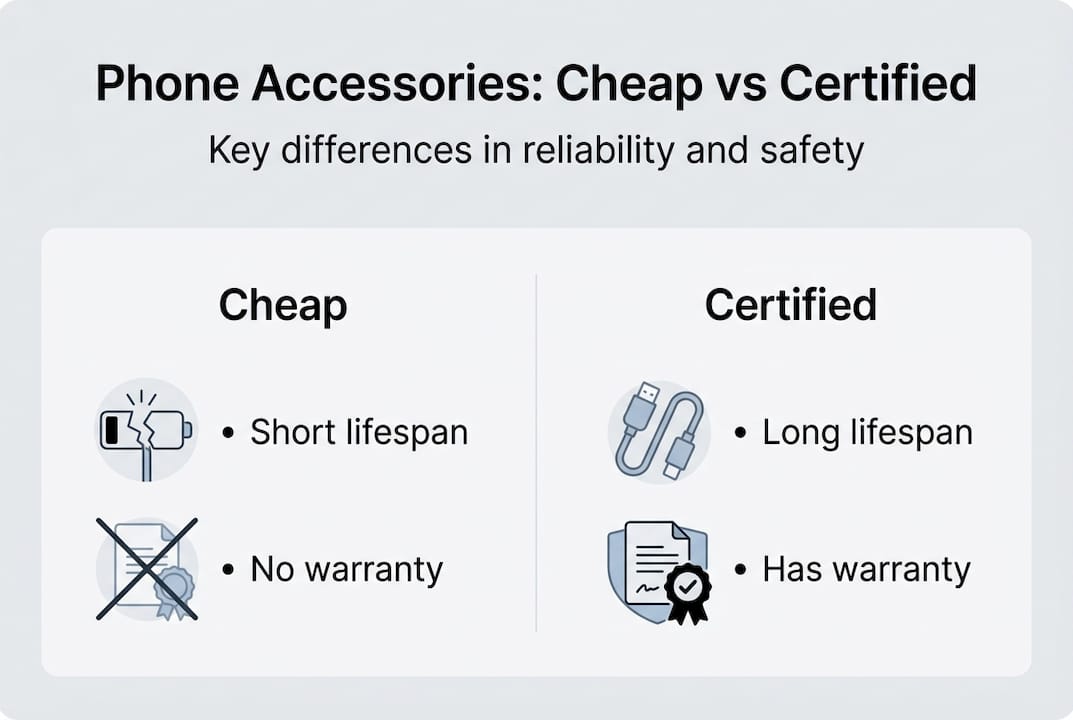
Cheap cables tested at £3 to £5 regularly fail within months, with documented overheating and false wattage ratings. Certified alternatives cost more upfront but deliver a far lower cost per year once you account for replacements and returns.
For repair businesses, the maths is straightforward. A 20% return rate on cheap stock erodes margins faster than the initial saving justifies. Tracking accessory trends for tech repair also helps you anticipate which certified products are gaining traction before your competitors do.
Pro Tip: Use a simple spreadsheet to log every warranty return by product type and supplier. After three months, patterns emerge quickly. You will see exactly which lines are costing you money and which are building customer loyalty.
Understanding the comparison, let us now look at which accessory types suit which situations.
Accessory types: what to use for each need
Different use cases demand different solutions. Matching the right accessory to the right situation reduces returns and increases customer satisfaction.
Cases
- Slim cases: Best for users who prioritise aesthetics and carry low-risk lifestyles. Offer minimal drop protection.
- Rugged cases: Ideal for tradespeople, outdoor users, or anyone prone to drops. Look for MIL-STD-810G rated options.
- Folio cases: Excellent for screen protection but check MagSafe fit carefully, as magnetic elements can interfere with wireless charging and NFC.
Screen protectors
Tempered glass consistently outperforms plastic film in scratch resistance and clarity. Always confirm edge-to-edge coverage for the specific device model.
Cables
Braided nylon cables with aramid fibre reinforcement are the standard to recommend. Avoid low-cost unlabelled bulk packs entirely.
| Accessory type | Recommended material | Key certification |
|---|---|---|
| Phone case | TPU or polycarbonate hybrid | CE marked |
| Screen protector | Tempered glass (9H hardness) | None required, check fit |
| Charging cable | Braided nylon, aramid fibre | USB-IF, MFI |
| Wireless charger | Qi-certified coil | Qi, CE |
Pro Tip: Always test MagSafe, NFC, and wireless charging after fitting any accessory with a magnetic element. A quick 60-second check prevents a customer complaint later.
For more ideas on what to stock and recommend, see our posts on innovative phone case tips and top accessories for 2025.
Now let us move from individual accessory choices to the bigger picture of building a reliable business inventory.
For small businesses: building a reliable accessory inventory
Running a repair shop means accessory quality is not just a personal preference. It is a business decision with direct financial consequences. Getting your inventory strategy right from the start saves significant time and money.
Here is a practical step-by-step approach:
- Research suppliers thoroughly. Prioritise those offering manufacturer warranties and certification documentation. Avoid mystery kits with unknown brand origins.
- Choose certified stock. Start-up inventory of £4,000 to £16,000 is typical for a well-stocked repair shop. Spend it on certified lines, not volume discounts on unverified parts.
- Track returns and failures. Use inventory management software to log SKUs, return reasons, and warranty claims. This data is invaluable for supplier negotiations.
- Review inventory monthly. Rotate slow-moving stock, identify high-return lines, and adjust orders based on real performance data rather than guesswork.
Key statistic: Repair businesses that prioritise certified accessories consistently report warranty claims under 5%, compared to 15 to 30% for shops stocking generic alternatives. That difference directly protects your profit margin.
Negotiating manufacturer warranties and certificates with your suppliers is not optional. It is the foundation of a credible repair business. Customers who receive a warranty-backed accessory are far more likely to return and recommend your shop.
Staying informed about future accessory trends and smart device accessory trends also positions your business ahead of demand shifts, particularly as wearables and smart accessories grow in popularity.
Find quality accessories and repair parts at Buy2fix
At Buy2fix, we stock a carefully curated range of certified phone accessories and repair parts for iPhone, Samsung, Huawei, Xiaomi, OPPO, and many more brands. Every item is quality-checked before shipping, and we back our stock with a one-year warranty and a 30-day return policy. Whether you are a hobbyist replacing a screen at home or a repair shop owner building a reliable inventory, we supply the parts and accessories that meet professional standards. Free UK mainland shipping applies to all orders, and we ship to over 40 countries worldwide. Browse our full range at buy2fix.co.uk and stock with confidence.
Frequently asked questions
How do I check if a phone case is compatible with my specific device?
Look for the exact model name or number in the accessory description and confirm compatibility with the device’s user manual or settings menu. Even minor model variants can have different camera layouts or button positions.
How can I tell if a charging cable is safe or certified?
Check for CE, MFI, or USB-IF certification logos on the packaging or the manufacturer’s website. 23 out of 53 cables tested in independent reviews failed basic safety checks, so avoid unbranded or unusually cheap options entirely.
What is the benefit of using braided cables over standard ones?
Braided cables are significantly more durable and can withstand over 35,000 bends without internal wire breakage, making them far more cost-effective over time.
How much should I invest in phone accessory stock as a new repair business?
Between £4,000 and £16,000 is a realistic starting range for a well-stocked shop using certified inventory. Spending within this range on verified, warranted stock minimises returns and protects your reputation from day one.
Recommended
Let customers speak for us
A quite sturdy cover, if you are looking for full protection and a more business-like style, this cover perfectly fulfills its purpose.
The shipping was fast, and it was delivered in perfect condition.

For LG TV Bluetooth Handheld Infrared Voice Multi-Function Remote Control(AKB75855501)

Tusen tack för bästa service och produkt som jag vänlig önskar dig tack

Works correctly and no issues so far

Took a while to get here but it was all good, watch looks brand new after replacement

What a fantastic 👏🏻 stylish case that has helped my phones temperature in the heatwave!!
Perfect 👌🏻 also it's cool as f##k

I love it!

The acid test of any company is how they respond when things go wrong. The Buy2Fix team were efficient in dealing with my emails and resolved the issue to my complete satisfaction

For Samsung Galaxy A26 SM-A266B Original Earpiece Speaker with Cable

Very good communication throught. Good product

Well made part very strong easy to fit great value for the money

Well packed, with fast shipping :)

Exactly what the doctor ordered…great color, comfort, and durability. Trust this watch band!

Brilliant strap, second purchase, bought bracelet before. Excellent value. Thank you

Great item for splitting your Audio signal
