

How to source repair parts: a technician's guide
TL;DR:
- Knowing the exact model number is essential for sourcing compatible repair parts and avoiding misfit errors.
- Verifying supplier credibility through technical questions and documentation ensures authenticity and quality.
Sourcing repair parts effectively means knowing exactly what you need before you contact a single supplier. Whether you are a DIY buyer fixing your own iPhone, a small repair business managing weekly stock, or a professional technician running a busy workshop, the same principle applies: wrong identification leads to wrong parts, wasted money, and frustrated customers. This guide covers the full process, from reading a model number off a device to vetting suppliers and avoiding the counterfeit traps that cost repair shops real money every year.
How to source repair parts: start with precise identification
The most common sourcing mistake is searching by device name alone. “Samsung screen” or “iPhone battery” returns hundreds of results, most of which will not fit your specific device. Exact manufacturer model numbers increase compatibility likelihood by over 90%, cutting out the guesswork that causes mis-fit returns.
Model numbers live in specific places depending on the device. On most smartphones, you will find them printed inside the SIM tray slot, on the back of the device under a protective case, or in the Settings menu under “About Phone.” For tablets and laptops, check the rating plate on the underside. Battery compartments on older devices often carry the full product code too.
Serial numbers alone are not enough. A serial number identifies a specific unit; it does not tell a supplier which screen assembly, charging port, or battery variant that unit uses. You need the model code, such as SM-G991B for a Samsung Galaxy S21, or A2403 for an iPhone 13 Pro Max.
| Identification method | Where to find it | Reliability for parts matching |
|---|---|---|
| Manufacturer model number | Settings, SIM tray, rating plate | High |
| Serial number | Settings, box label | Low (unit-specific only) |
| Part number on old component | Printed on the part itself | Very high |
| Device name only (e.g. “iPhone 13”) | Packaging, settings | Low (multiple variants exist) |
Pro Tip: Take a clear photo of the model number label before you disassemble anything. Once a device is apart, locating that information again wastes time and risks further damage.
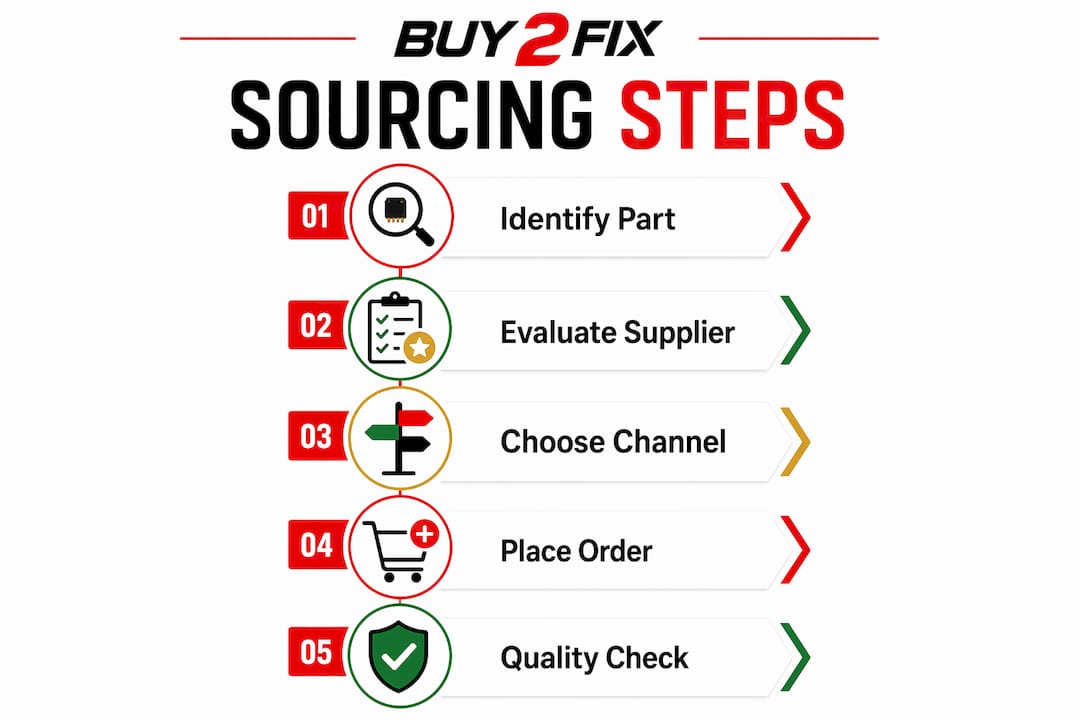
Follow a phone replacement parts checklist before ordering to confirm you have the right codes, the correct part variant, and the tools needed for the repair.
How do you evaluate and choose suppliers for repair parts?
Not all suppliers are equal, and the difference between tiers is not just price. The industry broadly splits into three supplier categories, and understanding them protects your margins and your reputation.

Tier 1 suppliers are factory-direct manufacturers. They offer the best traceability and consistency but typically require high minimum order quantities, making them impractical for small repair shops or individual buyers.
Tier 2 suppliers are certified distributors who buy directly from manufacturers and resell in smaller volumes. They carry genuine documentation, offer reasonable lead times, and are the most practical choice for most professional technicians.
Tier 3 resellers are the danger zone. Tier 3 suppliers routinely label rejects or refurbished parts as high quality, costing repair shops thousands in return costs and warranty claims. They are often indistinguishable from legitimate distributors at first glance.
The most reliable way to screen suppliers is to ask technical questions. Legitimate suppliers answer with specific IC brand names, quality control protocols, and verifiable product details. A supplier who responds vaguely or becomes defensive when asked about their quality control process is almost certainly a reseller with no direct product knowledge.
Key questions to ask any new supplier:
- What IC brand does this screen assembly use?
- Can you provide a certificate of conformance or traceability document?
- What is your returns process for DOA (dead on arrival) parts?
- Do you carry RoHS and CE certification for your components?
- What is your standard lead time and minimum order quantity?
Traceability documents matter beyond just authenticity checks. For rare or obsolete parts, certificates of conformance, original date codes, and country-of-origin records are the only reliable verification against counterfeits.
Pro Tip: Build a simple supplier scorecard. Rate each supplier on quality, lead time, communication, and returns handling after every order. After three orders, the pattern becomes clear.
Procurement should prioritise supplier reliability and lead time over the lowest unit cost, particularly for critical parts where repair downtime costs more than the component itself.
What are the best sourcing channels for quality repair parts?
Sourcing channels vary in quality, risk, and suitability depending on your volume and the parts you need. Knowing which channel fits which situation saves time and reduces costly errors.
OEM parts versus high-grade third-party assemblies is a distinction worth understanding properly. Many buyers assume “OEM” automatically means better quality. High-grade third-party assemblies often outperform OEM-marketed parts that lack traceable packaging or serial prefixes. Professionals favour tested assemblies with reliable specifications rather than assuming factory-direct is always superior. The label matters less than the documentation.
For volume sourcing, platforms like Alibaba and Made-in-China.com give access to a wide range of manufacturers. Always request physical samples before committing to a bulk order. A sample costs a fraction of a bad batch and tells you more than any product listing.
For rare or obsolete components, specialist brokers and surplus dealers are the correct channel. These suppliers hold old stock from discontinued production runs and can locate parts that standard distributors no longer carry. Traceability documentation becomes even more critical here, as the counterfeit risk rises sharply with component age and scarcity.
| Sourcing channel | Best for | Key risk |
|---|---|---|
| Factory-direct (Tier 1) | High-volume, consistent parts | High MOQ, long lead times |
| Certified distributor (Tier 2) | Regular workshop stock | Slightly higher unit cost |
| Alibaba / Made-in-China.com | Bulk sourcing with sample testing | Quality varies by seller |
| Specialty brokers | Rare or obsolete components | Counterfeit risk without documentation |
| UK specialist retailers (e.g. Buy2fix) | Small volumes, verified quality | Limited to stocked range |
Supplier consolidation cuts spending by 12–15% on average. Concentrating orders with fewer, better-vetted suppliers gives you negotiating power and simplifies quality control. Spreading orders across ten unknown suppliers does the opposite.
Pro Tip: Build a preferred supplier catalogue with agreed pricing, lead times, and quality standards. Treat it as a living document and review it quarterly.
For repair shops managing ongoing stock, inventory management practices directly affect sourcing efficiency. Knowing your consumption rate for common parts like iPhone screens and Samsung batteries prevents both stockouts and over-ordering.
What mistakes should you avoid when sourcing repair parts?
The most expensive sourcing mistakes are preventable. They almost always come down to skipping verification steps under time pressure.
- Ordering by device name instead of model code. A Samsung Galaxy A52 and A52s use different screens. The device name alone will not catch that difference. Always use the full manufacturer model number.
- Trusting “OEM” claims without documentation. The term OEM is widely misused in parts supply. Evaluating assembly quality and supplier credibility matters more than the label on the listing.
- Skipping physical comparison. When a new part arrives, compare it directly against the old one before fitting. Check connector positions, screw hole alignment, and cable routing. A part that looks right in a photo can still be the wrong variant.
- Ignoring certifications. RoHS and CE certifications confirm that a component meets European safety standards. A supplier who cannot produce these documents for electrical components is a risk.
- No returns process agreed upfront. Always confirm the DOA returns policy before placing an order. A supplier with no clear returns process will cost you more than the parts themselves when something goes wrong.
For quality benchmarks specific to mobile repair, Buy2fix publishes guidance on setting quality standards for mobile parts that covers what to look for when evaluating screens, batteries, and charging assemblies.
Pro Tip: Keep a log of every supplier interaction, including part numbers ordered, delivery times, DOA rates, and any quality issues. This record becomes your most valuable sourcing tool over time.
Centralising product management with consistent pricing, categorisation, and requisition workflows improves sourcing efficiency and makes supplier performance easy to monitor.
Key takeaways
Sourcing quality repair parts reliably requires precise identification, structured supplier vetting, and a consistent process that prioritises reliability over the lowest price.
| Point | Details |
|---|---|
| Use manufacturer model numbers | Model codes increase compatibility by over 90%; device names alone cause mis-fit returns. |
| Screen suppliers with technical questions | Genuine suppliers name IC brands and QC protocols; vague answers signal a reseller. |
| Prioritise reliability over unit cost | Downtime from a bad part costs more than paying slightly more for a verified one. |
| Request samples before bulk orders | A physical sample reveals quality issues that product listings never show. |
| Document everything | A supplier log of part numbers, lead times, and DOA rates is your best quality control tool. |
What I have learned from years of sourcing repair parts
The sourcing advice that gets repeated most often is “find a good supplier.” That is true but incomplete. The harder skill is knowing when a supplier who looks good is not.
I have seen repair shops lose significant money not because they were careless, but because they trusted a supplier’s marketing over their own technical instincts. A slick website and fast responses do not mean the parts are genuine. The moment you ask a supplier to name the IC brand in their screen assembly and they cannot answer, you have your answer.
The other lesson I would pass on is about the OEM myth. Buyers spend real time hunting for “genuine OEM” parts, assuming that label guarantees quality. It does not. A high-grade third-party assembly with full traceability and a tested specification will outperform an unverified “OEM” part every time. The documentation is the quality signal, not the marketing term.
Cost pressure is real, especially for small repair businesses. But the calculation changes when you factor in the cost of a DOA part, the time spent on a warranty repair, and the damage to your reputation with a customer whose phone fails again within a week. Paying a little more for a verified supplier is not a luxury. It is the cheaper option in the long run.
Build relationships with two or three suppliers you trust completely. Know their lead times, their quality control process, and their returns policy. That knowledge is worth more than access to a hundred unknown listings on a wholesale platform.
— Adewale
Buy2fix: quality-checked parts for professional technicians
Buy2fix stocks replacement parts for iPhone, Samsung Galaxy, Huawei, Xiaomi, OPPO, and a broad range of tablets and laptops, all quality-checked before dispatch. Every order ships free to UK mainland addresses, with a 30-day return policy and warranty support on eligible items. For technicians who need consistent stock without the supplier vetting headache, Buy2fix offers clear product information, fair pricing, and a catalogue built around the parts repair professionals actually need. Visit Buy2fix to browse the full range of mobile and electronic repair parts.
FAQ
What is the most reliable way to identify the correct repair part?
Use the full manufacturer model number, not the device name. Model numbers are found in device settings, on the SIM tray, or on the rating plate, and they increase compatibility accuracy by over 90%.
How do I know if a parts supplier is trustworthy?
Ask technical questions about IC brand names and quality control protocols. Genuine suppliers give specific, verifiable answers. Evasive or vague responses indicate a reseller rather than a direct source.
Are OEM parts always better than third-party assemblies?
No. High-grade third-party assemblies with full traceability documentation often outperform OEM-labelled parts that lack verifiable packaging or serial prefixes. Evaluate the documentation, not just the label.
What certifications should repair parts carry?
Look for RoHS and CE certifications on electrical components. These confirm the part meets European safety standards. A supplier who cannot provide these documents represents a quality and compliance risk.
How can I reduce sourcing costs without sacrificing quality?
Consolidate orders with fewer, well-vetted suppliers. Supplier consolidation cuts spending by 12–15% on average while giving you stronger negotiating leverage and simpler quality control.
Recommended
Let customers speak for us
I ❤️ love it, it's absolutely amazing I'm sooo happy 😊

Great

I saw this item and it was just what I was looking for. I found it here but not in Amazon or e-bay. However, it was in UK, I was surprised to find that they were able to ship it to the US. Excellent company, would do business with again

This is great for when out and about, to sharpen either coloured pencils, or watercolour pencils….would order again.

Great items would bye again

I have purchased several items from this store before. Recently, I encountered an issue with my latest order. After reporting the problem to customer support, they were consistently attentive and made every effort to resolve the situation. Upon investigation, they acknowledged the issue and promptly fixed it. This experience has increased my level of trust in this store.
Thank you so much. I'm so happy.

très bien

BC70 Car Bluetooth 5.0 FM Transmitter Radio Adapter Dual Display Wireless Handsfree Call MP3 Music Player QC3.0 PD USB Charger

A quite sturdy cover, if you are looking for full protection and a more business-like style, this cover perfectly fulfills its purpose.
The shipping was fast, and it was delivered in perfect condition.

For LG TV Bluetooth Handheld Infrared Voice Multi-Function Remote Control(AKB75855501)

Tusen tack för bästa service och produkt som jag vänlig önskar dig tack

Works correctly and no issues so far

Took a while to get here but it was all good, watch looks brand new after replacement

What a fantastic 👏🏻 stylish case that has helped my phones temperature in the heatwave!!
Perfect 👌🏻 also it's cool as f##k
