

Screen protectors explained: a practical guide for UK users
Most people grab the cheapest screen protector they can find, slap it on, and assume the job is done. Then the screen still cracks. Or the display looks foggy. Or a colleague glances over and reads a confidential email. The reality is that screen protectors vary enormously in technology, purpose, and quality, and choosing the wrong one is a surprisingly common and costly mistake. This guide cuts through the confusion, explains the key types and features available in 2026, and gives you a clear framework for choosing the right protector whether you are protecting a personal smartphone or managing a fleet of business tablets.
Table of Contents
- Why screen protectors matter for your devices
- Types of screen protectors and how they work
- Comparing screen protector features: What to look for
- When and how to choose the right screen protector
- Why the right screen protector choice pays off in practice
- Find your perfect screen protector at Buy2Fix
- Frequently asked questions
Key Takeaways
| Point | Details |
|---|---|
| Protection needs vary | Choose your screen protector type based on daily use and device model for best results. |
| Not all features suit everyone | Privacy and anti-glare options may lower clarity, so weigh your priorities. |
| Proper installation matters | A well-applied protector is as important as the type you select to maximise effectiveness. |
| Investing prevents repair costs | Quality protectors guard your tech and save money over time by averting damage. |
Why screen protectors matter for your devices
Your smartphone or tablet screen is the single most vulnerable part of the device. It faces daily contact with keys, coins, desk surfaces, and the occasional drop onto concrete. Even minor scratches accumulate over time, degrading touch sensitivity and reducing resale value. A cracked screen on a flagship phone can cost upwards of £200 to replace professionally, which makes a £10 to £20 protector look like an obvious investment.
But the risks go beyond physical damage. Consider what your screen displays every day:
- Bank account details and payment apps
- Private business communications and client data
- Personal messages and photos
- Login credentials and two-factor authentication codes
For small business owners in particular, a screen visible to strangers in a coffee shop or on the train is a genuine security risk. Phone accessory trends in 2025 and 2026 show a clear shift towards privacy-focused accessories, and it is not hard to see why.
“Privacy screens use micro-louver technology narrowing viewing angles, blocking side views via light direction control. Matte and anti-glare options reduce reflections but may lower clarity.”
Beyond privacy, protectors also guard against smudging, UV exposure, and in some cases, bacterial build-up on the screen surface. When you think about screen protectors for durability, the value proposition becomes clear: a small upfront cost prevents a much larger one down the line. The question is not whether to use one, but which type suits your situation.
Types of screen protectors and how they work
Not all screen protectors are built from the same material or designed for the same purpose. Understanding the core types helps you avoid buying something that looks right but performs poorly for your needs.
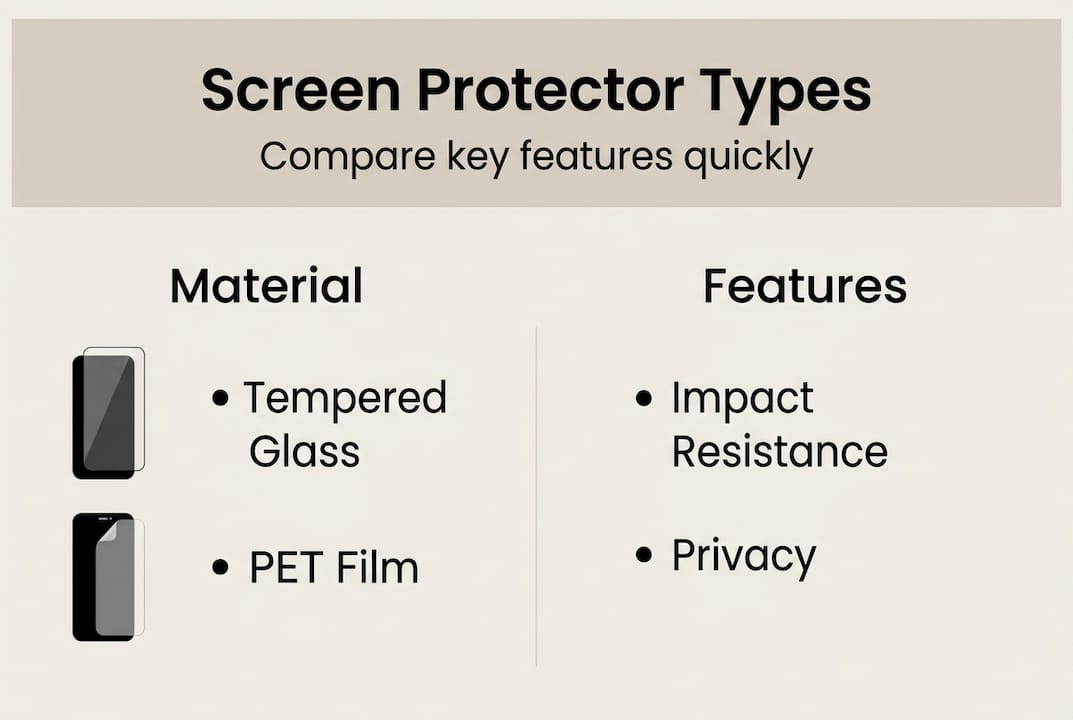
Tempered glass is the most popular option for good reason. It is made by heating and rapidly cooling glass to increase its strength, typically achieving a 9H hardness rating on the Mohs scale. It feels closest to the original screen, maintains excellent touch sensitivity, and offers strong impact resistance.
PET film (polyethylene terephthalate) is a thin plastic layer that provides basic scratch protection at a lower cost. It is flexible and lightweight, but offers limited impact resistance compared to tempered glass.
Privacy protectors use micro-louver technology to narrow the viewing angle, typically to 30 degrees either side of the screen. Anyone looking from the side sees only a dark or blurred display, while the person directly in front sees clearly.
Matte and anti-glare protectors are coated to diffuse light and reduce reflections, making them ideal for outdoor use. However, this coating can slightly soften the sharpness of the display.
Here is a quick comparison of the main types:
| Type | Scratch protection | Impact resistance | Clarity | Privacy | Typical cost |
|---|---|---|---|---|---|
| Tempered glass | Excellent | Excellent | High | No | £8 to £20 |
| PET film | Good | Low | High | No | £3 to £8 |
| Privacy glass | Excellent | Good | Moderate | Yes | £10 to £25 |
| Matte/anti-glare | Good | Good | Slightly reduced | No | £6 to £18 |
For a deeper look at which type suits different devices, the guide on best screen protector types covers specific model compatibility in detail.
Pro Tip: Not all privacy or anti-glare protectors are compatible with every device model. Always check the product listing for your exact make and model before purchasing, especially for curved-edge screens.
Comparing screen protector features: What to look for
Once you know the types, the next step is comparing specific features so you can match a protector to your actual usage. Here are the most important ones to evaluate:
- Hardness rating: The 9H rating refers to the pencil hardness scale. A 9H-rated tempered glass protector resists scratches from most everyday objects including keys and coins. Anything below 7H offers noticeably less protection.
- Viewing angle and privacy level: Micro-louver technology is available in two-way (blocks left and right) and four-way (blocks all sides) variants. Four-way privacy is more restrictive but offers the strongest protection in crowded environments.
- Touch sensitivity: Thick protectors or those with poor adhesive layers can introduce a slight lag or reduce swipe accuracy. Quality tempered glass at 0.3mm or less generally preserves full touch responsiveness.
- Optical clarity: Measured by light transmittance, premium clear protectors achieve 99% transparency. Matte protectors typically sit at 85 to 90%, which is visible in direct comparison but acceptable for most users.
- Anti-glare performance: Useful for outdoor workers or anyone frequently in bright environments. The trade-off is a slightly grainy appearance on high-resolution displays.
Here is a side-by-side feature comparison to make the decision easier:
| Feature | Tempered glass | PET film | Privacy glass | Matte glass |
|---|---|---|---|---|
| Hardness | 9H | 3H to 4H | 9H | 9H |
| Clarity | 99% | 95% | 85 to 90% | 85 to 90% |
| Touch response | Excellent | Good | Good | Good |
| Privacy | None | None | Strong | None |
| Glare reduction | Low | Low | Moderate | High |
Keeping an eye on phone accessory trends is worthwhile too, as newer protectors increasingly combine features, such as anti-glare coatings on privacy glass, giving you more options than ever before.
Pro Tip: Think about your primary use case before buying. If you work outdoors, prioritise anti-glare. If you handle sensitive data in public, privacy glass is worth the premium. If you want to protect a device for resale, a clear tempered glass protector preserves screen condition best.
When and how to choose the right screen protector
Choosing the right protector becomes straightforward once you match the product to your context. Here is a step-by-step process to guide your decision:
- Identify your device model exactly. Screen protectors are cut to precise dimensions. A protector designed for a Samsung Galaxy S24 will not fit an S24 Ultra correctly, and poor fit leads to lifting edges and trapped dust.
- Assess how and where you use the device. Outdoor workers benefit from matte or anti-glare options. Commuters and those in open-plan offices should consider privacy glass. General users will find clear tempered glass the best all-round choice.
- Consider device age and value. For a newer flagship, invest in a quality protector. For an older device you plan to replace soon, a basic PET film may suffice.
- Check screen protector quality ratings and reviews before purchasing, paying attention to comments about fit, adhesion, and touch sensitivity.
For business owners managing multiple devices, buy in bulk from a single supplier to ensure consistency across the fleet. Standardising on one type also simplifies installation training for staff.
Installation checklist:
- Clean the screen thoroughly with the included microfibre cloth
- Use the dust removal sticker to lift any remaining particles
- Align the protector carefully before pressing down
- Use a card or squeegee to push out air bubbles from the centre outward
- Allow the adhesive to settle for 24 hours before heavy use
Pro Tip: Matte and anti-glare protectors can slightly reduce display clarity, so if you are protecting a device primarily for resale, a high-clarity tempered glass option will better preserve the screen’s original appearance and appeal to future buyers.
Why the right screen protector choice pays off in practice
There is a persistent belief that all screen protectors are essentially the same and that spending more is unnecessary. We see the consequences of that thinking regularly. Customers come to us after a cracked screen repair costing £150 or more, and when we ask about their protector, the answer is usually a thin plastic film bought as an afterthought.
The real cost of a poor choice is not just financial. It is the lost data, the downtime while a device is repaired, and for business owners, the potential exposure of sensitive information to anyone who happened to be sitting nearby.
What we have found is that the users who get the most from their devices are those who treat screen protector durability as a deliberate decision rather than a default one. They match the protector to the device, the environment, and the type of data being handled. That approach costs no more in time and very little more in money, but the difference in outcomes is significant. For UK individuals and business owners alike, protecting your screen is protecting your investment.
Find your perfect screen protector at Buy2Fix
At Buy2Fix, we stock a carefully selected range of screen protectors suited to the needs of UK smartphone and tablet users, from clear tempered glass for everyday protection to privacy and anti-glare options for professional environments. Every product is quality-checked before dispatch, and we offer free UK mainland shipping with a one-year warranty on accessories. Whether you are protecting a single personal device or equipping a team of business handsets, our product listings include compatibility details and guidance to help you buy with confidence. Browse our full range online or get in touch if you need advice on the best option for your specific device and use case.
Frequently asked questions
How do privacy screen protectors prevent people from viewing my screen?
Privacy protectors use micro-louvre technology to narrow the screen’s viewing angle, so only the person directly in front can see what is displayed. Anyone viewing from the side sees a darkened or blurred screen.
Do matte and anti-glare screen protectors affect display clarity?
Yes, matte and anti-glare protectors can slightly reduce sharpness because their surface coating diffuses light. The trade-off is significantly reduced reflections, which is worthwhile in bright or outdoor environments.
What should I check before buying a screen protector for my business devices?
Verify compatibility with your exact device model, decide whether your team needs privacy, anti-glare, or standard clear protection, and check that the supplier offers consistent stock so you can standardise across multiple handsets.
Is it possible to install a screen protector without air bubbles?
Yes. Starting with a thoroughly cleaned screen, careful alignment, and using a squeegee or card to press from the centre outward will eliminate most bubbles, particularly with protectors that include applicator tools.
Recommended
Let customers speak for us
The acid test of any company is how they respond when things go wrong. The Buy2Fix team were efficient in dealing with my emails and resolved the issue to my complete satisfaction

For Samsung Galaxy A26 SM-A266B Original Earpiece Speaker with Cable

Very good communication throught. Good product

Well made part very strong easy to fit great value for the money

Well packed, with fast shipping :)

Exactly what the doctor ordered…great color, comfort, and durability. Trust this watch band!

Brilliant strap, second purchase, bought bracelet before. Excellent value. Thank you

Great item for splitting your Audio signal

Outstanding product!
Next level customer service.

Very satisfied but the delivery needs to get more faster...

Good price,quick delivery

Best phone case ever! This is my second one as I broke my first. Would defo recommend

Great fitting Apple Watch bands

For Apple Watch Ultra 3 / 2 / 1 49mm RedPepper Armor Metal Case Integrated Silicone Watch Band(Steel Black White)

Good price and quick postage
