


Nouvelles
Expert guide to upgrading older mobile devices in the UK
TL;DR:
- Upgrading older smartphones through battery, screen, or storage replacements can restore performance and extend device lifespan.
- Sourcing quality parts from trusted suppliers, verifying compatibility, and following proper repair techniques are crucial for success.
- Eco-friendly upgrades reduce e-waste, save money, and foster customer loyalty, offering competitive advantages for repair businesses.
Most people assume that when a phone starts slowing down or a screen gets cracked, the only sensible option is to buy a new one. That assumption is costing UK consumers hundreds of pounds every year. The truth is that the vast majority of popular smartphones, including older iPhones and Samsung Galaxy models, can be significantly improved with targeted upgrades. Whether you are a DIY enthusiast looking to revive a personal device or a repair shop owner wanting to offer more value to your customers, understanding how to upgrade rather than replace is one of the most practical skills you can develop right now.
Table of Contents
- Understanding the upgrade potential of older mobile devices
- Sourcing reliable replacement parts for DIY upgrades
- Eco-friendly upgrading: reducing e-waste and extending device life
- Practical tips for upgrading older smartphones and tablets
- Why the typical upgrade advice misses the real value
- Upgrade smarter with trusted parts and support
- Frequently asked questions
Key Takeaways
| Point | Details |
|---|---|
| Upgrade is practical | Older smartphones and tablets can often be improved with quality replacement parts. |
| Supplier credibility matters | Choosing reliable UK suppliers is essential to guarantee genuine parts for mobile upgrades. |
| Eco-friendly upgrades | Upgrading extends device life and significantly reduces e-waste. |
| DIY safety and success | Having the right tools and following proven steps helps ensure safe and effective upgrades. |
| Smart shops benefit | Repair shops that prioritise upgrades build stronger customer trust and greener business. |
Understanding the upgrade potential of older mobile devices
Having set the context, let’s explore which upgrades are truly possible and practical on older devices.
Most people think of “upgrading” as buying a new handset. In reality, the term covers a wide range of physical interventions that can return a device to near-new performance. The four most impactful upgrade categories are battery replacement, screen repair or replacement, internal storage expansion, and camera module swaps. Not every device supports all four, but most popular models support at least two or three of these options.
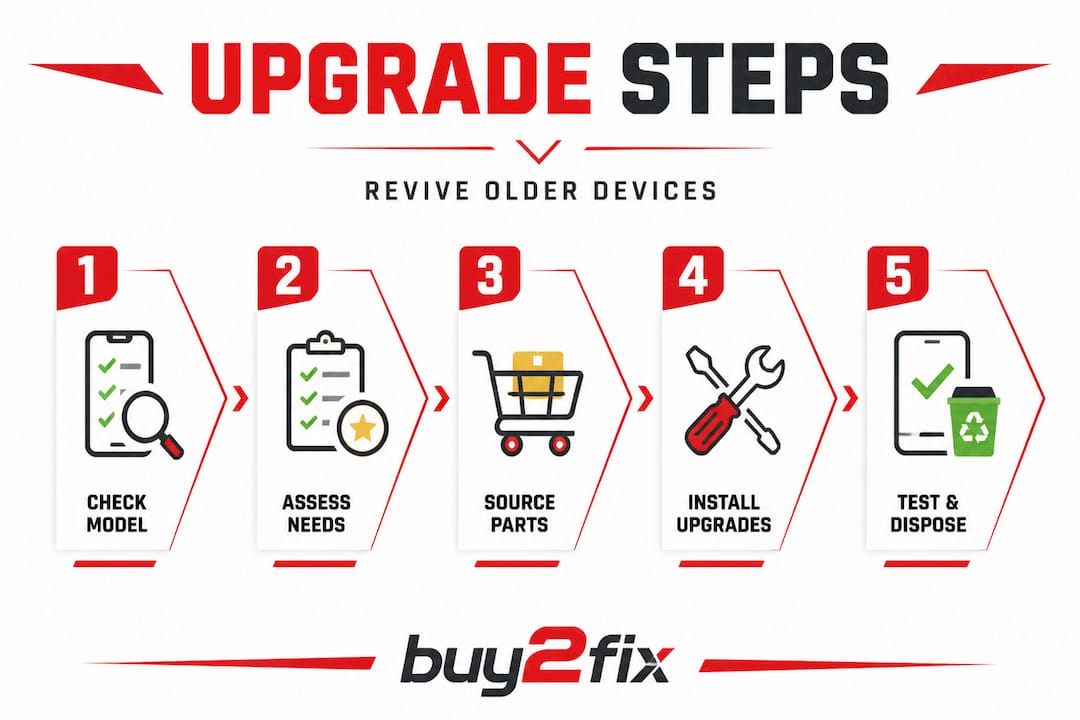
Battery degradation is the single biggest reason phones feel sluggish. Apple confirms that an iPhone battery at 80% capacity or below triggers performance throttling. A replacement battery on an iPhone 11 or Samsung Galaxy S10, for example, typically restores full processing speed instantly. Screen replacements are equally transformative, turning cracked and dim displays into something that feels factory fresh. Storage expansion is more model-specific: some Android devices support microSD cards or allow internal storage replacement, while iPhones do not. Camera module swaps are increasingly feasible on mid-range Androids, though they require confident handling.
| Device model | Battery | Screen | Storage | Camera module |
|---|---|---|---|---|
| iPhone 11 | ✓ Easy | ✓ Moderate | ✗ Not supported | ✗ Complex |
| iPhone SE (2nd gen) | ✓ Easy | ✓ Moderate | ✗ Not supported | ✗ Complex |
| Samsung Galaxy S10 | ✓ Moderate | ✓ Moderate | ✓ microSD | ✓ Advanced |
| Samsung Galaxy A52 | ✓ Easy | ✓ Easy | ✓ microSD | ✓ Moderate |
| Huawei P30 Lite | ✓ Easy | ✓ Moderate | ✓ NM card | ✓ Advanced |
| Xiaomi Redmi Note 10 | ✓ Easy | ✓ Easy | ✓ microSD | ✓ Moderate |
Several factors affect whether an upgrade will succeed on a given device. Part availability is perhaps the biggest, since older models sometimes have limited third-party supply chains. Software support matters too: a perfectly upgraded device that no longer receives security patches is a security liability. Technical complexity varies enormously between models. Sealed designs, adhesive-heavy construction, and fragile ribbon cables all increase risk for first-time repairers. If you want to understand what repairing old cell phones actually involves before you start, it is worth reviewing practical guidance on the topic.
Key factors affecting upgrade success:
- Part availability: Popular models like iPhone 11 and Samsung Galaxy A-series have strong third-party part supply
- Software support: Check whether the manufacturer still issues updates for your model
- Technical complexity: Sealed batteries and OLED displays increase the risk of damage during repair
- Adhesive construction: Many modern phones use heavy adhesive that requires heat and patience to open safely
- Repairability score: Industry guides and refurbished electronics guides often rate specific models on repairability
Studies show that refurbished phone options are becoming a mainstream choice, with the refurbished handset market growing steadily in the UK. That growth reflects a broader shift: consumers and repair professionals alike are recognising that older devices have significant remaining life.
Sourcing reliable replacement parts for DIY upgrades
Once you know what can be upgraded, the next challenge is finding quality replacement parts you can trust.
The UK market for mobile parts has expanded considerably, but quality varies wildly. You will encounter three main supplier categories: local independent repair shops, online marketplaces, and specialist online retailers. Each carries different levels of risk and reliability.
| Supplier type | Quality consistency | Warranty support | Price range | Recommended for |
|---|---|---|---|---|
| Local independent shop | Variable | Often limited | Medium to high | Quick, low-risk parts |
| Online marketplaces (eBay, Amazon third-party) | Inconsistent | Rarely included | Low to medium | Experienced repairers only |
| Specialist online retailers | High | Usually included | Medium | DIY and professional repairers |
| OEM direct or authorised | Highest | Full manufacturer | High | Critical components |
Verifying a supplier’s credibility before purchasing is essential. Follow these steps before placing any order:
- Check for a UK business address and registered company number. Legitimate retailers are traceable.
- Look for a stated returns policy and minimum 30-day return window. This protects you if parts arrive damaged or incompatible.
- Confirm warranty terms on the specific part, not just the retailer’s general policy.
- Read verified customer reviews on independent platforms rather than the retailer’s own website.
- Ask whether parts have been quality-checked before dispatch. Reputable suppliers inspect stock before sending it out.
- Check compatibility explicitly by device model number, not just device name. An iPhone 13 and iPhone 13 Pro use different screens.
Pro Tip: Counterfeits are most common in the battery and screen categories. Counterfeit batteries pose genuine fire risks and will fail within weeks. Always look for parts labelled as OEM-equivalent or OEM-grade, and avoid any listing that seems implausibly cheap. The price difference between a genuine quality part and a counterfeit is rarely more than £10 to £20, but the performance gap is enormous. Investing in proper screen protection tips after a screen replacement also extends the life of your work considerably.
Retail environments now stock a wider range of protective accessories suitable for older-generation devices. If you are buying for a repair business, establishing a consistent relationship with a single specialist supplier saves both time and the stress of evaluating each listing individually. The best screen protectors for 2025 models often fit previous-generation handsets of the same physical size, which is a useful cost-saving detail many repairers overlook.
Eco-friendly upgrading: reducing e-waste and extending device life
Beyond reliability, it’s important to consider the environmental impact of every mobile device upgrade.
The environmental case for upgrading is compelling, and it is becoming harder to ignore. Manufacturing a new smartphone produces, on average, around 70 kg of CO2 equivalent. Extending a device’s life by just two years through targeted upgrades reduces that carbon footprint significantly. For repair businesses, this is not just a feel-good angle. It is a genuine differentiator that resonates with a growing segment of UK consumers.
“Extending the lifespan of a mobile device by repairing or upgrading it is one of the most effective individual actions for reducing electronic waste. Each repaired device is one fewer device ending up in landfill, where toxic materials from batteries and circuit boards can leach into soil and water.”
Eco-friendly phone repairs are no longer niche. UK retailers and repair shops are increasingly offering upgrade and recycling services as standard, responding to consumer demand for more responsible options.
Eco-friendly upgrade practices worth adopting:
- Prioritise repair over replacement whenever a device is within its software support window
- Use parts with responsible sourcing credentials where possible
- Return unusable components to certified recycling schemes rather than general waste
- Offer customers a trade-in or recycling option for the components you remove during upgrades
- Educate customers on the lifespan of their devices so they make informed decisions
- Batch smaller components for recycling rather than disposing of them individually
Pro Tip: Old batteries are classified as hazardous waste in the UK and must not go into standard household recycling. Most major supermarkets and electronics retailers provide battery collection points. For larger quantities, specialist services handle bulk collection. Exploring phone recycling near you is a straightforward first step for both individuals and businesses.
For repair shops specifically, handling e-waste responsibly builds trust and can support compliance with UK WEEE (Waste Electrical and Electronic Equipment) regulations. You can find detailed guidance in our electronics recycling guide and stay current with the latest smartphone recycling facts that affect how professionals handle end-of-life components.
Practical tips for upgrading older smartphones and tablets
Armed with sourcing and eco know-how, let’s move to practical strategies for getting your upgrades right the first time.
Execution matters as much as planning. The most common upgrade failures come from avoidable mistakes, not technical complexity. Understanding where repairers typically go wrong helps you sidestep the issues that cause damage or wasted parts.
Common mistakes to avoid:
- Skipping data backup before opening the device. Physical upgrades carry a small but real risk of data loss if something goes wrong
- Using the wrong tools. Standard screwdrivers strip the tiny screws on most mobile devices. Invest in proper precision sets
- Rushing the adhesive removal. Applying insufficient heat before prying causes cracked screens and torn ribbons
- Ignoring electrostatic discharge (ESD) risk. Without an ESD wrist strap, a static discharge can fry sensitive components invisibly
- Not testing parts before full reassembly. Always power on and test functionality before applying adhesive or closing the case
- Ordering parts without confirming sub-model variants. A Samsung Galaxy S21 Ultra and S21 FE are very different inside
Pro Tip: Your toolkit should include, at minimum: a set of JIS and Phillips precision screwdrivers (sizes 000, 00, and 0), plastic spudgers and opening picks, ESD-safe tweezers, a suction cup handle, a heat gun or iOpener pad, and an adhesive strip set for reassembly. Spending £25 to £30 on a quality toolkit pays for itself on the first repair. Do not substitute a hairdryer for a heat gun: temperature control matters.
Safeguarding data before starting any physical upgrade is not optional. Use iCloud or Google One for cloud backup, and for Android devices, consider also connecting to a PC for a full local backup. Even when you are confident in your ability, accidents happen. A cracked connector or accidentally discharged battery mid-repair is rare but not impossible. Having a complete backup eliminates that risk entirely.
When comparing options between building new skills and buying pre-upgraded handsets, the refurbished vs new iPhone insights available for UK repair shops give helpful context for pricing and customer expectations. Understanding that market also helps you explain value to customers who are weighing a repair quote against a new purchase.
Why the typical upgrade advice misses the real value
Most articles about mobile device upgrades focus narrowly on the technical process: which screwdriver to use, which battery to order. That is useful, but it misses something more important. The real value of upgrading older devices is not just financial for the individual. It is a compound benefit that accumulates across customers, communities, and the repair industry itself.
Conventional wisdom treats a two or three-year-old phone as a liability. Manufacturers reinforce this narrative with planned obsolescence signals: slower software updates, subtle performance throttling, and marketing that emphasises how different the newest model is. What that narrative ignores is that a well-upgraded device often outperforms a mid-range new phone in daily use, simply because the hardware quality in flagship devices from three years ago was genuinely excellent.
For repair professionals, the upgrade-over-replace approach builds a qualitatively different kind of customer relationship. A customer who brings in a four-year-old iPhone and leaves with a phone that feels new again becomes a loyal repeat customer. They tell their friends. They trust you with their data and their device. That is worth far more than the short-term margin on a screen swap.
The financial argument for upgrades is also more compelling than most guides acknowledge. A battery replacement costing £30 to £50 can add two full years to a device’s functional life, delaying a £700 to £1,000 handset purchase. Over a family of four devices, the savings are substantial. Repair shops that frame this clearly to customers are not just offering a service. They are offering real, demonstrable value that manufacturers and mobile network retailers simply cannot match.
The environmental angle reinforces all of this. Recycling old electronics responsibly is important when devices truly reach end of life, but the goal should always be to delay that point as long as possible. The repair industry is uniquely positioned to make that argument credibly and to act on it with genuine expertise. Embracing this perspective is not idealism. It is a competitive advantage.
Upgrade smarter with trusted parts and support
If you are ready to put this guidance into practice, buy2fix.co.uk is a reliable starting point. We stock a broad range of replacement parts for iPhone, Samsung Galaxy, Huawei, Xiaomi, and OPPO devices, alongside tablets and laptop components, all quality-checked before dispatch. Every order to UK mainland addresses ships free, and our 30-day return policy means you are not taking on unnecessary risk when trying a new supplier. Whether you are a confident DIY repairer tackling your first battery swap or a repair business looking to build a reliable supply chain, our catalogue is built to support your work. Browse our parts range and recycling resources at buy2fix.co.uk to find what you need for your next upgrade project.
Frequently asked questions
Which upgrades make the biggest difference in older mobile device performance?
Battery replacements, screen repairs, and storage upgrades tend to offer the most noticeable improvements in older devices, with battery swaps often delivering the most immediate performance gain.
How can I verify that replacement parts are genuine?
Always buy from reputable UK suppliers with clear warranty terms, and check for authenticity labels or OEM-grade certification on parts, particularly for screen components and batteries.
Is upgrading better for the environment than recycling?
Yes, upgrading devices extends their usable lifespan and reduces e-waste at the source, making it a more sustainable first choice before considering eco-friendly phone repairs or recycling.
What tools do I need for safe DIY mobile upgrades?
Essential tools include a small Phillips and JIS precision screwdriver set, ESD-safe tweezers, plastic opening picks, a suction cup handle, and a heat source such as a heat gun or iOpener pad for adhesive removal.
Where can I recycle old mobile components in the UK?
Many local UK shops and specialist online services offer reliable mobile recycling options for batteries, screens, and other components, with some providing free collection for larger quantities.
Recommended
- Diagnose phone battery issues: a step-by-step UK guide – buy2fix
- Mobile device repair for beginners: A practical DIY guide – buy2fix
- Reduce mobile device wear and tear: Practical repair guide – buy2fix
- Best Options for What is the Best Refurbished Phone to Buy – Expert Co – buy2fix
- Your essential guide to building a mobile-friendly website
Let customers speak for us
For Garmin Forerunner 165 20mm Two Color Textured Silicone Watch Band(Teal)

For Samsung Galaxy S26+ 5G R-JUST Sliding Camera Life Waterproof Holder Phone Case(Black)

I ❤️ love it, it's absolutely amazing I'm sooo happy 😊

Great

I saw this item and it was just what I was looking for. I found it here but not in Amazon or e-bay. However, it was in UK, I was surprised to find that they were able to ship it to the US. Excellent company, would do business with again

This is great for when out and about, to sharpen either coloured pencils, or watercolour pencils….would order again.

Great items would bye again

I have purchased several items from this store before. Recently, I encountered an issue with my latest order. After reporting the problem to customer support, they were consistently attentive and made every effort to resolve the situation. Upon investigation, they acknowledged the issue and promptly fixed it. This experience has increased my level of trust in this store.
Thank you so much. I'm so happy.

très bien

BC70 Car Bluetooth 5.0 FM Transmitter Radio Adapter Dual Display Wireless Handsfree Call MP3 Music Player QC3.0 PD USB Charger

A quite sturdy cover, if you are looking for full protection and a more business-like style, this cover perfectly fulfills its purpose.
The shipping was fast, and it was delivered in perfect condition.

For LG TV Bluetooth Handheld Infrared Voice Multi-Function Remote Control(AKB75855501)

Tusen tack för bästa service och produkt som jag vänlig önskar dig tack

Works correctly and no issues so far
