

Screen Assembly Explained: Impact on Device Repairs
Broken screens rank among the top issues for british smartphone repairs, with over 65 percent of damaged devices needing screen assembly replacement. For DIY repair fans and small shop owners, understanding how modern assemblies work unlocks better results and fewer mistakes. This overview shares practical insights into layered screen technologies, helping british professionals choose products confidently, avoid common pitfalls, and deliver smooth repair outcomes for every device.
Table of Contents
- What Is A Screen Assembly In Devices
- Types Of Screen Assemblies Explained
- Components And Functions Of A Screen Assembly
- How Screen Assemblies Enable Device Repairs
- Common Mistakes With Screen Assembly Repairs
Key Takeaways
| Point | Details |
|---|---|
| Understanding Screen Assembly | A screen assembly is a crucial component in digital devices, combining layers that translate electronic signals into visible displays. |
| Types and Technologies | Various screen technologies, including LCD, OLED, and AMOLED, offer differing image qualities and energy efficiencies. |
| Component Functions | Key components such as the display panel and touch digitiser work together to enhance user interaction and experience. |
| Repair Considerations | Proper diagnostic tools and a systematic approach are essential for successful screen assembly repairs to avoid common mistakes and damages. |
What Is a Screen Assembly in Devices
A screen assembly represents the complete visual interface mechanism in digital devices, comprising multiple sophisticated layers that enable graphical interaction and display functionality. Screen technology integrates various components to transform electronic signals into visible images, text, and user interfaces across smartphones, tablets, laptops, and other electronic equipment.
The screen assembly typically includes several critical elements: the display panel itself, a touch-sensitive digitizer layer, protective glass covering, internal connectors, and sometimes a supporting frame or border. These intricate components work together to translate digital information into visual output, allowing users to interact with their devices through touch, view content, and navigate interfaces seamlessly.
Modern screen assemblies have evolved significantly, incorporating advanced technologies like liquid crystal displays (LCDs), organic light-emitting diode (OLED) panels, and increasingly sophisticated touch-sensing mechanisms. Electronic display technologies now offer higher resolutions, better colour reproduction, and more responsive touch interactions compared to earlier generations of display components.
Pro tip: When purchasing replacement screen assemblies, always verify exact model compatibility to ensure proper fit and functionality for your specific device make and model.
Types of Screen Assemblies Explained
Screen assemblies represent diverse technological approaches in device display engineering, with each type offering unique characteristics and performance attributes. Display technologies can be categorised into several primary categories, including Liquid Crystal Displays (LCD), Light Emitting Diode (LED), Organic Light Emitting Diode (OLED), and Active Matrix OLED (AMOLED) variants. These different technologies fundamentally differ in their underlying construction, energy consumption, image quality, and potential repair complexity.
LCD screen assemblies remain particularly prevalent, with Thin Film Transistor (TFT) technologies offering enhanced image rendering and responsiveness compared to earlier passive matrix displays. TFT LCDs incorporate intricate transistor networks that improve pixel control, enabling sharper image reproduction and faster response times. These assemblies are predominantly used in smartphones, laptops, desktop monitors, and various portable electronic devices, each requiring specific technical understanding for effective repair and replacement.
Moreover, emerging display technologies like OLED and micro-LED present increasingly sophisticated screen assembly configurations. OLED displays distinguish themselves by emitting light directly through organic compounds, eliminating the need for backlighting and enabling thinner, more energy-efficient screen designs. These advanced assemblies often feature complex multilayered structures that demand specialised knowledge and precision during repair processes, making them significantly different from traditional LCD screen technologies.
Pro tip: When working with different screen assembly types, always invest in manufacturer-specific tools and consult detailed technical documentation to ensure accurate diagnostics and successful repair outcomes.
Here’s a comparison of major screen assembly technologies and their typical use cases:
| Technology Type | Typical Devices | Image Quality | Energy Efficiency |
|---|---|---|---|
| LCD (TFT) | Laptops, monitors, smartphones | Sharp, moderate colour | Moderate power use |
| OLED | Premium smartphones, smartwatches | Vivid, high contrast | Low power use |
| AMOLED | High-end phones, tablets | Deep blacks, rich colours | Very efficient |
| Micro-LED | Future displays, TVs | Exceptional brightness | Highly efficient |
Components and Functions of a Screen Assembly
A screen assembly represents a complex ecosystem of interconnected technological components, each playing a crucial role in transforming electrical signals into visual displays. Screen assembly components typically include multiple sophisticated layers such as glass substrates, liquid crystal materials, polarising filters, thin film transistors, colour filters, and integrated drive electronics. These intricate elements work in precise synchronisation to generate the dynamic visual experiences we encounter in modern digital devices.

The fundamental mechanism of screen assemblies revolves around the interaction between key components. Thin Film Transistor (TFT) technologies create a matrix of pixels, with each pixel containing a dedicated transistor and liquid crystal cell. These transistors function as sophisticated electronic switches, controlling individual pixel states with remarkable precision. The backlighting systems, typically implemented using LED technologies, illuminate these pixel matrices, while colour filters enable the reproduction of vibrant, multicoloured images by filtering light through red, green, and blue channels.
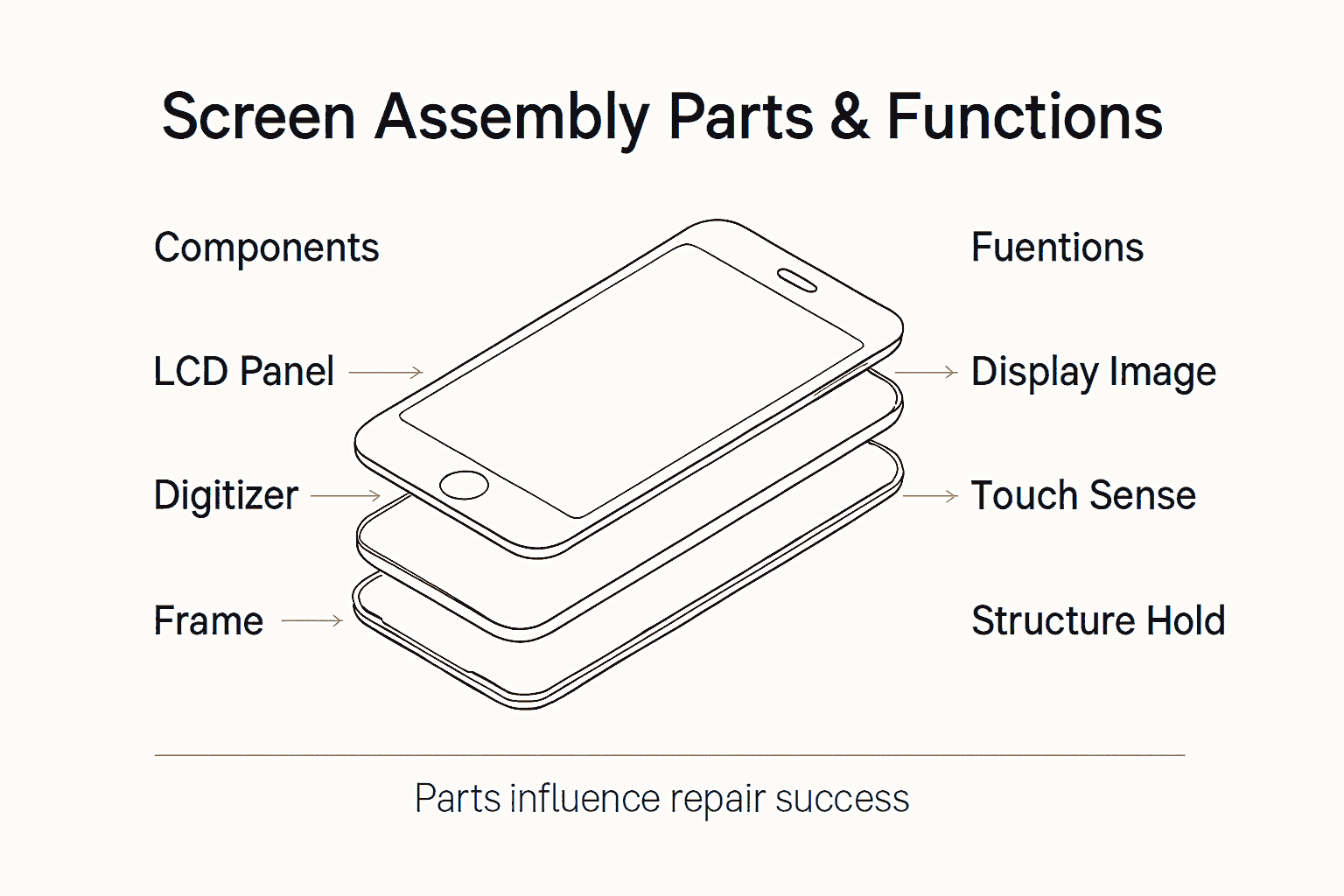
Beyond the primary display mechanics, screen assemblies incorporate additional critical components that enhance performance and durability. Polarising layers control light transmission, ensuring optimal visual clarity and contrast, while protective glass substrates shield the delicate internal mechanisms from external damage. The drive electronics embedded within the assembly translate signals from the device’s graphics processing unit, converting complex digital information into the seamless visual experiences users expect from modern electronic devices.
Pro tip: Always handle screen assembly components with anti-static equipment and use precision tools to minimise the risk of electrical or mechanical damage during repair processes.
The following table summarises key functions of core screen assembly components:
| Component | Primary Function | Impact on User Experience |
|---|---|---|
| Display panel | Visual image rendering | Determines clarity and content visibility |
| Touch digitiser | Detects user inputs | Enables smooth interactive control |
| Protective glass | Shields internal layers | Prevents scratches and breakage |
| Drive electronics | Signal processing | Delivers responsive display changes |
How Screen Assemblies Enable Device Repairs
Screen assemblies are engineered with remarkable design considerations that fundamentally support and streamline device repair processes. Modular screen assembly technologies enable technicians to replace damaged components with precision and efficiency, reducing the complexity and risk associated with comprehensive device disassembly. The strategic integration of components like flexible printed circuits, specialised connectors, and carefully designed adhesive layers allows for targeted repairs that minimise potential collateral damage to surrounding device systems.
The architectural approach of modern screen assemblies prioritises maintainability through sophisticated engineering techniques. Manufacturers incorporate design strategies that facilitate easier component separation, using specialised staking methods and protective coatings that balance durability with repairability. Electronic assembly design principles emphasise creating subassemblies that can be individually diagnosed, removed, and replaced without compromising the entire device’s structural integrity. This approach significantly reduces repair time and provides technicians with more predictable and manageable intervention strategies.
Beyond physical design, screen assemblies incorporate technological innovations that support diagnostic and repair processes. Integrated electronic interfaces and standardised connection protocols enable rapid identification of specific failure points, allowing repair professionals to target precise issues within the screen assembly. The modular nature of these assemblies means that individual components such as touch sensors, display panels, and protective layers can often be replaced independently, offering a more economical and targeted approach to device maintenance.
Pro tip: Invest in manufacturer-specific diagnostic tools and consult detailed technical documentation to ensure precise identification of screen assembly issues before attempting any repair interventions.
Common Mistakes With Screen Assembly Repairs
Screen assembly repairs are fraught with potential errors that can transform a straightforward maintenance task into a costly disaster. Common repair mistakes frequently stem from improper diagnostic procedures, leading technicians to unnecessarily replace entire screen assemblies when more targeted interventions might suffice. Inexperienced repair professionals often compound initial problems by using non-genuine replacement parts that compromise device functionality, structural integrity, and long-term performance.
Precision is paramount in screen assembly repairs, with numerous potential pitfalls threatening successful restoration. Technicians can inadvertently cause significant damage through careless handling, such as tearing delicate flex cables, misaligning critical connectors, or introducing static electricity that can permanently damage sensitive electronic components. Display performance complications can arise from seemingly minor repair mistakes, manifesting as visual artifacts like inconsistent backlighting, screen flickering, unexpected colour distortions, or persistent tearing effects that fundamentally degrade user experience.
The most critical mistakes in screen assembly repairs often involve a lack of systematic approach and insufficient technical understanding. Rushing through repairs without properly documenting original component positions, failing to ground oneself against static discharge, using inappropriate tools, or attempting repairs without manufacturer-specific guidance can transform what should be a routine maintenance task into an expensive device replacement scenario. Successful screen assembly repairs demand meticulous attention to detail, comprehensive device knowledge, and a patient, methodical workflow that prioritises component preservation and precise reassembly.
Pro tip: Create a systematic workspace with anti-static mats, properly organised tools, and manufacturer-specific repair documentation before attempting any screen assembly repair.
Simplify Your Screen Assembly Repairs With Expert Parts and Support
Understanding the intricate components and repair challenges of screen assemblies highlights the importance of sourcing high-quality, compatible replacement parts. From delicate flex cables to precise LCD screen assemblies, having reliable materials is essential to avoid common repair mistakes such as damaged connectors or poor fit issues. At Buy2fix, we specialise in providing genuine and aftermarket mobile phone repair parts including LCD screens and display assemblies meticulously selected to meet manufacturer standards and support the latest models and legacy devices.
Whether you are a professional technician or a dedicated DIY enthusiast, our comprehensive inventory offers everything you need for confident, accurate repairs. With benefits like free UK mainland shipping, a one-year warranty, and rigorous quality control, you can trust Buy2fix as your one-stop shop for tablet and mobile phone components. Don’t risk costly errors by using substandard parts—explore our extensive selection of mobile phone repair parts today and equip yourself with the tools to restore device functionality quickly and securely. Take control of your repair outcomes now and visit Buy2fix to find the exact screen assembly components your device requires.
Frequently Asked Questions
What is a screen assembly?
A screen assembly is the complete visual interface mechanism in digital devices, including components like the display panel, touch-sensitive digitizer, protective glass, connectors, and sometimes a support frame. These components work together to display images and allow user interaction.
What types of screen assembly technologies are available?
Screen assemblies can be categorised into several technologies, including Liquid Crystal Displays (LCD), Light Emitting Diode (LED), Organic Light Emitting Diode (OLED), and Active Matrix OLED (AMOLED). Each has unique characteristics, advantages, and typical use cases.
How do screen assemblies impact device repairs?
Screen assemblies are designed for repairability, with a modular approach facilitating targeted repairs. This allows technicians to replace individual components rather than the entire assembly, reducing repair time and costs.
What are common mistakes to avoid when repairing screen assemblies?
Common mistakes include improper diagnostics, using non-genuine parts, rushing repairs, and neglecting to handle components carefully. These errors can lead to additional damage and decreased functionality of the device.
Recommended
- Common Screen Replacement Issues – What Every Repairer Faces – buy2fix
- Complete Guide to Fixing Your Phone Screen Cost – buy2fix
- Understanding the Phone Screen Replacement Guide – buy2fix
- Understanding Choosing Screen Replacements for Devices – buy2fix
- Akkus reparieren Guide: So bringen Sie Ihre Akkus zurück ins Leben - accu.blog
Let customers speak for us
I ❤️ love it, it's absolutely amazing I'm sooo happy 😊

Great

I saw this item and it was just what I was looking for. I found it here but not in Amazon or e-bay. However, it was in UK, I was surprised to find that they were able to ship it to the US. Excellent company, would do business with again

This is great for when out and about, to sharpen either coloured pencils, or watercolour pencils….would order again.

Great items would bye again

I have purchased several items from this store before. Recently, I encountered an issue with my latest order. After reporting the problem to customer support, they were consistently attentive and made every effort to resolve the situation. Upon investigation, they acknowledged the issue and promptly fixed it. This experience has increased my level of trust in this store.
Thank you so much. I'm so happy.

très bien

BC70 Car Bluetooth 5.0 FM Transmitter Radio Adapter Dual Display Wireless Handsfree Call MP3 Music Player QC3.0 PD USB Charger

A quite sturdy cover, if you are looking for full protection and a more business-like style, this cover perfectly fulfills its purpose.
The shipping was fast, and it was delivered in perfect condition.

For LG TV Bluetooth Handheld Infrared Voice Multi-Function Remote Control(AKB75855501)

Tusen tack för bästa service och produkt som jag vänlig önskar dig tack

Works correctly and no issues so far

Took a while to get here but it was all good, watch looks brand new after replacement

What a fantastic 👏🏻 stylish case that has helped my phones temperature in the heatwave!!
Perfect 👌🏻 also it's cool as f##k
