

Should you repair or replace your smartphone? UK guide
TL;DR:
- The decision to repair or replace a UK smartphone depends on factors like cost percentage, age, software support, and fault history. The 50% rule offers a useful starting point, but must be combined with considerations of device lifecycle, support, and potential future costs. Accurate assessment ensures smarter choices, balancing short-term expenses against long-term value.
Every UK smartphone owner eventually faces it: a cracked screen, a battery that barely lasts until noon, or a fault that appeared from nowhere. The question of should you repair or replace sits somewhere between a financial puzzle and a gut feeling, and most advice online reduces it to a single number. It doesn’t work that way. Repair vs replacement decisions involve age, software support, hidden costs, and the realistic probability that one repair leads to another. This guide gives you a practical framework to make that call with confidence, whether you’re fixing your own device or running a small repair business.
Table of Contents
- Should you repair or replace? start with the 50% rule
- Key factors beyond the 50% rule: age, software support, and repair risks
- Comparing repair costs with replacement and lifecycle expenses
- When to prioritise replacement: signs and scenarios for UK smartphones
- Practical tips for DIYers and small repair businesses to assess repair value accurately
- Why the 50% rule alone isn’t enough for modern UK smartphone repair decisions
- Find quality parts and tools to help with your smartphone repair
- Frequently asked questions
Should you repair or replace? start with the 50% rule
The 50% rule is the most widely used starting point in repair decision-making, and for good reason. It states that if the repair cost exceeds 50% of what a comparable replacement would cost, you’re generally better off replacing the device. The logic is sound: spending £180 to repair a phone you could replace for £220 is rarely good value when you factor in residual risk.
For many common faults, this rule works in favour of repair. A screen replacement on a mid-range Samsung Galaxy or iPhone typically falls well below the 50% threshold, which is why screen repairs remain the most frequently performed job in UK repair shops. The 50% rule supports repair especially for mid-to-high-end phones where replacement costs are significantly higher than repair costs.
Where the rule starts to show its limits is when you apply it in isolation. A repair costing 40% of replacement might still be poor value if the phone is three years old, no longer receives security updates, and already has a failing battery. That’s where most straightforward guides leave you stranded.
When the 50% rule points clearly towards repair:
- Single fault on a phone under two years old
- Repair cost is under one third of a comparable replacement
- Device still receives manufacturer software and security updates
- No prior history of component failures
When it points towards replacement regardless:
- Repair cost exceeds half the replacement price
- Multiple faults present at the same time
- Phone is no longer supported by the manufacturer
- Repair requires board-level work or water damage assessment
“The 50% rule is not a verdict. It’s a starting heuristic that helps you avoid the sunk cost trap, but it must always be combined with age, software status, and fault history before you act on it.”
| Scenario | Repair cost | Replacement cost | 50% threshold | Decision |
|---|---|---|---|---|
| iPhone 14 cracked screen | £120 | £650 | £325 | Repair |
| Samsung Galaxy A52 battery | £55 | £200 | £100 | Repair |
| 5-year-old phone, screen + battery | £160 | £180 | £90 | Replace |
| iPhone 13 Pro, water damage | £280 | £700 | £350 | Borderline |
Key factors beyond the 50% rule: age, software support, and repair risks
While the 50% rule offers a clear metric, the practical and financial wisdom of repair depends heavily on factors it doesn’t capture. Age is the most important of these. A phone that’s 18 months old with a single cracked screen is a completely different proposition from a four-year-old device with the same fault.

Phones under two years old with a single fault and active software updates almost always justify repair. Older phones with multiple faults or no manufacturer support lean towards replacement. This isn’t just about cost. It’s about what the device will be worth to you after the repair, both functionally and in resale terms.
Software support is a factor many DIYers overlook entirely. An iPhone that no longer receives iOS updates, or a Samsung that has been dropped from its security patch schedule, is a security liability. Repairing it extends its life but also extends your exposure to unpatched vulnerabilities. For personal use you may accept that trade-off. For a business handling customer data, you probably shouldn’t.
Questions to ask before committing to repair:
- Is the phone still receiving security updates?
- Has it had any previous repairs that might affect structural integrity?
- Are there any secondary symptoms (random restarts, poor signal, camera faults) that suggest wider issues?
- What is the realistic resale value post-repair compared to pre-fault?
For DIYers specifically, there are hidden costs that rarely appear in a headline repair price. Screen quality varies enormously between part grades. A budget-grade replacement screen on an iPhone may deliver noticeably worse colour accuracy and brightness than the original. Aftermarket adhesives and seals can compromise water resistance ratings, which matters significantly on IP-rated devices. Time is also a cost. A two-hour DIY repair has a real value attached to it.
Pro Tip: Before you order parts, look up your phone’s current trade-in or secondhand value in its current broken state and in estimated repaired condition. If the repair won’t meaningfully increase that value, the economics shift considerably.
For small repair businesses, DIY repair hidden costs compound when multiplied across a high volume of jobs. One batch of substandard screens can generate a wave of returns and reputational damage that outweighs the initial saving on parts.
Comparing repair costs with replacement and lifecycle expenses
Understanding hidden and future costs is what separates a smart repair decision from an expensive mistake. The total cost of ownership framework forces you to look beyond a single repair quote and consider the full financial picture over the device’s remaining useful life.
A true repair vs replace comparison must weigh repair plus expected future costs against the net benefits of replacement, not just a single quote against a retail price. Most people skip this step and then wonder why they’re spending money on the same phone again six months later.
Five-step total cost of ownership comparison:
- Get a realistic repair quote including labour if applicable, not just the parts cost
- Estimate future repair probability based on the phone’s age, fault history, and any secondary symptoms
- Calculate downtime cost if this is a business device, even a day without a working handset has value
- Find the true replacement cost including any contract exit fees, data migration time, and accessory replacement
- Compare the two totals over a 12 to 24 month horizon, not just today’s numbers
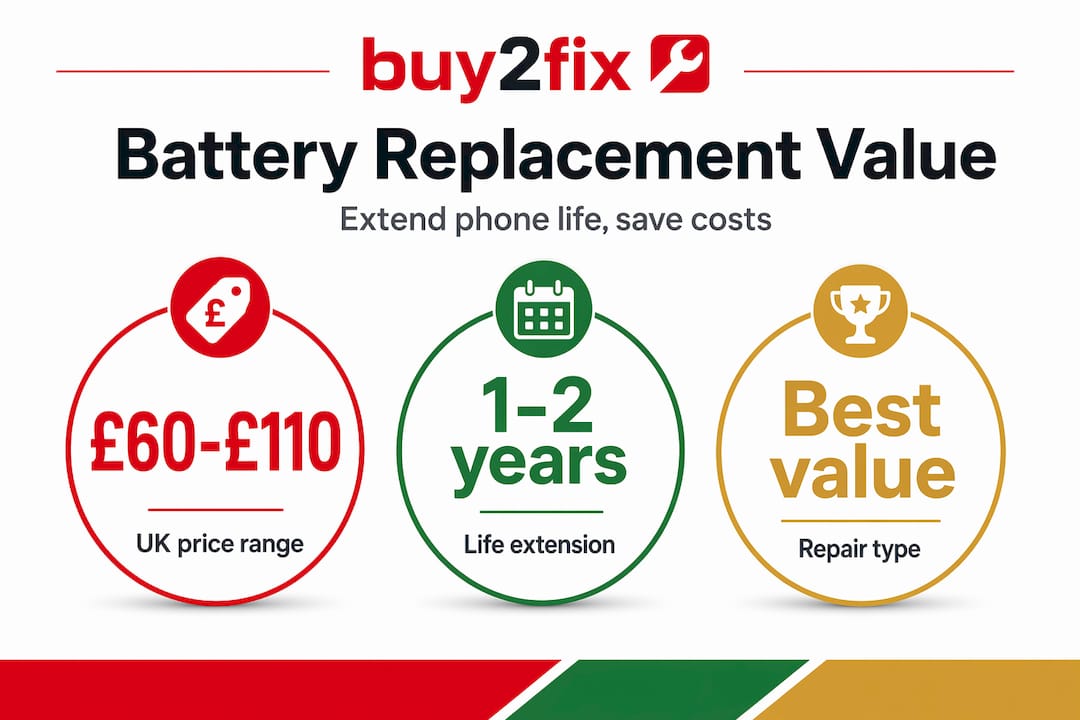
Battery replacement is consistently the best-value repair on this framework. UK battery replacements typically cost between £60 and £110 and can extend a phone’s usable life by one to two years. On a phone that would cost £400 to replace, that’s exceptional value. The calculation changes only if the phone is already showing other signs of age.
| Repair type | Typical UK cost | Expected life extension | Replacement avoided (mid-range) | Worth it? |
|---|---|---|---|---|
| Battery replacement | £60–£110 | 1–2 years | £250–£450 | Almost always |
| Screen replacement | £80–£180 | 2+ years | £250–£700 | Usually |
| Charging port | £50–£90 | 1–2 years | £250–£450 | Often |
| Water damage repair | £100–£250+ | Uncertain | Varies | Case by case |
| Motherboard repair | £150–£300+ | Uncertain | Varies | Rarely |
Pro Tip: For business devices, include the cost of data migration, app reconfiguration, and staff downtime when calculating replacement costs. These invisible expenses frequently tip the balance in favour of repair.
When to prioritise replacement: signs and scenarios for UK smartphones
Knowing when to replace rounds out the risk-aware approach to smartphone decisions. Some situations make replacement the clearer, safer choice regardless of repair costs.
Phones over approximately four years old with no manufacturer updates, multiple faults, or extensive damage are prime replacement candidates. This isn’t pessimism. It’s the recognition that at some point, repairing ageing hardware is like patching a roof that needs replacing entirely.
Clear signals that replacement is the better call:
- The phone has dropped out of its manufacturer’s software update cycle
- Two or more components have failed, or secondary symptoms suggest wider hardware issues
- Water damage is extensive and affects the motherboard or battery
- The cost of repair approaches or exceeds the 50% threshold on a phone already showing age
- The device is no longer compatible with apps or services your business depends on
“Replacement is the pragmatic choice when a phone is over four years old, receives no updates, has multiple faults, or has sustained significant physical damage. The economics simply stop supporting repair at that point.”
For small repair businesses, this framing also matters commercially. When you advise a customer on whether fixing a cracked screen is worth it on an older handset, giving an honest assessment builds long-term trust, even if it means losing that individual repair job.
High-risk repairs such as board-level faults and water damage often cost more in the medium term than replacement, even when the initial repair quote looks reasonable. The failure rate on water-damaged boards remains elevated even after professional cleaning and component replacement.
Practical tips for DIYers and small repair businesses to assess repair value accurately
Armed with risks and cost factors, the next step is applying sharper valuation to each specific repair decision. This is where expert repair valuation moves beyond cost ratios and into realistic probability assessments.
Practical valuation checklist:
- Check secondhand market prices for your specific model in both broken and repaired condition
- Identify whether the fault is isolated or accompanied by secondary symptoms
- Research the part quality tiers available for your specific model, not all screens or batteries are equal
- Account for the time cost of the repair, especially on complex disassembly jobs
- Assess whether the repair will restore water resistance ratings if the device is IP-rated
Stacking failures deserve particular caution. A phone that has had its screen replaced, now needs a new battery, and is also showing intermittent charging issues is not a good repair candidate regardless of age. Each previous intervention introduces small risks to seals, cables, and connectors. At some point the cumulative risk of smartphone repair tips being undone by a prior repair outweighs the benefit of the current one.
For repair businesses specifically, part sourcing quality directly affects customer satisfaction and return rates. Using original-quality or OEM-equivalent parts on higher-value repairs protects both your margin and your reputation.
Pro Tip: Always calculate total cost of ownership over the phone’s expected remaining life, not just the single repair cost. A £90 screen repair on a phone with 18 months of usable life left is a very different proposition to the same repair on a phone that might last another three years.
Why the 50% rule alone isn’t enough for modern UK smartphone repair decisions
Here’s the honest truth about repair guidance in the UK. The 50% rule is everywhere because it’s easy to explain and easy to remember. But it was designed for simpler times, when a washing machine either worked or it didn’t, and when the cost of repair was the only variable worth considering. Smartphones are not washing machines.
Modern devices are layered systems where software support, hardware integration, and lifecycle value interact in ways that a single cost ratio cannot capture. Experts consistently stress that the rule is a heuristic, not a verdict, and that balancing restored value against future failure risk requires context the rule simply doesn’t provide.
The most expensive mistake we see is people repairing phones that are on the edge of losing software support. The UK smartphone repair cost framework changes fundamentally once a device stops receiving security updates. You’re no longer extending the life of a functional device. You’re extending the life of a device that will become a liability.
Repair decisions for modern devices need to be treated as lifecycle management. Every fault is a prompt to reassess where that device sits in its useful life, not just a one-off cost to resolve. For DIYers, that means being honest about a phone’s remaining value. For repair businesses, it means giving customers advice that serves their actual interests rather than just generating a job.
Pro Tip: Build a simple scoring system for every device you assess. Rate the phone on age, software support status, fault severity, and fault history. A total score across those four factors will tell you more reliably than cost alone whether repair or replacement is the right call.
Find quality parts and tools to help with your smartphone repair
With a clearer framework for when to repair or replace, the next step is sourcing parts and tools that actually support a successful outcome. At Buy2fix, we stock replacement screens, batteries, charging ports, and repair tools for iPhone, Samsung Galaxy, Huawei, Xiaomi, OPPO, and many other major brands. Every item goes through quality checks before dispatch, so you’re not gambling on part consistency. We offer free UK mainland shipping, a 30-day returns policy, and warranty support on eligible items. Whether you’re a DIY enthusiast repairing your own handset or a small shop that needs reliable parts in volume, you’ll find what you need without the guesswork.
Frequently asked questions
What is the 50% rule in smartphone repair?
The 50% rule states that if the cost of repairing a phone exceeds half the cost of replacing it with an equivalent device, replacement is generally the better choice. It’s a useful starting point but works best alongside other factors such as age and software support status.
How does phone age affect repair versus replace decisions?
Phones under two years old with a single fault and active manufacturer updates almost always justify repair, while older devices with multiple faults or expired software support lean towards replacement. Age affects not just cost but the expected remaining useful life you’ll get from the repair.
Are battery replacements for UK smartphones generally worth it?
Yes, UK battery replacements typically cost between £60 and £110 and can extend phone life by one to two years, making them one of the most cost-effective repairs available. The value only diminishes on phones that are also showing other signs of hardware age.
Why consider future repairs and total cost of ownership when deciding?
A single repair quote ignores potential future faults, downtime costs, and the genuine benefits a new device would bring. Comparing total expected costs over a 12 to 24 month horizon gives you a far more accurate picture of which option actually saves money.
What hidden costs should DIY smartphone repairers be aware of?
Hidden costs in DIY repairs include screen quality variance, compromised seal integrity, loss of water resistance ratings, and the time cost of complex disassembly. These factors can make a repair that looks cheap on paper significantly less cost-effective in practice.
Recommended
Let customers speak for us
The acid test of any company is how they respond when things go wrong. The Buy2Fix team were efficient in dealing with my emails and resolved the issue to my complete satisfaction

For Samsung Galaxy A26 SM-A266B Original Earpiece Speaker with Cable

Very good communication throught. Good product

Well made part very strong easy to fit great value for the money

Well packed, with fast shipping :)

Exactly what the doctor ordered…great color, comfort, and durability. Trust this watch band!

Brilliant strap, second purchase, bought bracelet before. Excellent value. Thank you

Great item for splitting your Audio signal

Outstanding product!
Next level customer service.

Very satisfied but the delivery needs to get more faster...

Good price,quick delivery

Best phone case ever! This is my second one as I broke my first. Would defo recommend

Great fitting Apple Watch bands

For Apple Watch Ultra 3 / 2 / 1 49mm RedPepper Armor Metal Case Integrated Silicone Watch Band(Steel Black White)

Good price and quick postage
