


Nouvelles
What are LCD screens made of? a technical guide
TL;DR:
- LCD screens are intricate multilayer assemblies consisting of substrate glass, liquid crystal blends, polarising films, colour filters, and conductive layers that work together to produce images. The composition and quality of each material significantly influence display performance, lifespan, and repair outcomes. Understanding these complex materials is essential for technicians to ensure proper repairs and prevent permanent damage.
LCD screens are defined as multi-layered optical assemblies that combine substrate glass, liquid crystal mixtures, polarising films, and colour filters to produce images by controlling light. The LCD display materials market is valued at $10.04 billion as of Q1 2026, growing at a CAGR of 3.6% through 2034. That figure reflects just how material-intensive these displays are. Understanding what are LCD screens made of matters whether you are repairing a Samsung Galaxy, specifying a replacement panel, or simply curious about the technology behind the glass.
What are the essential materials used in LCD screen construction?
An LCD screen is not a single sheet of glass. It is a precisely ordered stack of functional layers, each made from a different class of material, each doing a specific job.
Substrate glass
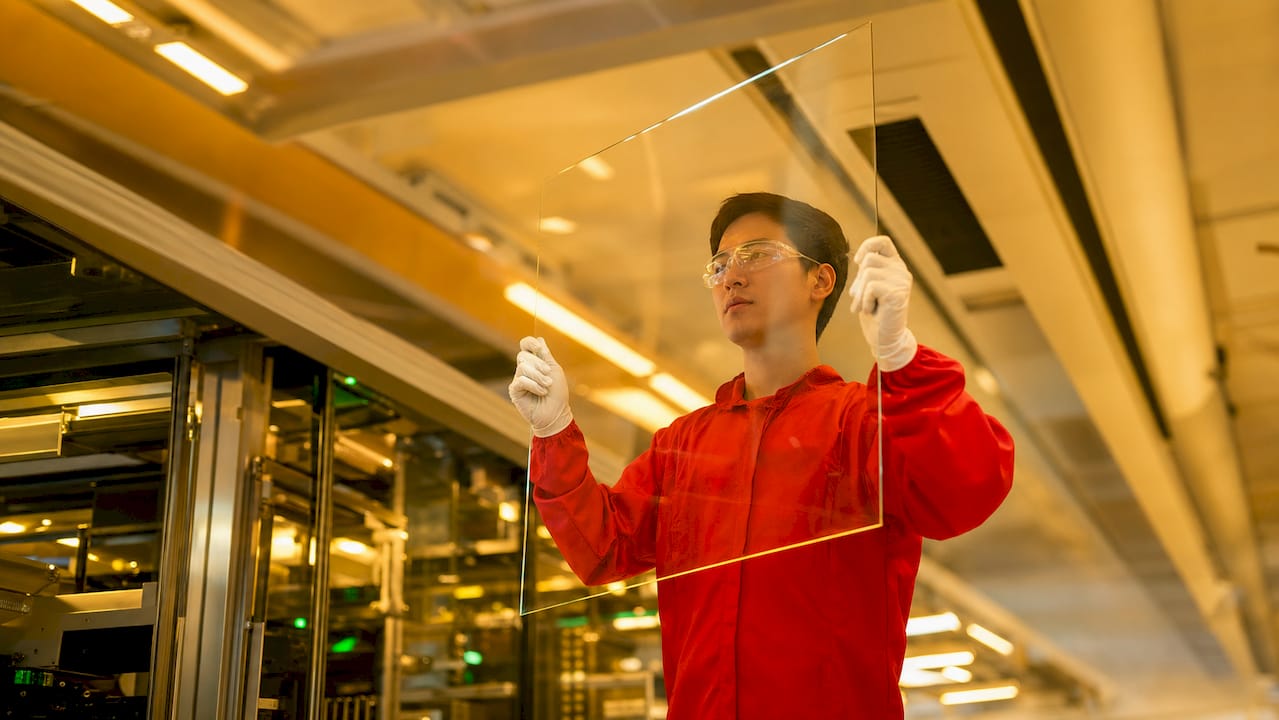
The foundation of every LCD panel is substrate glass. For TFT-LCDs (thin-film transistor liquid crystal displays), this glass must be alkali-free in composition to prevent sodium and potassium ions from migrating into the transistor layer. Ion migration destabilises gate voltage in TFT arrays, causing display artefacts and early failure. The raw materials used to produce this glass include quartz powder, boron oxide, and alumina, combined in tightly controlled ratios.
Liquid crystal mixtures
The liquid crystal layer is the functional core of the display. Liquid crystal mixtures typically comprise 10–20 organic compounds, each selected for specific electro-optical properties. These compounds are not a single chemical but a formulated blend, engineered to achieve target response times of 5ms or less for standard panels, and 1ms or less for high-refresh-rate displays. The blend determines how quickly pixels switch, which directly affects motion clarity.
Polarising films
Two polarising films sit on opposite sides of the liquid crystal layer, one above and one below. These films are made from iodine-PVA (polyvinyl alcohol) or dye-based materials. Polariser film quality directly determines contrast ratio, viewing angle, and image sharpness. A degraded or mismatched polariser produces washed-out colours and poor off-axis visibility, which is why replacement polarisers must match the original specification precisely.
Colour filters and conductive layers
Colour filters are formed from red, green, and blue photoresists applied via photolithography. Pigment particles in these filters measure approximately 40 nanometres in size. That scale is smaller than most bacteria. Between the glass substrates, a transparent conductive layer of indium tin oxide (ITO) carries the electrical signals that switch individual pixels. Alignment layers made from polyimide polymers are deposited on top of the ITO to orient liquid crystal molecules in the correct resting direction.
- Substrate glass: alkali-free, ultra-pure, typically less than 0.7mm thick
- Liquid crystal mixture: 10–20 organic compounds, panel-specific blend
- Polarising films: iodine-PVA or dye-based, bonded to outer glass surfaces
- Colour filters: RGB photoresists, ~40nm pigment particles, applied by photolithography
- ITO layer: transparent conductive oxide for pixel switching
- Polyimide alignment layer: orients liquid crystal molecules at rest
Pro Tip: When sourcing replacement LCD assemblies, check whether the polariser film type matches the original panel specification. Iodine-PVA and dye-based polarisers behave differently under heat and UV exposure, and substituting one for the other can reduce display lifespan significantly.
How are LCD screens manufactured?
The manufacturing sequence for an LCD panel is one of the most contamination-sensitive processes in consumer electronics. A single dust particle between layers can render an entire panel unusable.
- Glass substrate preparation. Raw alkali-free glass is cut, polished, and cleaned to nanometre-level flatness. Any surface irregularity at this stage propagates through every subsequent layer.
- TFT array deposition. Thin-film transistors are deposited onto one glass substrate using chemical vapour deposition and photolithography. These transistors control each individual pixel.
- Colour filter fabrication. Red, green, and blue photoresists are applied to the second substrate using photolithography. Carbon-pigment black matrices replace older chromium layers and are deposited at micron-level thickness, making them extremely fragile under mechanical stress.
- ITO and alignment layer coating. Indium tin oxide is sputtered onto both substrates. Polyimide alignment layers are then applied and rubbed in a controlled direction to set liquid crystal orientation.
- Liquid crystal filling. The two substrates are bonded together with a precision sealant, leaving a small gap. Liquid crystal is introduced either by vacuum injection or the one-drop fill (ODF) method, which places a precise volume of liquid crystal onto one substrate before bonding.
- Polariser film lamination. Polarising films are laminated to the outer surfaces of both glass substrates. Alignment of the polariser axes relative to each other determines whether the panel operates in normally white or normally black mode.
- Driver IC and FPC bonding. TFT driver chips are bonded to the glass electrodes using anisotropic conductive film (ACF). Flexible printed circuits (FPC) connect the panel to the device’s main board. Chip-on-glass (COG) bonding places the driver IC directly onto the glass edge, reducing module thickness.
- Backlight unit assembly. The completed LCD cell is mounted onto a backlight unit, which typically uses edge-lit or direct-lit LED arrays to provide the light source the liquid crystals modulate.
Pro Tip: The one-drop fill method is now standard in high-volume manufacturing because it reduces liquid crystal waste and shortens cycle time. If you are assessing panel quality for repair purposes, ODF panels tend to have more consistent cell gaps than older vacuum-filled panels.
How do materials differ across LCD screen types?
Not all LCD panels use identical materials. The type of panel determines the glass, liquid crystal blend, and polariser specification.
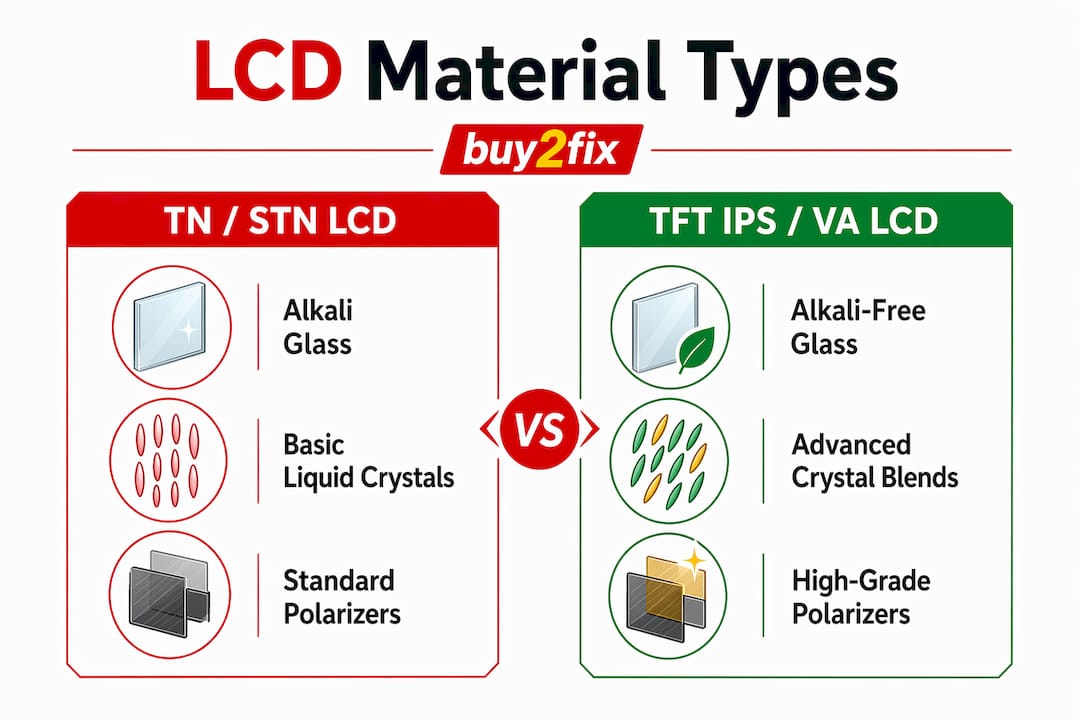
| Feature | TN / STN LCD | TFT IPS / VA LCD |
|---|---|---|
| Substrate glass | Alkali-containing glass acceptable | Alkali-free glass required |
| Liquid crystal blend | Simpler mixture, faster but narrower viewing angle | Complex multi-compound blend for wide viewing angle |
| Polariser film | Standard iodine-PVA | High-grade iodine-PVA or dye-based for wider angle |
| Substrate material | Glass or rigid plastic | Primarily glass; flexible plastic in some mobile panels |
| Colour filter precision | Standard photolithography | High-resolution photolithography for finer sub-pixels |
| Repair complexity | Lower | Higher due to tighter material tolerances |
The difference between alkali-containing and alkali-free glass is not cosmetic. Sodium and potassium ions in standard glass migrate under electrical load, shifting transistor threshold voltages over time. TFT panels using alkali-containing glass degrade faster and produce uneven brightness across the display.
Plastic substrates appear in flexible and foldable displays, including some panels used in Huawei and Samsung Galaxy foldable devices. Plastic is lighter and more impact-resistant than glass, but it scratches more easily and is more permeable to moisture, which affects liquid crystal stability over time. For LCD versus OLED comparisons, the substrate and emissive layer differences explain much of the performance gap between the two technologies.
- IPS panels use compensation films in addition to standard polarisers to extend viewing angles beyond 170 degrees
- VA panels use vertically aligned liquid crystals that require different polyimide alignment layers compared to IPS
- TN panels have the simplest material stack but the narrowest viewing angles and lowest colour accuracy
What should repair professionals know about LCD materials?
Knowing the composition of an LCD screen changes how you approach repairs. The materials are not interchangeable, and handling errors at any layer cause permanent damage.
Liquid crystal degradation manifests as changes in viscosity and dielectric anisotropy rather than visible leakage. A panel with degraded liquid crystals shows ghosting, motion blur, or uneven response across the display. These symptoms are often misdiagnosed as driver IC failures. The blend of 10–20 compounds in a liquid crystal mixture is panel-specific, so a mismatched replacement causes the same symptoms as degraded original material.
Contamination during assembly is the most common cause of quality failure in repaired panels. Even microscopic dust particles between the polariser and glass surface scatter light and create visible bright spots. Professional repair environments use anti-static mats, filtered air, and lint-free tools to minimise this risk. Understanding how contamination affects LCD assembly quality is as important as knowing which part to order.
Polariser films are particularly vulnerable. They are thin, adhesive-backed, and sensitive to fingerprint oils, heat, and UV exposure. Replacing a polariser without the correct specification for that panel type produces visible colour shifts and reduced contrast, even if the rest of the assembly is intact.
Pro Tip: When handling LCD panels during repair, never apply pressure to the active area of the display. The carbon-pigment black matrix layers are only microns thick and fracture under localised stress, creating permanent dark patches that no software fix can resolve.
Material purity also affects screen lifespan. Panels built with lower-grade ITO or substandard polyimide alignment layers show earlier onset of dead pixels and backlight bleed. For professional repair technicians, sourcing replacement assemblies from verified suppliers is not a preference. It is a technical requirement.
Key takeaways
LCD screens are complex multilayer assemblies where every material, from alkali-free substrate glass to panel-specific liquid crystal blends, directly determines display performance, longevity, and repairability.
| Point | Details |
|---|---|
| Alkali-free glass is non-negotiable | TFT-LCD panels require alkali-free substrate glass to prevent ion migration and transistor instability. |
| Liquid crystal blends are panel-specific | Mixtures of 10–20 compounds are formulated for each panel type; mismatched blends cause ghosting and blur. |
| Polariser films define image quality | Iodine-PVA and dye-based polarisers differ in durability and performance; always match the original specification. |
| Contamination causes permanent damage | Dust between layers scatters light and creates visible defects that cannot be corrected after assembly. |
| Material choice affects repair outcomes | Lower-grade ITO and alignment layers accelerate pixel failure; verified replacement parts reduce this risk. |
Why LCD materials are more sophisticated than most people realise
People often describe a broken phone screen as “just cracked glass.” Having spent years working with display technology and repair parts, I find that framing consistently leads to poor repair decisions.
The glass is the least technically demanding component in the stack. The alkali-free substrate, the polyimide alignment layer, the ITO coating, the liquid crystal blend, the colour filter photoresists, and the polariser films are each the product of highly specialised chemistry and manufacturing. When a repair goes wrong, it is almost never the glass that causes the problem. It is a mismatched polariser, a contaminated cell gap, or a liquid crystal blend that does not match the panel’s original specification.
The other misconception I encounter regularly is that all LCD panels of the same size are interchangeable. They are not. An IPS panel from a Xiaomi device and an IPS panel from an iPhone use different liquid crystal blends, different polariser specifications, and potentially different glass thicknesses. Fitting the wrong assembly produces a display that technically works but delivers noticeably inferior image quality.
What genuinely interests me about this field is how material science is pushing display technology forward. Quantum dot enhancement films are now being layered into LCD stacks to extend colour gamut without switching to OLED. Flexible polyimide substrates are replacing glass in foldable devices. The types of LCD screens available today reflect decades of incremental material refinement, not a single invention.
For anyone working in device repair, understanding the material stack is the difference between a repair that lasts and one that fails within weeks.
— Adewale
Quality LCD replacement parts from Buy2fix
Buy2fix stocks a broad range of LCD assemblies and replacement screens for iPhone, Samsung Galaxy, Huawei, Xiaomi, OPPO, and other major brands. Every part goes through quality checks before dispatch, so you are not guessing about material compatibility when a device comes in for repair. Whether you need a complete LCD screen assembly or want to understand the construction differences between panel types before ordering, the Buy2fix knowledge base covers both. Free UK mainland shipping and a 30-day return policy mean you can order with confidence. Visit Buy2fix to browse the full range of display parts and repair accessories.
FAQ
What layers make up an LCD screen?
An LCD screen comprises substrate glass, a liquid crystal layer, polarising films, colour filters made from RGB photoresists, an indium tin oxide conductive layer, and polyimide alignment layers. Each layer serves a distinct optical or electrical function.
Why does LCD substrate glass need to be alkali-free?
Alkali-free glass prevents sodium and potassium ions from migrating into the TFT transistor layer under electrical load. Ion migration shifts transistor gate voltages, causing brightness irregularities and accelerated panel degradation.
What causes ghosting on an LCD screen?
Ghosting is most commonly caused by liquid crystal degradation, where the blend loses its correct viscosity and dielectric properties. A mismatched or substandard liquid crystal mixture fitted during repair produces identical symptoms.
Can polariser films be replaced during a screen repair?
Polariser films can be replaced, but the replacement must match the original panel specification exactly. Substituting an iodine-PVA film for a dye-based film, or vice versa, produces colour shifts and reduced contrast even when the rest of the panel is undamaged.
How does contamination affect LCD screen quality?
Dust or oil between the polariser and glass surface scatters light, creating visible bright spots or clouding. Because the cell gap is only a few micrometres wide, even microscopic particles cause permanent image defects that cannot be corrected after assembly.
Recommended
Let customers speak for us
For Garmin Forerunner 165 20mm Two Color Textured Silicone Watch Band(Teal)

For Samsung Galaxy S26+ 5G R-JUST Sliding Camera Life Waterproof Holder Phone Case(Black)

I ❤️ love it, it's absolutely amazing I'm sooo happy 😊

Great

I saw this item and it was just what I was looking for. I found it here but not in Amazon or e-bay. However, it was in UK, I was surprised to find that they were able to ship it to the US. Excellent company, would do business with again

This is great for when out and about, to sharpen either coloured pencils, or watercolour pencils….would order again.

Great items would bye again

I have purchased several items from this store before. Recently, I encountered an issue with my latest order. After reporting the problem to customer support, they were consistently attentive and made every effort to resolve the situation. Upon investigation, they acknowledged the issue and promptly fixed it. This experience has increased my level of trust in this store.
Thank you so much. I'm so happy.

très bien

BC70 Car Bluetooth 5.0 FM Transmitter Radio Adapter Dual Display Wireless Handsfree Call MP3 Music Player QC3.0 PD USB Charger

A quite sturdy cover, if you are looking for full protection and a more business-like style, this cover perfectly fulfills its purpose.
The shipping was fast, and it was delivered in perfect condition.

For LG TV Bluetooth Handheld Infrared Voice Multi-Function Remote Control(AKB75855501)

Tusen tack för bästa service och produkt som jag vänlig önskar dig tack

Works correctly and no issues so far
