


Nouvelles
What is AMOLED LCD? Display technology explained
TL;DR:
- AMOLED screens emit their own light pixels, providing true blacks and vibrant colors, unlike LCDs which rely on a backlight. AMOLED offers faster response times, better contrast, and power savings in dark environments, but is more susceptible to burn-in and typically costs more to repair. LCD screens are more resistant to burn-in and cheaper to fix but have limited contrast and lower power efficiency in dark display modes.
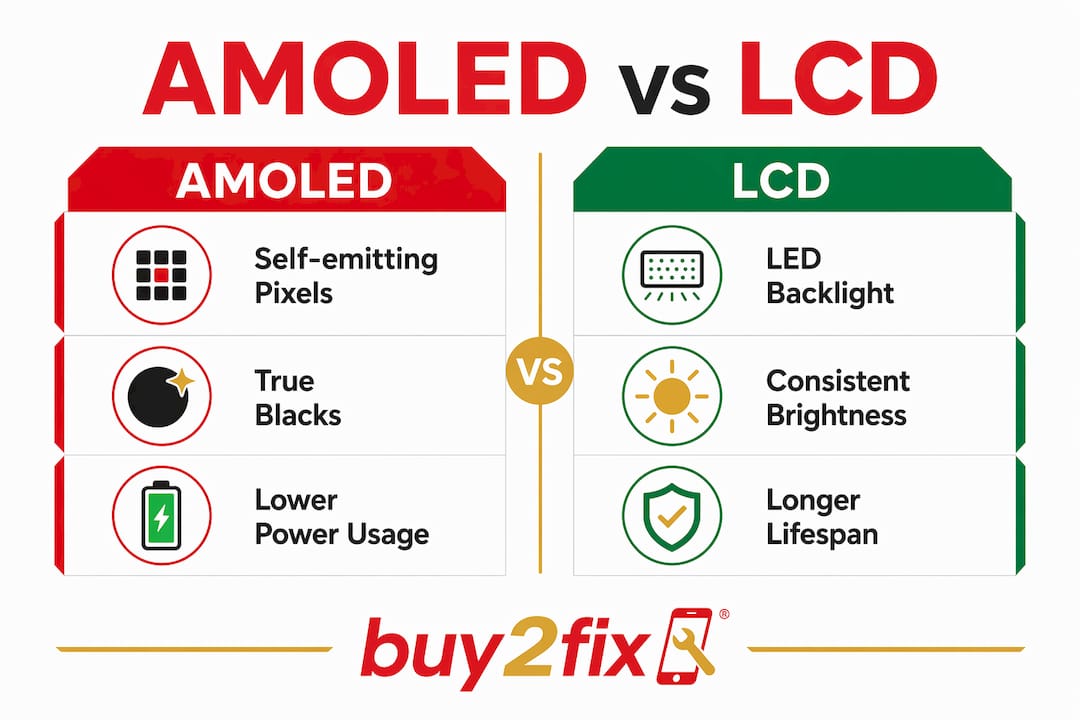
AMOLED and LCD are the two dominant display technologies in modern smartphones and tablets, distinguished by a single fundamental difference: how each pixel produces light. AMOLED pixels emit their own light individually, while LCD pixels rely on a constant backlight shining through liquid crystals. That distinction drives every meaningful difference in contrast, colour, power consumption, and repairability you will encounter when choosing or repairing a device. Understanding what is AMOLED LCD technology means understanding this core split, not the marketing terms layered on top of it.
How do AMOLED and LCD displays work at the pixel level?
AMOLED stands for Active-Matrix Organic Light-Emitting Diode. Each pixel contains organic compounds that emit light when an electric current passes through them. An active-matrix TFT backplane controls each pixel individually, switching it on or off with precision. This is what separates AMOLED from the older PMOLED (Passive-Matrix OLED) standard, which scanned rows sequentially and could not support high resolutions or fast refresh rates.
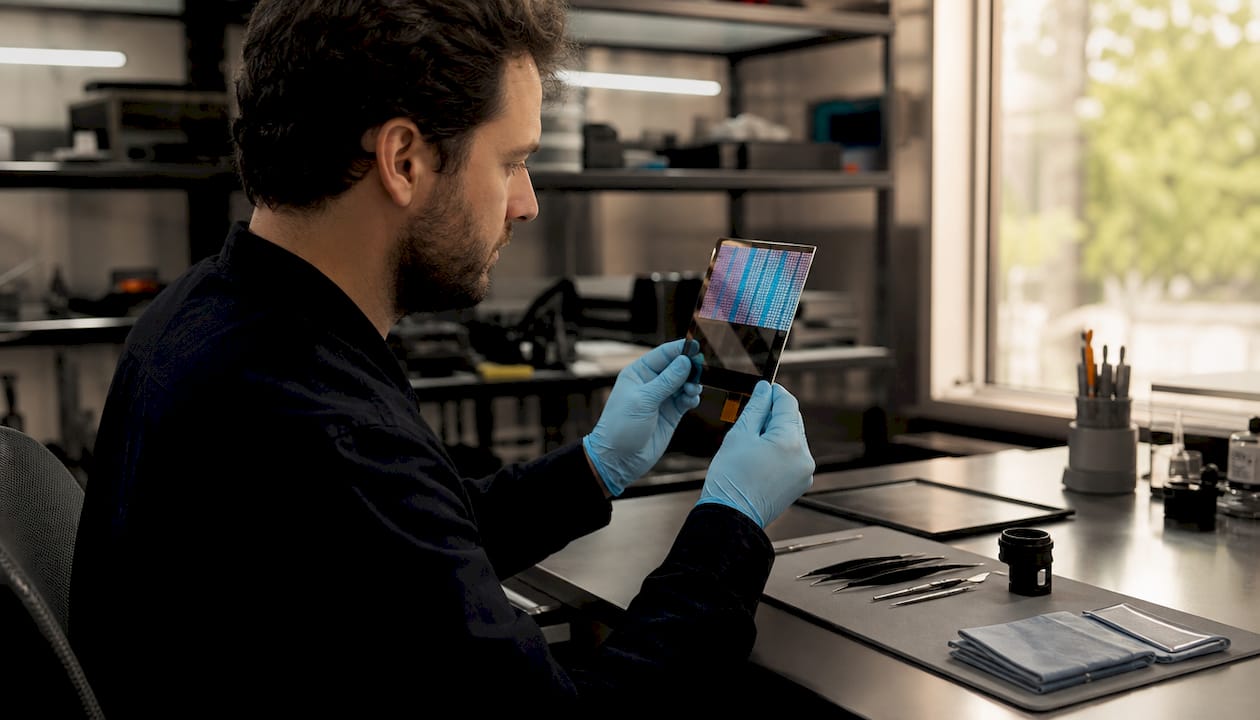
LCD, or Liquid Crystal Display, works differently. A panel of liquid crystals acts as a shutter, blocking or allowing light from an LED backlight positioned behind the screen. Colour filters divide each pixel into red, green, and blue subpixels. The backlight stays on continuously, regardless of what the screen is showing.
| Feature | AMOLED | LCD |
|---|---|---|
| Light source | Each pixel self-emits | Constant LED backlight |
| Pixel control | Individual TFT switching | Liquid crystal shutter |
| Black level | True black (pixel off) | Dark grey (backlight bleeds) |
| Colour filter | Organic emitter per subpixel | RGB filter over white backlight |
| Flexible form factor | Yes, widely used | Rarely, limited applications |
LTPO (Low-Temperature Polycrystalline Oxide) is a refinement of the TFT backplane used in premium AMOLED panels. It allows dynamic refresh rates from 1Hz to 120Hz, dropping to 1Hz when the screen is static and jumping to 120Hz during scrolling. That adaptability is impossible with a standard LCD backlight architecture.
What are the performance and visual differences between AMOLED and LCD?
AMOLED achieves true blacks and infinite contrast by simply turning off pixels that should display black. LCD cannot replicate this. Even the best LCD panels show a dark grey rather than true black, because the backlight continues to shine through the liquid crystal layer. The practical result is that AMOLED images look more three-dimensional, particularly in dark scenes.
Colour reproduction differs too. AMOLED panels produce vivid, saturated colours that many readers find visually striking. LCD panels, by contrast, tend toward more neutral colour accuracy, which some professionals prefer for photo editing or colour-critical work. Neither approach is objectively wrong. It depends on what you value.
Response time is where AMOLED has a clear technical edge:
- AMOLED response time: approximately 0.1ms, making motion blur and ghosting virtually undetectable
- LCD response time: typically around 10ms, which can produce visible ghosting during fast-paced gaming or action video
- Viewing angles: AMOLED maintains consistent colour and brightness at wide angles; LCD panels often shift colour or lose brightness when viewed off-axis
- Outdoor visibility: high-brightness AMOLED panels perform well in sunlight; standard LCD panels can wash out unless peak brightness is high
- Dark environments: AMOLED’s true black makes it far more comfortable to use in low light, reducing eye strain
Pro Tip: If you use your phone frequently in dark rooms, an AMOLED screen set to dark mode will look noticeably better and consume less power than an equivalent LCD.
The 0.1ms response time of AMOLED is not just a specification. It means that in competitive gaming or high-frame-rate video, the display keeps up with the content without smearing. LCD’s 10ms lag is imperceptible in casual use but becomes visible in fast motion sequences.
How does power consumption compare between AMOLED and LCD screens?
Power consumption is one of the most misunderstood aspects of the AMOLED vs LCD comparison. AMOLED pixels consume power only when they are lit. A pixel displaying black uses zero energy. LCD panels draw a relatively constant amount of power regardless of screen content, because the backlight runs at full intensity whether you are reading a white webpage or watching a dark film.
This has a direct consequence for battery life. Samsung’s Super AMOLED achieves 20% lower power consumption compared to first-generation AMOLED panels, alongside 80% less sunlight reflection. Those are meaningful gains for everyday use.
Key power consumption differences to understand:
- Dark mode on AMOLED: switching to a dark system theme genuinely saves battery, because large black areas mean many pixels are off
- Dark mode on LCD: saves almost no battery, because the backlight remains on at the same intensity
- LTPO AMOLED: the 1Hz–120Hz dynamic refresh rate delivers 15–20% battery savings compared to fixed-rate panels
- Always-on displays: AMOLED handles always-on clock or notification screens efficiently; LCD wastes power showing a mostly dark screen with a full backlight
- Bright, white content: displaying a fully white screen on AMOLED can actually consume more power than an equivalent LCD, because every pixel is at maximum brightness
Pro Tip: On an AMOLED device, switching your wallpaper and app themes to dark colours is one of the simplest ways to extend battery life between charges.
LCD has one genuine power advantage. When displaying bright, predominantly white content such as documents or spreadsheets, LCD’s constant backlight is more efficient than lighting every AMOLED pixel to full brightness. For readers who spend most of their screen time on white-background apps, this is worth considering.
What are the durability, maintenance, and cost considerations?
Durability is where LCD holds a genuine advantage over AMOLED. The organic materials in AMOLED pixels degrade over time, and burn-in remains a physical limitation even as software mitigation reduces its frequency. Burn-in occurs when static UI elements, such as navigation bars or status icons, are displayed at high brightness for extended periods. The organic pixels in those areas age faster than surrounding pixels, leaving a faint ghost image.
LCD panels do not suffer burn-in. Their backlight may dim uniformly after years of use, but the degradation is even and rarely produces visible artefacts. For devices used in fixed-display environments, such as point-of-sale terminals or information kiosks, LCD is the more reliable long-term choice.
Repair complexity differs significantly between the two technologies:
- AMOLED repair: the touch digitizer is integrated within the display module, meaning a cracked glass almost always requires full panel replacement
- LCD repair: the glass and digitizer are often separate components, allowing glass-only or digitizer-only replacement at lower cost
- AMOLED replacement cost: higher due to the integrated structure and the premium materials involved
- LCD replacement cost: generally lower, with more affordable parts available across a wider range of devices
LCD panels remain affordable for budget devices, while AMOLED has become the standard for high-end smartphones. That pricing gap is narrowing as AMOLED production scales up, but it still influences repair costs at every level of the market.
What should you consider when choosing between AMOLED and LCD?
The right display technology depends on how you use your device, not on which technology sounds more impressive. AMOLED suits readers who prioritise visual quality, use dark mode regularly, or want the best possible experience for gaming and video. LCD suits readers who need colour accuracy for professional work, prefer lower device costs, or want a screen that is less susceptible to long-term degradation.
Here is a practical framework for making the decision:
- Prioritise contrast and colour vibrancy: choose AMOLED. True blacks and saturated colours make a visible difference in everyday use.
- Prioritise colour accuracy for creative work: consider LCD. Its more neutral colour reproduction suits photo editing and design tasks.
- Prioritise battery life with dark mode: choose AMOLED. The power savings from dark themes are real and measurable.
- Prioritise repair affordability: LCD panels are generally cheaper to replace, particularly when only the glass is damaged.
- Prioritise flexible or curved form factors: AMOLED panels enable foldable and curved designs that LCD cannot replicate.
Marketing terms add confusion to this decision. “Super AMOLED” refers to manufacturer enhancements such as the integrated touch layer, not a fundamentally different underlying technology. The core active-matrix TFT backplane remains the same. Understanding this helps you cut through the marketing and focus on the specifications that actually matter.
Pro Tip: When comparing devices, look at peak brightness (nits), colour gamut (DCI-P3 or sRGB coverage), and refresh rate rather than brand-specific display names. Those numbers tell you far more than a product label.
For a deeper technical breakdown of how these technologies affect display quality in phones, the distinction between panel types becomes especially relevant when you are choosing a replacement screen.
Key takeaways
AMOLED delivers superior contrast, faster response times, and better power efficiency for dark content, while LCD offers lower repair costs, resistance to burn-in, and more neutral colour accuracy.
| Point | Details |
|---|---|
| Pixel illumination method | AMOLED pixels self-emit; LCD pixels rely on a constant backlight behind the panel. |
| Contrast and black levels | AMOLED achieves true black by turning pixels off; LCD produces dark grey due to backlight bleed. |
| Power efficiency | AMOLED saves battery with dark content; LCD power draw stays constant regardless of screen content. |
| Burn-in risk | AMOLED organic pixels degrade unevenly with static images; LCD is immune to burn-in. |
| Repair cost | AMOLED requires full module replacement; LCD glass and digitizer are often separately replaceable. |
The display gap is closing, but the trade-offs remain real
I have spent years looking at display specifications across hundreds of devices, and the single biggest mistake I see readers make is treating AMOLED as universally superior. It is not. It is better for specific things, and understanding that distinction saves money and frustration.
The trend I find genuinely interesting is how AMOLED has moved down the price ladder. Devices that would have shipped with LCD two years ago now carry AMOLED panels, and that is largely down to LTPO manufacturing becoming cheaper. But the repair cost gap has not closed at the same pace. A cracked AMOLED screen on a mid-range device can still cost more to fix than the same repair on a flagship LCD phone from three years ago, because the integrated digitizer structure does not get cheaper just because the panel does.
Burn-in is also less of a ghost story than it used to be. Modern software techniques, pixel shifting, and reduced always-on brightness have made it a rare occurrence for typical users. But it is not zero. If you run a device at high brightness with a persistent navigation bar for three years, you will likely see it. That is physics, not a manufacturing defect.
My honest recommendation: if you are buying a device primarily for media consumption and battery life, AMOLED is the better choice. If you are buying for longevity, colour accuracy, or low repair costs, LCD still makes a strong case. The LCD display guide at Buy2fix covers the repair side of this in practical detail if you want to go further.
— Adewale
Display repairs and screen replacements at Buy2fix
Understanding the difference between AMOLED and LCD matters most when something goes wrong with your screen. Buy2fix stocks replacement display modules for a wide range of devices, including iPhone, Samsung Galaxy, Huawei, Xiaomi, and OPPO, covering both AMOLED and LCD variants. Whether you are a DIY repairer replacing a cracked panel at home or a professional technician sourcing parts in volume, Buy2fix provides quality-checked components with free UK mainland shipping and a 30-day return policy. Visit Buy2fix to find the right screen replacement for your device and get it back to full working order.
FAQ
What does AMOLED stand for?
AMOLED stands for Active-Matrix Organic Light-Emitting Diode. The active-matrix TFT backplane controls each pixel individually, enabling high resolutions and fast refresh rates.
Is AMOLED better than LCD for everyday use?
AMOLED offers better contrast, true blacks, and power efficiency with dark themes, making it the stronger choice for most everyday smartphone use. LCD remains preferable for colour-accurate work and lower repair costs.
Does AMOLED burn-in still happen in 2026?
Burn-in remains a physical limitation of organic pixels, though modern software mitigation has made it rare under typical usage conditions.
Why is AMOLED screen repair more expensive than LCD?
AMOLED displays integrate the touch digitizer within the panel, requiring full module replacement when damaged. LCD screens often allow separate glass or digitizer replacement at lower cost.
What is Super AMOLED and is it different from standard AMOLED?
Super AMOLED is a manufacturer enhancement that integrates the touch layer directly into the display, reducing thickness and glare. The underlying active-matrix OLED technology is the same as standard AMOLED.
Recommended
Let customers speak for us
love that it came on time and works really well

Very simple and easy to use. Thank you!!

Too small because of disability

Fits and watch works well with it on.

Looks great!

Snel en makkelijk besteld, vlotte levering !

item was packaged safely, no damage. it’s now October and since replacing it in January i’ve had no issues.

Great

They had what I was looking for ... ordering was easy, payment was easy, delivery was as promised.
-

Absolutely love this case! Heavy, sturdy and full coverage

Thank You! I really love it! 😊

For Garmin Forerunner 165 20mm Two Color Textured Silicone Watch Band(Teal)

For Samsung Galaxy S26+ 5G R-JUST Sliding Camera Life Waterproof Holder Phone Case(Black)

I ❤️ love it, it's absolutely amazing I'm sooo happy 😊
