


News
iPhone battery replacement cost UK: Genuine vs DIY
TL;DR:
- iPhone battery replacement costs vary from under £20 DIY kits to up to £119 at Apple Stores depending on model and location. Apple offers genuine parts with warranty, but third-party shops and DIY options can be cheaper with increased risks and potential quality issues. Consider your device’s age, resale value, and risk tolerance when choosing the best replacement method.
Not all iPhone battery replacements cost the same, and that surprises more people than you’d expect. Prices in the UK range from under £20 for a DIY kit all the way to £119 at an Apple Store, depending on your model, where you go, and what parts are used. Whether you’re weighing up Apple’s official service, a local repair shop, or doing it yourself, the right answer depends heavily on your device, your budget, and how much risk you’re willing to accept. This guide lays out every option clearly so you can make a confident, informed decision.
Table of Contents
- What affects the cost to replace an iPhone battery in the UK
- Apple official battery replacement: Prices and warranty impact
- Third-party and retail battery replacement: Savings and trade-offs
- DIY battery replacement: Cheapest route, highest risks
- Our take: What most guides miss about iPhone battery costs
- Get your iPhone battery replaced with confidence
- Frequently asked questions
Key Takeaways
| Point | Details |
|---|---|
| Official costs vary by model | Genuine Apple battery replacements in the UK cost £79-£119, with higher-end models at the top. |
| Third-party shops offer savings | Independent repair shops can be quicker and cheaper but may affect your warranty and battery health readings. |
| DIY is cheapest, but risky | DIY kits save money but bring the greatest chance of errors or permanent phone damage. |
| Consumer law protects repairs | UK law covers poor workmanship and faulty parts, so you have recourse if a replacement goes wrong. |
What affects the cost to replace an iPhone battery in the UK
The price you’ll pay for an iPhone battery replacement isn’t fixed. Several factors push it up or down, and understanding them helps you avoid nasty surprises.
Model age and battery type play a significant role. Newer iPhones use more advanced battery technology and require more complex disassembly, which drives up both parts and labour costs. An iPhone 6s battery is straightforward to replace; an iPhone 16 Pro Max is a different story entirely.
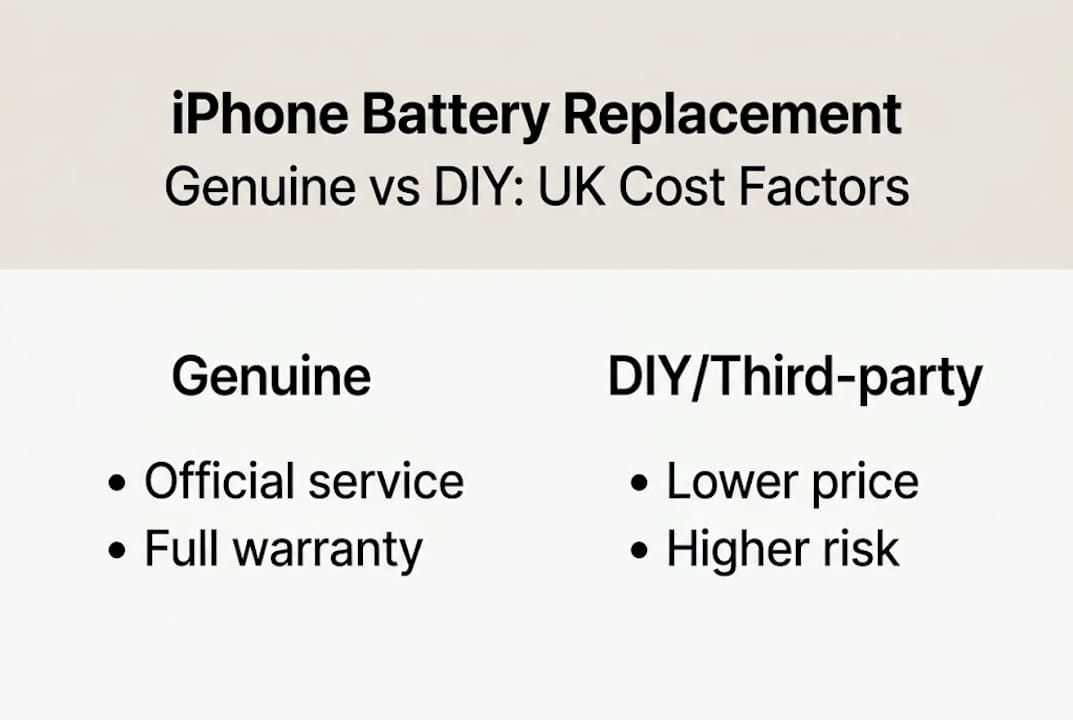
Who does the repair matters just as much. Apple Authorised Service Providers charge structured rates tied to Apple’s pricing. Independent shops set their own prices, often lower, but with variable quality. DIY sits at the bottom of the cost ladder but at the top of the risk scale.
Here’s a quick breakdown of the main factors:
- Warranty and AppleCare+ status: If you have AppleCare+, a battery below 80% health is replaced free of charge
- Parts quality: Genuine Apple batteries versus aftermarket alternatives affect both price and phone performance
- VAT and diagnostic fees: Some shops add diagnostics charges or shipping costs on top of the advertised price
- Geographic availability: Not every town has an Apple Store, which can mean travel costs or postal service fees
- Consumer law protections: UK law requires repairers to stand behind their workmanship, which adds a layer of accountability worth factoring in
Apple’s official out-of-warranty pricing for UK battery replacements runs from £79 to £119 depending on the model. That’s a meaningful range, and it doesn’t include what third-party shops or DIY options cost. For a deeper look at how this plays out on a specific older model, see our breakdown of iPhone 11 battery replacement pricing.
The condition of your existing battery also affects urgency. A battery dropping to 79% health will throttle your phone’s performance automatically, a feature Apple introduced after the throttling controversy in 2017. At that point, replacement stops being optional and becomes necessary.
Apple official battery replacement: Prices and warranty impact
Apple’s official service is the gold standard for iPhone battery replacement, and it comes with a price tag to match. Here’s what the current 2026 pricing looks like for key models in the UK:
| iPhone model | Out-of-warranty cost |
|---|---|
| iPhone 16 series | £109 |
| iPhone 17 base | £99 |
| iPhone 15 series | £95 |
| iPhone 14 series | £89 |
| iPhone 13 series | £85 |
| iPhone 12 and older | £79 |
These figures reflect Apple’s current UK pricing, where out-of-warranty replacements range from £79 to £119 and AppleCare+ covers the swap at no extra cost if battery capacity drops below 80%.
A battery replacement from Apple uses a genuine part, preserves your warranty, and typically comes with a 90-day service warranty on the repair itself, or the remainder of your Apple warranty, whichever is longer.
For historical context on what Apple used to charge and how pricing has shifted, our overview of official Apple battery prices covers earlier models in detail.
What you’re actually paying for includes calibrated battery health reporting in iOS, a genuine Apple-grade cell with accurate capacity specs, and the reassurance that your device warranty remains intact. Apple technicians also run diagnostics on the device before and after, which occasionally surfaces other issues.
Pro Tip: Book your Apple repair online in advance rather than walking in. Same-day appointments are often unavailable at busy stores, and postal repair services can add three to five business days. Planning ahead avoids extended downtime.
The main drawbacks are cost and wait time. At £109 for an iPhone 16, you’re paying a premium. And if you’re replacing an iPhone 8 battery on a device worth perhaps £80 secondhand, the maths becomes harder to justify through Apple’s official channel.
Third-party and retail battery replacement: Savings and trade-offs
Beyond Apple, the independent repair market in the UK is large and varied. High-street shops, national chains, and local technicians all offer battery replacement, often at significantly lower prices.
Typical pricing from independent repairers tends to fall in the £25 to £60 range depending on model and location. That’s a meaningful saving over Apple’s rates, but the trade-offs are real.
| Factor | Apple official | Third-party shop |
|---|---|---|
| Parts quality | Genuine Apple | Aftermarket or refurbished |
| Price range | £79 to £119 | £25 to £60 |
| Turnaround time | 1 to 3 days | Often same-day |
| Warranty impact | Preserved | Potentially voided |
| Health reporting in iOS | Accurate | May show warning |
| Consumer law protection | Yes | Yes |
Non-genuine batteries often don’t report accurate health percentages in iOS and may trigger a warning message in your battery settings. This doesn’t always mean the battery performs poorly, but it does mean you lose one of iOS’s most useful diagnostic tools.
For a broader evaluation of your options, our third-party repair comparisons cover what to look for in a reliable independent repairer.
Here’s what to check before choosing an independent shop:
- Ask specifically whether they use genuine or aftermarket parts
- Confirm the warranty they offer on the repair itself
- Check whether VAT is included in the quoted price
- Verify they’re familiar with your specific iPhone model
One underappreciated advantage of independent shops is speed. Many complete battery swaps within an hour while you wait, which is genuinely useful if you can’t be without your phone for days. On the protection side, UK consumer rights require repairers to fix or refund faulty workmanship, so you’re not entirely without recourse if something goes wrong.
DIY battery replacement: Cheapest route, highest risks
For those who are comfortable with tools and don’t mind taking a calculated risk, DIY battery replacement is the cheapest route available. But it’s worth being honest about what’s involved before you start.
Here’s a realistic cost breakdown for a typical DIY iPhone battery swap:
- Replacement battery: £8 to £20 depending on model and supplier quality
- Tool kit (pentalobe screwdriver, suction cup, spudger, opening picks): £5 to £15 if you don’t already own them
- Adhesive strips: Often included with the battery kit, but worth confirming
- Your time: Expect 30 to 90 minutes for a first attempt, depending on the model
Total cost: roughly £13 to £35, which is significantly cheaper than any professional service.
DIY carries the highest risk of any replacement route, and is best suited to experienced users following guides from sources like iFixit. For detailed step-by-step scenarios on specific models, our DIY cost scenarios article is worth reading before you start.
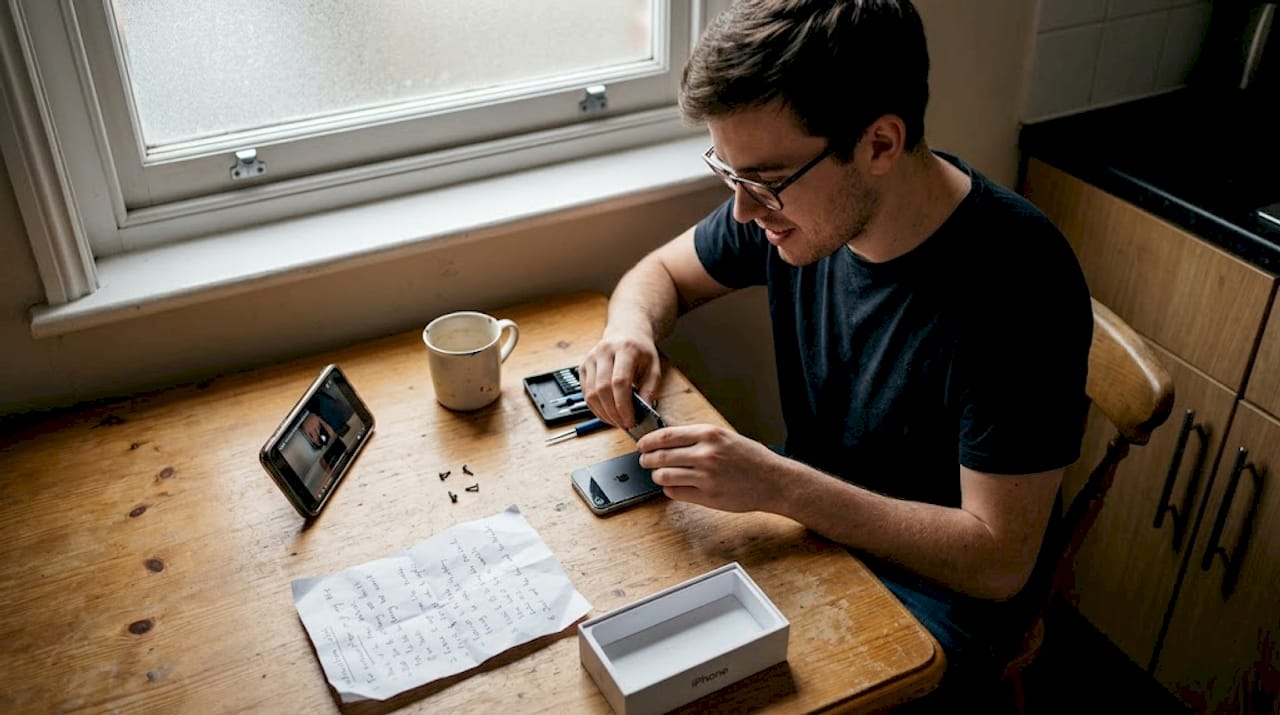
The risks are not trivial. You could tear a flex cable during disassembly, crack the rear glass on newer models, or puncture the battery itself, which is a genuine fire hazard. Apple’s warranty is voided the moment you open the phone without authorisation. And as with third-party repairs, the replacement battery is unlikely to report health data accurately in iOS.
Pro Tip: If you’re attempting a DIY battery swap, watch at least two full video guides for your exact iPhone model before touching your phone. The process varies significantly between generations, and knowing where the adhesive pull tabs sit before you begin can prevent the most common mistakes.
DIY makes the most sense for older iPhones that are out of warranty, particularly models from iPhone 7 onwards where repair guides are mature and well-documented. If your device is still under warranty or you rely on it for work, the cost saving rarely justifies the risk.
Our take: What most guides miss about iPhone battery costs
Most cost comparisons stop at the headline price. They list Apple at £109 and a local shop at £40 and call it a saving. But that framing misses several things that actually matter.
Consider resale value. A phone with a documented Apple battery replacement retains more value than one with an unknown aftermarket cell. If you plan to sell your iPhone in the next year, that £69 difference shrinks considerably once you factor in what a buyer will pay.
Consider downtime risk. A botched third-party repair or a DIY mistake can turn a £40 job into a £200 problem. Most people underestimate this probability until it happens to them.
And consider the hidden cost of unreliable battery health data. If your battery isn’t reporting correctly, you lose the early warning system that tells you when performance throttling is about to kick in. That’s not just an inconvenience; it affects how you manage your device day to day.
The right choice genuinely depends on your phone’s age and how long you intend to keep it. For a two-year-old iPhone you plan to sell next year, Apple’s official service is probably worth it. For a five-year-old handset you’re running into the ground, a quality third-party replacement or careful DIY makes more sense. Our article on long-term phone value explores this trade-off in more detail.
Get your iPhone battery replaced with confidence
If you’ve worked through the options and want a reliable source for quality parts, Buy2fix stocks a comprehensive range of iPhone battery replacements for models from the iPhone 6 series right through to the latest iPhone 17. All parts go through quality checks before dispatch, and free UK mainland shipping means the price you see is the price you pay. Whether you’re a seasoned technician or a careful DIY enthusiast, you’ll find trusted iPhone battery replacement parts backed by a one-year warranty and a 30-day returns policy. Browse the full range and get your iPhone running at full capacity again.
Frequently asked questions
Is it worth replacing your iPhone battery or buying a new phone?
Replacing your battery is almost always cheaper than a new handset and can add two or more years to your device’s useful life, making it the more practical and cost-effective choice for most users.
Will a third-party battery show correct health information in iOS?
Non-genuine batteries typically do not report accurate battery health percentages in iOS, and many trigger a warning message in the battery settings menu.
Can a faulty iPhone battery replacement be fixed under consumer law in the UK?
Yes. UK consumer law requires repairers to rectify faulty workmanship or defective parts, giving you a legal route to redress regardless of which repairer you use.
Is DIY battery replacement safe for most iPhone users?
DIY battery swaps carry a meaningful risk of device damage and warranty loss, and are only recommended for users who have prior experience with phone repairs and access to proper tools.
Recommended
Let customers speak for us
item was packaged safely, no damage. it’s now October and since replacing it in January i’ve had no issues.

Great

They had what I was looking for ... ordering was easy, payment was easy, delivery was as promised.
-

Absolutely love this case! Heavy, sturdy and full coverage

Thank You! I really love it! 😊

For Garmin Forerunner 165 20mm Two Color Textured Silicone Watch Band(Teal)

For Samsung Galaxy S26+ 5G R-JUST Sliding Camera Life Waterproof Holder Phone Case(Black)

I ❤️ love it, it's absolutely amazing I'm sooo happy 😊

Great

I saw this item and it was just what I was looking for. I found it here but not in Amazon or e-bay. However, it was in UK, I was surprised to find that they were able to ship it to the US. Excellent company, would do business with again

This is great for when out and about, to sharpen either coloured pencils, or watercolour pencils….would order again.

Great items would bye again

I have purchased several items from this store before. Recently, I encountered an issue with my latest order. After reporting the problem to customer support, they were consistently attentive and made every effort to resolve the situation. Upon investigation, they acknowledged the issue and promptly fixed it. This experience has increased my level of trust in this store.
Thank you so much. I'm so happy.
