


News
How much is an iPhone 11 battery replacement in 2026
Confusion surrounds iPhone 11 battery replacement pricing in the UK, with quotes ranging from under £40 to well over £100 depending on battery quality, supplier, and installation method. Many DIY enthusiasts and small repair businesses struggle to navigate the maze of OEM versus aftermarket options, professional service costs, and quality assurance standards. This guide cuts through the uncertainty by breaking down actual 2026 UK pricing, battery type differences, symptom recognition, and the critical decision between DIY and professional replacement, giving you the clarity needed to make cost-effective, quality-driven choices.
Table of Contents
- Understanding iPhone 11 Battery Types And Pricing Factors
- How Much Does An iPhone 11 Battery Replacement Cost In The UK In 2026?
- Common Symptoms Indicating An iPhone 11 Battery Needs Replacement
- Choosing Between DIY And Professional iPhone 11 Battery Replacement
- Get Quality iPhone 11 Batteries And Repair Supplies From Buy2Fix
- Frequently Asked Questions About iPhone 11 Battery Replacement Costs
Key takeaways
| Point | Details |
|---|---|
| Cost range | UK battery replacement typically costs £40-£80 for parts, with professional labour adding £30-£60 in 2026 |
| Battery types | OEM batteries offer superior reliability but cost more than aftermarket or refurbished alternatives |
| Warning signs | Rapid battery drain, unexpected shutdowns, and overheating indicate replacement needs |
| DIY vs professional | DIY saves money but risks warranty voiding and component damage, while professional service ensures quality |
| Quality matters | Higher capacity batteries and extended warranties justify premium pricing for long-term value |
Understanding iPhone 11 battery types and pricing factors
The iPhone 11 battery market presents three distinct options, each with unique cost and performance characteristics. OEM batteries are generally more reliable but costlier than aftermarket alternatives typically used in UK repairs. Original Equipment Manufacturer batteries match Apple’s specifications precisely, delivering 3110 mAh capacity and maintaining optimal performance throughout their lifecycle. Aftermarket batteries vary widely in quality, with reputable manufacturers offering comparable capacity at reduced prices whilst budget options may underdeliver on promised specifications.
Refurbished batteries occupy a middle ground, sourced from recycled devices and tested for functionality. These units typically cost 20-30% less than new OEM batteries but carry shorter warranties and potentially reduced cycle counts. Battery capacity, measured in milliampere-hours, directly influences both performance and pricing. Higher mAh ratings enable longer usage between charges, justifying premium costs for users demanding maximum uptime.
Warranty coverage significantly impacts buyer confidence and long-term value. Quality suppliers offer 12-month guarantees on replacement batteries, protecting against premature failure and manufacturing defects. Budget batteries often lack meaningful warranty support, leaving buyers vulnerable to additional replacement costs if issues arise. Testing procedures and quality certifications further differentiate premium from budget options, with reputable suppliers conducting rigorous capacity and safety checks before shipping.
Pro Tip: Always verify actual mAh capacity rather than relying solely on advertised specifications, as some aftermarket batteries overstate their true performance capabilities.
Typical UK market pricing in 2026 reflects these quality tiers clearly:
- OEM specification batteries: £55-£80
- Premium aftermarket batteries: £40-£60
- Budget aftermarket batteries: £25-£40
- Refurbished batteries: £30-£50
Quality expectations align with pricing, where premium options deliver consistent performance matching or exceeding original Apple batteries, whilst budget alternatives may exhibit reduced longevity and inconsistent charging behaviour. Understanding these fundamental differences enables informed purchasing decisions that balance immediate cost savings against long-term reliability and performance requirements.
How much does an iPhone 11 battery replacement cost in the UK in 2026?
UK retail prices for iPhone 11 battery replacement vary but typically fall between £40 and £80 for parts, with professional labour adding to total cost. Professional repair services charge comprehensive fees covering parts, labour, testing, and warranty support. High street repair shops typically quote £70-£120 for complete battery replacement, whilst authorised service providers command premium rates of £90-£140 for guaranteed Apple-certified components and workmanship.

DIY battery replacement dramatically reduces costs by eliminating labour charges. Online suppliers offer complete battery kits including necessary tools for £35-£65, representing savings of 40-60% compared to professional services. However, tool investment adds initial expense for first-time repairers. Essential equipment includes pentalobe and tri-point screwdrivers, spudgers, suction cups, and adhesive strips, collectively costing £15-£25 for quality toolsets.
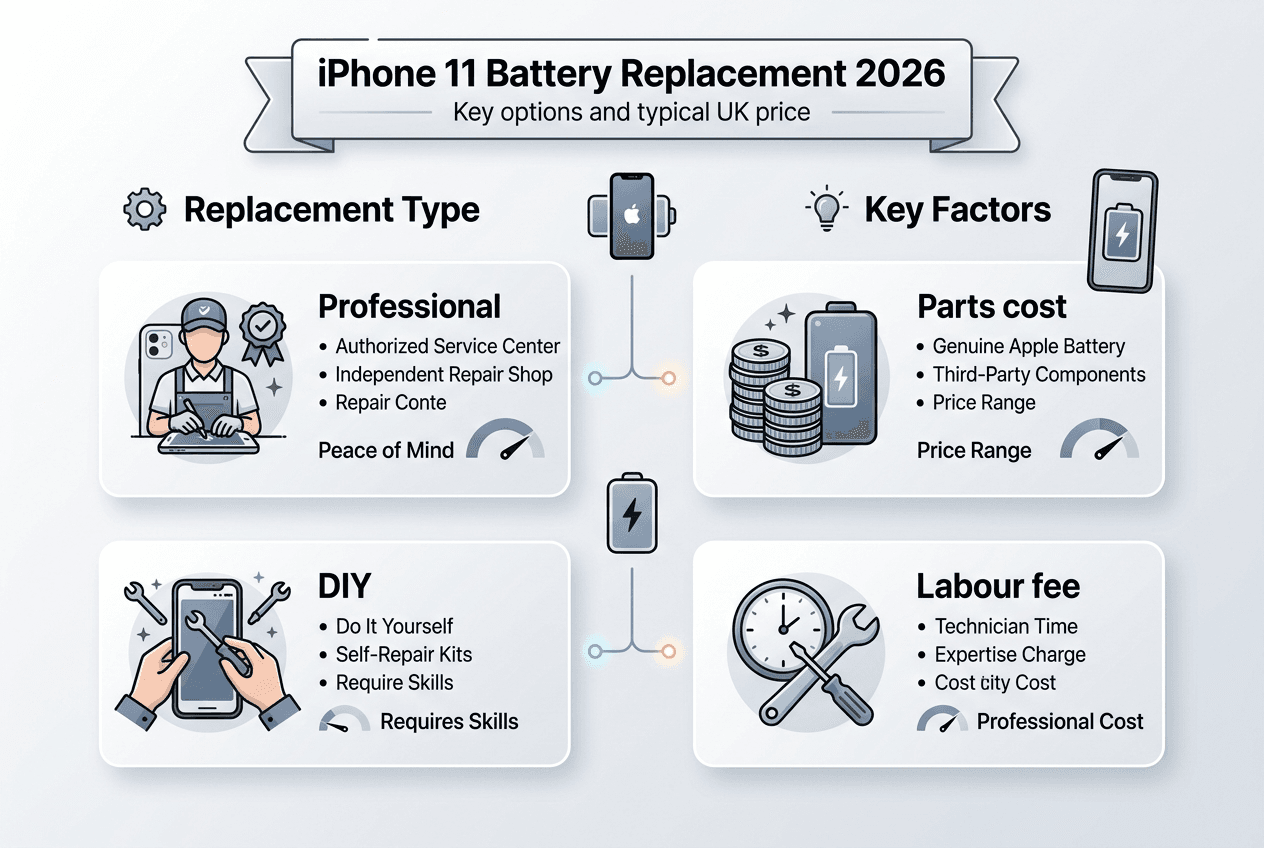
Labour costs for professional replacement reflect skill, time, and overhead expenses. Experienced technicians complete battery swaps in 30-45 minutes, charging £30-£60 for their expertise. This fee covers careful disassembly, adhesive removal, battery installation, and comprehensive testing to verify proper functionality. Premium service providers include additional value through extended warranties and post-repair support.
| Replacement Method | Parts Cost | Labour/Tools | Total Cost | Warranty | | — | — | — | — | | Professional (high street) | £40-£60 | £30-£50 | £70-£110 | 3-6 months | | Professional (authorised) | £60-£80 | £30-£60 | £90-£140 | 12 months | | DIY (first time) | £35-£65 | £15-£25 | £50-£90 | Varies | | DIY (experienced) | £35-£65 | £0 | £35-£65 | Varies |
Hidden costs warrant careful consideration when evaluating replacement options. Non-OEM batteries may void remaining Apple warranty coverage, potentially eliminating free repair eligibility for unrelated issues. Insurance policies sometimes exclude coverage for devices modified with third-party components, creating additional financial risk. Failed DIY attempts requiring subsequent professional repair effectively double total costs, negating initial savings.
Pro Tip: Calculate total cost of ownership over the battery’s expected lifespan rather than focusing solely on upfront purchase price, as premium batteries often deliver superior value through extended longevity.
Comparing UK iPhone 11 battery replacement prices against similar models provides useful context. The iPhone 8 battery replacement costs typically run £5-£15 lower due to smaller capacity requirements and simpler installation procedures. Conversely, newer models command premium pricing reflecting advanced technology and increased complexity.
Common symptoms indicating an iPhone 11 battery needs replacement
Typical indicators of battery wear include rapid battery drain, unexpected shutdowns, and poor charging performance. Healthy iPhone 11 batteries maintain 80% capacity after 500 complete charge cycles, roughly equivalent to 18-24 months of typical usage. Degradation beyond this threshold manifests through progressively worsening symptoms that disrupt daily device functionality.
Rapid battery depletion represents the most common warning sign, where full charges barely last half a typical usage day. Users notice their device requiring midday charging despite previously lasting until evening. This accelerated drain stems from reduced chemical capacity within degraded battery cells, limiting total energy storage despite showing 100% charge status.
Unexpected power-offs occur when battery voltage drops below minimum operating thresholds, even with substantial charge percentage remaining. The device suddenly shuts down at 20-40% battery level, then displays critically low battery warnings upon restart. These shutdowns intensify during processor-intensive tasks or cold weather conditions, where power demands exceed degraded battery capabilities.
Additional symptoms indicating replacement needs:
- Device overheating during charging or routine usage
- Charging cycles taking significantly longer than original specifications
- Battery percentage jumping erratically between different levels
- Physical battery swelling causing screen separation or back cover bulging
- iOS displaying “Service” recommendation in battery health settings
Checking battery health through iOS settings provides objective degradation assessment. Navigate to Settings, then Battery, then Battery Health to view maximum capacity percentage and peak performance capability status. Maximum capacity below 80% strongly indicates replacement needs, whilst “Peak Performance Capability” warnings confirm the system has detected significant degradation affecting device operation.
Early detection enables proactive replacement scheduling, avoiding inconvenient failures during critical usage periods. Monitoring battery health quarterly helps identify gradual degradation trends before they severely impact functionality. Timely replacement preserves device resale value and prevents potential safety issues associated with swollen or damaged batteries. Delaying replacement risks cascading problems including motherboard damage from battery swelling or complete device failure requiring costlier comprehensive repairs.
Choosing between DIY and professional iPhone 11 battery replacement
DIY replacements save money but carry risks related to complexity and warranty voiding, whilst professional services cost more but ensure quality and safety. Evaluating personal technical capability honestly determines appropriate replacement approach. The iPhone 11’s construction requires careful handling of delicate components and precise reassembly to maintain water resistance and structural integrity.
DIY replacement readiness assessment:
- Previous electronics repair experience, particularly with adhesive removal and small connector handling
- Access to proper workspace with adequate lighting and anti-static precautions
- Patience for methodical disassembly following detailed repair guides
- Willingness to accept responsibility for potential component damage
- Comfort working without warranty protection or professional recourse
Risks associated with DIY battery replacement extend beyond simple installation errors. Damaging fragile display connectors during disassembly renders screens non-functional, requiring costly additional repairs. Puncturing lithium batteries during removal creates fire hazards and releases toxic chemicals. Improper adhesive application compromises water resistance, leaving devices vulnerable to moisture damage. Stripped screws or broken clips prevent proper reassembly, potentially leaving devices permanently damaged.
Battery disposal presents environmental and legal obligations often overlooked by DIY repairers. UK regulations classify lithium batteries as hazardous waste requiring proper recycling through authorised collection points. Improper disposal through household rubbish violates environmental protection laws and creates safety risks. Professional services handle disposal compliance automatically, eliminating this burden from customers.
Professional replacement advantages:
- Experienced technicians minimise component damage risks
- Warranty coverage protects against installation defects
- Proper testing verifies complete functionality post-replacement
- Compliance with safety regulations and disposal requirements
- Preservation of water resistance through correct adhesive application
| Consideration | DIY Replacement | Professional Service |
|---|---|---|
| Cost | £35-£90 total | £70-£140 total |
| Time required | 60-90 minutes | 30-45 minutes |
| Warranty coverage | Component only | Full service warranty |
| Damage risk | Moderate to high | Minimal |
| Skill requirement | Intermediate to advanced | None |
Cost savings calculations must account for potential rework expenses. Failed DIY attempts requiring professional correction effectively double total costs, negating initial savings. Conservative estimates suggest 15-20% of first-time DIY battery replacements encounter complications requiring professional intervention. Experienced repairers with proper tools and workspace reduce this risk substantially.
Pro Tip: Source batteries and tools from reputable UK suppliers offering quality guarantees and technical support, as cheap components from unknown sellers frequently fail prematurely or arrive with incorrect specifications.
Sourcing considerations for DIY projects prioritise supplier reputation and component quality verification. Established retailers provide detailed specifications, compatibility confirmation, and responsive customer service. Reading verified customer reviews identifies suppliers consistently delivering quality components versus those shipping substandard products. Checking return policies and warranty terms protects against receiving defective batteries.
Professional service selection requires similar diligence. Requesting quotes from multiple providers reveals market rates and identifies unusually high or suspiciously low pricing. Verifying technician certifications and business credentials ensures qualified service delivery. Reading recent customer reviews highlights service quality, turnaround times, and warranty claim handling. Comparing professional iPhone 11 repair services against DIY iPhone 11 repairs guide resources clarifies realistic expectations for both approaches.
Get quality iPhone 11 batteries and repair supplies from Buy2Fix
Buy2Fix serves UK DIY enthusiasts and repair businesses with quality iPhone 11 batteries and comprehensive repair supplies. Our extensive inventory includes OEM specification batteries, premium aftermarket options, and complete toolkit bundles designed specifically for iPhone 11 servicing. Every battery undergoes rigorous capacity testing and quality verification before shipping, ensuring reliable performance matching or exceeding original specifications.
Free UK mainland shipping eliminates delivery costs, whilst our 30-day return policy and one-year warranty provide confidence in every purchase. Professional repair businesses benefit from bulk pricing and priority support, whilst DIY repairers access detailed installation guides and technical assistance. Browse our complete range of iPhone components, tools, and accessories at Buy2Fix UK repair supplies, where quality meets affordability. Our battery replacement cost guide offers additional insights for informed purchasing decisions.
Frequently asked questions about iPhone 11 battery replacement costs
What is the average cost to replace an iPhone 11 battery in the UK?
Typical costs range from £70-£110 for professional replacement including parts and labour, whilst DIY approaches cost £35-£65 for battery and tools. Premium authorised service providers charge £90-£140 but include extended warranties and guaranteed Apple-certified components. Budget options exist below these ranges but often compromise quality or warranty coverage.
How does battery quality affect replacement pricing?
OEM specification batteries command premium prices of £55-£80 due to guaranteed capacity, longevity, and safety certifications, whilst aftermarket alternatives range from £25-£60 depending on manufacturer reputation and specifications. Higher quality batteries deliver consistent performance throughout their lifecycle, justifying increased upfront costs through extended replacement intervals. Budget batteries may initially function adequately but typically degrade faster, requiring more frequent replacement.
Will replacing my iPhone 11 battery with aftermarket parts void my warranty?
Apple warranty coverage typically excludes devices modified with non-Apple components, potentially voiding eligibility for free repairs on unrelated issues. However, UK Consumer Rights Act 2015 protections remain intact regardless of third-party repairs. After Apple’s standard warranty expires, using quality aftermarket batteries presents no warranty concerns. Professional installers using certified components sometimes maintain limited warranty coverage through careful documentation.
How long should a replacement iPhone 11 battery last?
Quality replacement batteries typically deliver 500-800 complete charge cycles before dropping below 80% capacity, equivalent to 18-30 months of typical usage patterns. Premium batteries with higher quality cells and proper installation often exceed these expectations, whilst budget alternatives may degrade within 12-18 months. Usage patterns significantly influence longevity, where heavy users experience faster degradation than occasional users.
Can I replace my iPhone 11 battery myself safely?
Experienced DIY repairers with proper tools and workspace can safely replace iPhone 11 batteries following detailed guides, though risks include component damage, warranty voiding, and safety hazards from punctured batteries. First-time repairers should carefully assess their technical capabilities and comfort with delicate electronics work. Professional replacement eliminates these risks whilst providing warranty protection and guaranteed functionality.
What tools do I need for DIY iPhone 11 battery replacement?
Essential tools include pentalobe and tri-point screwdrivers for case and battery connector screws, plastic spudgers for safe prying, suction cups for screen removal, and replacement adhesive strips for reassembly. Quality toolkit bundles cost £15-£25 and include all necessary implements plus optional items like tweezers and anti-static mats. Investing in proper tools significantly reduces damage risks and improves installation success rates.
Recommended
Let customers speak for us
item was packaged safely, no damage. it’s now October and since replacing it in January i’ve had no issues.

Great

They had what I was looking for ... ordering was easy, payment was easy, delivery was as promised.
-

Absolutely love this case! Heavy, sturdy and full coverage

Thank You! I really love it! 😊

For Garmin Forerunner 165 20mm Two Color Textured Silicone Watch Band(Teal)

For Samsung Galaxy S26+ 5G R-JUST Sliding Camera Life Waterproof Holder Phone Case(Black)

I ❤️ love it, it's absolutely amazing I'm sooo happy 😊

Great

I saw this item and it was just what I was looking for. I found it here but not in Amazon or e-bay. However, it was in UK, I was surprised to find that they were able to ship it to the US. Excellent company, would do business with again

This is great for when out and about, to sharpen either coloured pencils, or watercolour pencils….would order again.

Great items would bye again

I have purchased several items from this store before. Recently, I encountered an issue with my latest order. After reporting the problem to customer support, they were consistently attentive and made every effort to resolve the situation. Upon investigation, they acknowledged the issue and promptly fixed it. This experience has increased my level of trust in this store.
Thank you so much. I'm so happy.
