

What Are Smart Wearables and Why They Matter
Repairing a smartwatch or smart ring can quickly turn from a simple fix into a delicate puzzle, especially when devices stop working without obvious cause. Knowing how smart wearables actually work and understanding their frequent failures gives UK DIY enthusiasts and small shop owners a clear advantage. Here, you will uncover the real capabilities and limitations of smart wearables, common myths, and key repair considerations, backed by practical insights from leading research.
Table of Contents
- Defining Smart Wearables And Common Myths
- Key Types: Watches, Rings, Glasses, And More
- How Modern Smart Wearables Actually Work
- Major Benefits And Real-World Applications
- Risks, Data Privacy, And Common Pitfalls
- Your Responsibility As A Repair Professional
Key Takeaways
| Point | Details |
|---|---|
| Understanding Smart Wearables | Smart wearables are advanced devices that continuously monitor health data, offering personalised insights rather than clinical diagnoses. |
| Addressing Common Myths | While wearables enhance health awareness, they are not substitutes for professional medical advice; understanding their limitations is crucial. |
| Repair Insights | Repair professionals should be aware of common failures and prioritise inventory based on device type and user needs for effective servicing. |
| Data Privacy Considerations | Ensuring customer data protection during repairs is essential; establish protocols for handling sensitive health information. |
Defining Smart Wearables and Common Myths
Smart wearables are electronic devices worn on your body that continuously collect real-time health and activity data. Think of them as miniature computers that track everything from your heart rate to your sleep patterns while you go about your day.
Unlike traditional fitness trackers, smart wearables integrate computing power with physiological sensors. They’re not just glorified step counters—they actively process information and help you make informed decisions about your health and fitness.
What Smart Wearables Actually Do
Smart wearables collect vital physiological data by monitoring metrics continuously throughout your day:
- Heart rate and heart rate variability
- Sleep quality and duration
- Body temperature and skin conductance
- Activity levels and movement patterns
- Blood oxygen saturation (SpO2)
- Stress levels and recovery metrics
These devices operate across multiple sectors beyond health. Sports professionals use them for performance optimisation, manufacturers monitor worker fatigue, and educators track student engagement. The versatility is remarkable.
Common Myths About Smart Wearables
There’s significant confusion around what these devices can and cannot do. Let’s address the biggest misconceptions head-on:
Myth 1: They diagnose medical conditions. Smart wearables provide data, not clinical diagnoses. Your smartwatch can track your heart rate, but only a qualified doctor can diagnose atrial fibrillation.
Myth 2: They’re completely private. Data collected by wearables often syncs to cloud servers. Your personal health information travels digitally, meaning privacy concerns are legitimate. Always check manufacturer privacy policies.
Myth 3: More sensors mean better accuracy. Adding sensors doesn’t guarantee better results. A device with properly calibrated sensors outperforms one with numerous poorly-engineered sensors.
Myth 4: They work without proper setup. Wearables require correct wearing position, regular charging, and periodic recalibration. Careless users get poor data.
Smart wearables enhance your health awareness, but they’re tools for personal insight, not medical devices or replacement for professional healthcare advice.
Why Repair and Customisation Matter
As a DIY enthusiast or repair shop owner, understanding wearable internals opens revenue opportunities. Many users damage screens, battery connections, or sensors. Understanding the difference between smartwatches and smart rings helps you identify which components fail most frequently and which repairs generate repeat business.
Wearables contain delicate flex cables, tiny sensors, and proprietary connectors. One wrong move during repair destroys the device. Quality replacement parts and careful technique are essential.
Pro tip: Before accepting any wearable repair, photograph the device from multiple angles and document which functions work. This protects your reputation and helps diagnose hidden component failures.
Key Types: Watches, Rings, Glasses, and More
Smart wearables come in multiple form factors, each designed for different purposes and wearing positions. Understanding these distinctions helps you identify which devices appeal to your customers and which components they’re likely to need repaired.
Smartwatches: The Most Popular Category
Smartwatches dominate the wearables market because they combine visibility, processing power, and versatility. Worn on the wrist like traditional watches, they display notifications, track fitness metrics, and run applications.
These devices pack impressive tech into a compact space:
- Full-colour touchscreen displays
- Multiple sensors (accelerometer, gyroscope, heart rate, SpO2)
- Battery life ranging from 1 to 14 days depending on model
- Water resistance for swimming and water sports
- Independent connectivity (Wi-Fi, Bluetooth, cellular options)
As a repair professional, smartwatches generate consistent work. Screen damage, battery degradation, and charging port failures are common issues. Understanding smartwatch functionality helps diagnose problems quickly.
Smart Rings: Discreet and Precise
Smart rings represent the subtle end of wearables. These small band-like devices sit on your finger and track biometric data without drawing attention.
Rings excel at collecting accurate health data because they rest directly against the skin. They monitor heart rate, body temperature, sleep quality, and stress levels with minimal user interaction required.
Key advantages for users:
- Minimal battery drain (7 to 10 days per charge)
- Subtle appearance for professional settings
- Compact size means fewer moving parts to break
- Lightweight and comfortable for continuous wear
Repair work on rings differs significantly from watches. They contain fewer components, but those components are tightly integrated. Replacing a battery in a smart ring requires precision and proper tools.
Smart Glasses: Augmented Reality and Beyond
Smart glasses feature head-mounted displays capable of overlaying digital information onto your real-world view. They’re the most complex wearables in terms of functionality and engineering.

These devices handle computing tasks beyond simple data collection. They run applications, stream video, enable video calls, and support augmented reality experiences.
What makes smart glasses unique:
- Optical display technology (holographic or waveguide lenses)
- Onboard processors handling heavy computation
- High power consumption requiring daily charging
- Voice and gesture controls as primary interfaces
- Camera systems for capturing perspective-view content
Other Wearable Types
Beyond the primary three categories, wearable technologies comprise diverse form factors including smart textiles, ear-worn devices, and body patches. Each serves specific applications across health, fitness, industry, and communication sectors.
Ear-worn wearables track audio input whilst monitoring heart rate and body temperature. Smart textiles embed sensors directly into fabrics for continuous biometric monitoring. Body patches provide temporary health monitoring without requiring a dedicated device.
The wearable market continues fragmenting into specialised form factors. Your repair shop succeeds by understanding which device types your customers own and stocking appropriate replacement components.
Pro tip: Create a reference chart documenting which sensors and components fail most frequently in each wearable type you repair—this helps you maintain focused inventory and predict customer needs.
Here is a comparison of major smart wearable types and typical repair considerations:
| Wearable Type | Typical Use Case | Most Common Repair Need | Notes for Technicians |
|---|---|---|---|
| Smartwatch | Fitness & notifications | Screen and battery replacement | Multiple sensors, requires careful reassembly |
| Smart Ring | Discreet health tracking | Battery replacement | Components are compact and tightly integrated |
| Smart Glasses | Augmented reality tasks | Display or camera issues | Delicate optics, specialist tools often required |
| Ear-worn Device | Audio & biometrics | Battery or connector issues | Miniaturised parts, risk of speaker damage |
How Modern Smart Wearables Actually Work
Smart wearables operate through a coordinated system of sensors, processors, and communication channels working together seamlessly. Understanding this architecture helps you diagnose problems and identify which components fail most frequently in your repair work.
The Sensor Foundation
Everything starts with sensors—tiny electronic components that detect physical changes in the user’s body and environment. These sensors continuously gather raw data without requiring conscious input from the wearer.
Common sensors in smart wearables:
- Accelerometers detect movement and orientation changes
- Gyroscopes measure rotational motion and body position
- Heart rate sensors use light reflection to count pulses
- Temperature sensors monitor skin and core temperature
- Pressure sensors measure altitude and barometric changes
- Electrocardiogram sensors capture electrical heart signals
These components are extremely delicate. Dropping a smartwatch or applying excessive pressure can misalign sensors permanently, resulting in inaccurate readings that frustrate users. Sensor replacement often requires specialist tools and calibration.
Data Processing: Local versus Cloud
Smart wearables integrate machine learning and edge computing to make sense of sensor data in real time. Some processing happens directly on the device, whilst other analysis occurs remotely on manufacturer servers.
On-device processing offers advantages:
- Faster response times (no network delay)
- Improved battery efficiency
- Better privacy protection
- Works offline without internet connectivity
Cloud processing handles complex analysis requiring significant computational power. Your device sends encrypted data to servers that run sophisticated algorithms, then return personalised insights and recommendations.
Communication Networks
Connectivity is the nervous system of wearables. Devices use multiple communication technologies depending on context and power constraints.
Primary connectivity options:
- Bluetooth Low Energy (BLE) for efficient short-range communication with phones
- Wi-Fi for faster data transfer and updates
- Cellular connectivity for independent operation without smartphones
- NFC (near-field communication) for contactless payments
Bluetooth connectivity accounts for a significant portion of wearable failures. Poor connections often stem from damaged antenna flex cables or corroded charging contacts. These components are difficult to repair without specialist equipment.
The Complete Data Pipeline
Sensor data flows through integrated hardware, software, and networked systems to deliver actionable insights. Here’s how the chain operates:
Sensors capture data → On-device processing → Local storage or cloud transmission → Analysis and pattern recognition → User feedback through app or device display.
Each stage introduces potential failure points. Battery degradation affects sensor accuracy. Corrupted storage fails to preserve data. Connectivity problems prevent cloud synchronisation. Processor failures disable all functionality.
Battery lifespan remains the critical limitation in wearables. Modern devices sacrifice processing power and sensor count to achieve multi-day battery life, creating a constant tension between capability and endurance.
Why This Matters for Your Repair Business
Understanding this architecture helps you stock the right replacement components. Damaged screens are obvious, but failed sensors, corroded charging ports, and battery swelling represent hidden revenue opportunities.
Many devices fail partially—the screen works but the heart rate sensor doesn’t, or connectivity drops intermittently. Diagnose accurately by testing each system independently.
Pro tip: When customers report intermittent issues like dropping Bluetooth connections or inconsistent heart rate readings, often the fault lies with corroded antenna connectors or contact pads rather than processor failure—test connectivity first before replacing expensive components.
Major Benefits and Real-World Applications
Smart wearables deliver tangible value across health, fitness, sports, and industrial sectors. Understanding these real-world applications helps you identify which customer segments will drive your repair business and which devices warrant premium service investment.
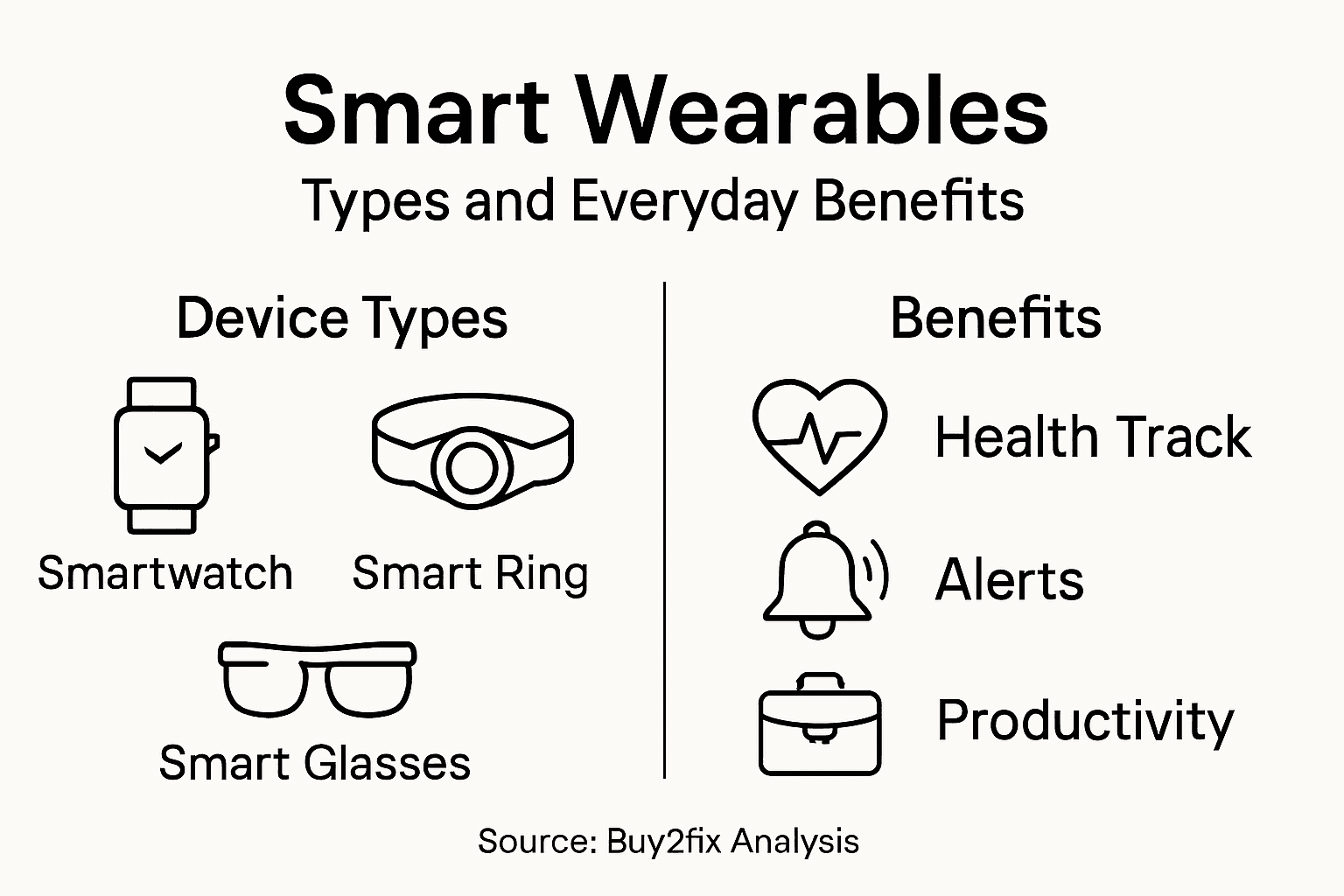
Health Monitoring and Disease Management
Smart wearables enable continuous health monitoring and preventative healthcare by tracking vital signs throughout your day without clinical appointments. Patients with chronic conditions receive early warning signals when their metrics drift outside safe ranges.
Specific health applications include:
- Cardiac monitoring for arrhythmia detection
- Diabetes management through glucose pattern analysis
- Sleep disorder diagnosis and improvement tracking
- Respiratory condition monitoring
- Post-surgery recovery observation
These applications create customer loyalty because failure means health risks. A patient relying on cardiac monitoring cannot simply abandon a broken smartwatch—they need immediate repair or replacement. This transforms wearable repair from convenience service into essential maintenance.
Fitness and Performance Optimisation
Fitness tracking remains the most visible wearable application. Amateur runners, cyclists, and gym enthusiasts use wearables to track training progress, optimise recovery, and prevent overtraining injuries.
Key fitness benefits:
- Real-time heart rate zones during exercise
- Training load management and adaptation
- Sleep quality monitoring for recovery assessment
- Calorie expenditure and nutrition tracking
- Motivation through achievement badges and social sharing
Fitness users replace devices frequently—typically upgrading every 18 to 24 months. However, they also repair damage aggressively rather than upgrading early. A cracked screen on a primary training device generates immediate repair requests.
Industrial and Workplace Safety
Manufacturers deploy wearables to monitor worker safety and productivity in hazardous environments. Devices track fatigue levels, environmental exposure, and fall detection for workers on elevated platforms.
Wearables reduce workplace accidents by alerting supervisors when workers show signs of fatigue or enter dangerous zones. This translates into reduced injuries, lower insurance premiums, and increased productivity for employers.
Education and Skill Development
Wearable technologies improve health outcomes and enhance user engagement across education and athletic training programs. Students learning anatomy benefit from augmented reality smart glasses showing interactive body systems. Athletes receive real-time coaching feedback through audio devices integrated into wearables.
Wearables create behaviour change by delivering personalised feedback at precise moments when users are most receptive—this relevance drives adoption and sustained engagement far beyond traditional devices.
Why Your Repair Shop Benefits
Different applications create different repair patterns. Health-focused customers prioritise rapid turnaround and data preservation. Fitness customers value cosmetic restoration. Industrial clients demand ruggedness and reliability testing after repair.
Understanding these applications helps you:
- Prioritise inventory based on customer demographics
- Develop specialised repair techniques for specific use cases
- Market services to corporate wellness programmes
- Build relationships with medical practices and sports clubs
Pro tip: Target your marketing towards fitness clubs and corporate wellness programmes rather than general consumers—these organisations have budgets for employee device repair and replacement, creating predictable recurring revenue streams.
Risks, Data Privacy, and Common Pitfalls
Smart wearables collect intimate health data continuously, creating significant privacy and security risks. As a repair professional, understanding these concerns helps you protect customer data and build trust within your business.
Data Privacy and Misuse Concerns
Significant ethical and privacy concerns exist regarding data security and corporate involvement with wearable data. Manufacturers collect biometric information—heart rate, location, sleep patterns, stress levels—that reveals deeply personal insights about user behaviour and health status.
Common privacy risks include:
- Third-party data sharing with insurance companies or employers
- AI profiling used to manipulate purchasing behaviour
- Inadequate data encryption during transmission and storage
- Indefinite data retention after device obsolescence
- Government access requests without proper warrants
- Data breaches exposing millions of users simultaneously
When customers bring devices for repair, they often forget data remains on the device. A simple screen replacement exposes your technician to sensitive health information. Establish clear protocols for data handling during repairs.
Security Vulnerabilities in Wearables
Wearables are notoriously difficult to secure because manufacturers prioritise battery life and ease of use over robust security. Many devices use outdated encryption protocols or transmit data over unencrypted connections.
Common security weaknesses:
- Weak authentication (simple PINs instead of biometric security)
- Unpatched firmware vulnerabilities manufacturers never address
- Insecure Bluetooth connections allowing interception attacks
- Manufacturing backdoors enabling unauthorised access
- Poor password management in companion mobile applications
Hackers exploit these vulnerabilities to intercept heart rate data, location tracking, and personal health information. Users often remain unaware their devices have been compromised for months.
Overreliance and Medical Risks
Safety and ethical issues include health risks from overreliance on technology accuracy. Wearables provide estimates, not clinical diagnoses, yet users often treat readings as absolute truth.
Critical pitfalls users face:
- Delaying professional medical consultation based on wearable readings
- Trusting inaccurate sleep or stress metrics for treatment decisions
- Ignoring genuine symptoms because wearable metrics appear normal
- Anxiety from false alerts suggesting abnormal heart rhythms
- Abandoning prescribed medications based on wearable data
Your customers may blame you when wearables deliver inaccurate results after repair. Always emphasise that wearables are tools for awareness, not medical devices.
Common User Mistakes
Many wearable failures stem from user negligence rather than manufacturing defects. Users fail to reset devices before selling or trading them, leaving personal data exposed to new owners. They use weak passwords on companion apps. They ignore security updates entirely.
Below is a summary of privacy and security pitfalls for wearables, highlighting user risk and technician focus:
| Risk Type | User Impact | Technician Attention Needed |
|---|---|---|
| Data Exposure | Loss of personal health information | Factory reset before repair |
| Weak Encryption | Potential for data interception | Advise on firmware updates |
| Forgotten Logins | Unauthorised access by new owners | Confirm logout post-repair |
| Overreliance on Data | Incorrect self-diagnosis | Educate users about limits |
Users often treat wearables as disposable gadgets despite the intimate personal data they contain—educating customers about data security transforms your repair service into a trusted health data custodian.
Your Responsibility as a Repair Professional
Protecting mobile data during repairs requires best practices that apply equally to wearables. Before accepting any device, require customers to reset it to factory settings or provide written consent to access their data.
Document everything. Create a data handling policy stating you do not access, store, or transmit customer health information. Back up this policy with secure procedures—never photograph screens displaying health metrics, never connect devices to public Wi-Fi, never share diagnostic information with unauthorised parties.
Pro tip: Develop a simple one-page “Data Privacy Agreement” customers sign before repairs—this protects your business legally whilst educating users about data risks and building confidence in your professional standards.
Enhance Your Smart Wearable Repairs with Expert Parts and Support
The article highlights the delicate and complex nature of smart wearables such as smartwatches, smart rings, and smart glasses. Common pain points include fragile screens, battery failures, sensor misalignments, and connectivity issues that demand precise repair skills and quality parts. At Buy2fix, we understand these challenges and provide a comprehensive range of specialised components from LCD screens to flex cables designed specifically for wearables and other smart technologies. Whether you are a DIY enthusiast or a professional technician, sourcing reliable replacement parts is critical to restoring device functionality and preserving customer trust.
Take control of your repair success by accessing high-quality smart wearable components at Buy2fix. Explore our extensive Smart Technology category for genuine and aftermarket parts that meet the exacting standards needed for repairing devices like smartwatches and smart rings. Don’t let damaged components or faulty sensors cause customer dissatisfaction—equip yourself with the finest parts and expert knowledge today. Visit Buy2fix now and secure the parts that power the wearable revolution.
Frequently Asked Questions
What are smart wearables?
Smart wearables are electronic devices worn on the body that continuously collect real-time health and activity data, such as heart rate, sleep patterns, and movement metrics.
How do smart wearables improve health monitoring?
Smart wearables enable continuous tracking of vital signs, providing early warning signals for chronic conditions, and assisting in preventative healthcare without needing frequent clinical appointments.
What are the main differences between smartwatches, smart rings, and smart glasses?
Smartwatches provide versatile functionality for notifications and fitness tracking, smart rings offer discreet health tracking, and smart glasses feature augmented reality capabilities alongside advanced computing tasks.
Why should users be concerned about data privacy with smart wearables?
Smart wearables collect sensitive health information, which can lead to privacy risks such as third-party data sharing and potential data breaches. Users should be aware of how their data is stored and transmitted.
Recommended
Let customers speak for us
The acid test of any company is how they respond when things go wrong. The Buy2Fix team were efficient in dealing with my emails and resolved the issue to my complete satisfaction

For Samsung Galaxy A26 SM-A266B Original Earpiece Speaker with Cable

Very good communication throught. Good product

Well made part very strong easy to fit great value for the money

Well packed, with fast shipping :)

Exactly what the doctor ordered…great color, comfort, and durability. Trust this watch band!

Brilliant strap, second purchase, bought bracelet before. Excellent value. Thank you

Great item for splitting your Audio signal

Outstanding product!
Next level customer service.

Very satisfied but the delivery needs to get more faster...

Good price,quick delivery

Best phone case ever! This is my second one as I broke my first. Would defo recommend

Great fitting Apple Watch bands

For Apple Watch Ultra 3 / 2 / 1 49mm RedPepper Armor Metal Case Integrated Silicone Watch Band(Steel Black White)

Good price and quick postage
