


1
/
of
7
No reviews
B877 3 Channel Personal Listener Headset Listening Mixer (Black)
B877 3 Channel Personal Listener Headset Listening Mixer (Black)
SKU: PC0220B
Regular price
£72.69
Regular price
Sale price
£72.69
Duties & Import Tax Information
Duties are only included if shown at checkout. Otherwise, your local government may apply customs fees, which your courier will collect directly from you before delivery.
In Stock
CHN
This item is shipped from China.
Processed in 0–3 days
Quantity
Couldn't load pickup availability
Shipping info
To find all available shipping methods and exact delivery times, add the product to your cart and check using our shipping calculator.
30-day returns
Fast refunds: Once we receive and check your item, we aim to process your refund within 48 hours.
Return postage: Just changed your mind? You'll need to cover the return postage. If the item arrived faulty, we'll cover the cost to get it back to us.
Your details are safe
We treat your data the way we'd want ours treated. Your payment details are locked down with bank-level encryption. We never actually see your credit card numbers, and we will absolutely never sell your personal information.
Product Details
About The Product
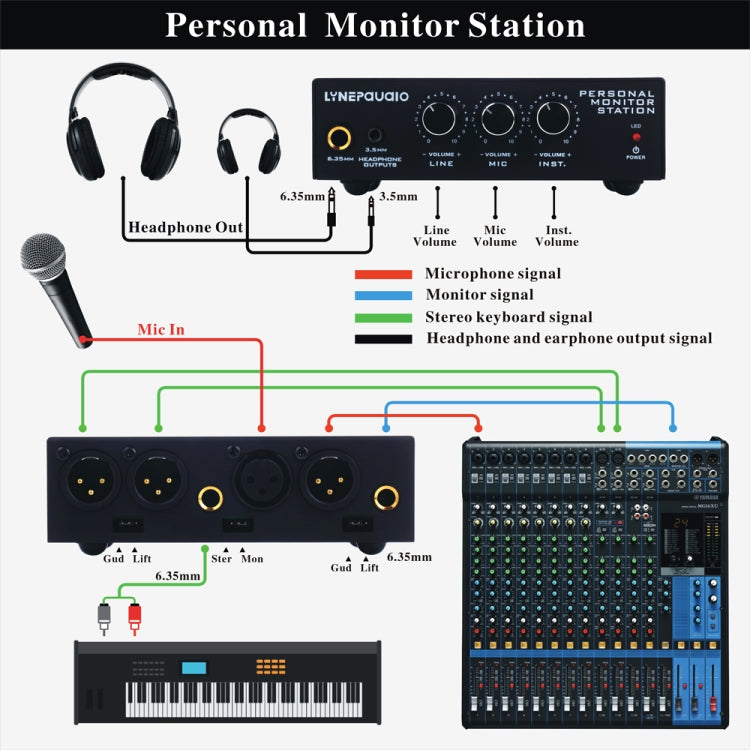
1. LINEPAUDIO B877 personal listener. Designed for players who want to listen to their voices via headphones or earphones, such as their vocal and musical instruments, mainly for drummers, who need to mix click tracks with listener signals. Church choir singing and others needs to listen to the sound of their music. All 3 stereo channels personal monitor desk headphone mixer,
2. Three input channels are outputted by 1/4 and 1/8 (6.5 and 3.5 mm) of headphone holes through various level controllers, and the microphone channel and device output are connected to ground switches. Easy to eliminate the current ground buzzing noise. This product is an ideal choice for live band and church musicians as well as studio musicians and singers. It has the ability to customize the main music and the voice and instrument input of musicians. Make the product become an effective and multifunctional listening device.
3. Line input: 1/4 TRS stereo Jack for connecting line level signal sources, such as mixer listening / auxiliary output, cassette player output, CD player output, and etc.
4. Ground connecting: Plug jumper to disconnect the chassis grounding input of microphone pin 1 and the microphone passes through.
5. The microphone: XLR Jack is in parallel with the microphone input Jack (hardwired) for delivery to the mixer or other microphone-level input device.
6. Microphone input: XLR balanced Jack for connecting capacitors or moving-coil microphones.
7. Device input: 1/4 TRS stereo Jack for connecting device or line level signals, such as guitar processors, keyboards, musical instruments, keyboards, or previous outputs of musical instruments.
8. Mono / stereo jumper: Select whether the input Jack is mono or stereo.
9. Left / right output: Transformer balanced XLR output from device input.
10. hGrounding route: A plug jumper used to disconnect the chassis from the output Jack of the 1/4 RS device.
11. Mono / stereo jumper (located below the line input): select whether the line input Jack is mono or stereo.
12. Note: The interface of the XLR Jack under MONO mode can be used for "Phantom Power" which is required to connect the mixer.
13. Headset output: 1/4 stereo Jack and 1/8 stereo Jack for connecting stereo headphones or headphones.
14. Line level: Adjust the level signal from the line input to the headphone mixing.
15. Microphone level: Adjust the level signal from microphone input to headphone mixing.
16. Inst. level: Adjust the level signal from inst. input to headphone mixing.
17. The line input is connected to a 1/4 "stereo or mono plug." If the plug is 6.35mm stereo, select the mono / stereo jumper set by stereo. The plug is a single-ended mono channel. Select mono / stereo jumper settings.
18. Microphone input is connected to a dynamic microphone or capacitive microphone via a standard XLR cable. If you are using a capacitive microphone, you need to charge it with power from the mixer connected to the microphone Jack. This Jack transmits the phantom power from the mixer to the microphone. Connect the microphone through the Jack to the mixer as needed.
19. Instrument input is connected to the guitar preamplifier output, keyboard or any stereo or monophonic instrument signal. Select stereo or mono.
Features
1. Max input level: -20 dB XLR, +40dB line, +15dB instrument.
2. Input impedance: 50K ohms
3. Output frequency response: 10-30kHz +/-3dB
4. Output impedance HDPHN: 10ohms
5. Output impedance: 2 ea; 100ohms balanced
6. Gain: 20 dB 1/4 inch, 50dB XLR
7. HDPHN frequency response: 20Hz-20kHz
8. S/N ratio: 90dB
9. Power: DC 9-16V
10. 1/4 TRS stereo / mono listening input.
11. The XLR microphone enters w/ pass-through.
12. 1/4 TRS stereo instrument input, 6.35mm / 3.5mm stereo / mono output.
1. LINEPAUDIO B877 personal listener. Designed for players who want to listen to their voices via headphones or earphones, such as their vocal and musical instruments, mainly for drummers, who need to mix click tracks with listener signals. Church choir singing and others needs to listen to the sound of their music. All 3 stereo channels personal monitor desk headphone mixer,
2. Three input channels are outputted by 1/4 and 1/8 (6.5 and 3.5 mm) of headphone holes through various level controllers, and the microphone channel and device output are connected to ground switches. Easy to eliminate the current ground buzzing noise. This product is an ideal choice for live band and church musicians as well as studio musicians and singers. It has the ability to customize the main music and the voice and instrument input of musicians. Make the product become an effective and multifunctional listening device.
3. Line input: 1/4 TRS stereo Jack for connecting line level signal sources, such as mixer listening / auxiliary output, cassette player output, CD player output, and etc.
4. Ground connecting: Plug jumper to disconnect the chassis grounding input of microphone pin 1 and the microphone passes through.
5. The microphone: XLR Jack is in parallel with the microphone input Jack (hardwired) for delivery to the mixer or other microphone-level input device.
6. Microphone input: XLR balanced Jack for connecting capacitors or moving-coil microphones.
7. Device input: 1/4 TRS stereo Jack for connecting device or line level signals, such as guitar processors, keyboards, musical instruments, keyboards, or previous outputs of musical instruments.
8. Mono / stereo jumper: Select whether the input Jack is mono or stereo.
9. Left / right output: Transformer balanced XLR output from device input.
10. hGrounding route: A plug jumper used to disconnect the chassis from the output Jack of the 1/4 RS device.
11. Mono / stereo jumper (located below the line input): select whether the line input Jack is mono or stereo.
12. Note: The interface of the XLR Jack under MONO mode can be used for "Phantom Power" which is required to connect the mixer.
13. Headset output: 1/4 stereo Jack and 1/8 stereo Jack for connecting stereo headphones or headphones.
14. Line level: Adjust the level signal from the line input to the headphone mixing.
15. Microphone level: Adjust the level signal from microphone input to headphone mixing.
16. Inst. level: Adjust the level signal from inst. input to headphone mixing.
17. The line input is connected to a 1/4 "stereo or mono plug." If the plug is 6.35mm stereo, select the mono / stereo jumper set by stereo. The plug is a single-ended mono channel. Select mono / stereo jumper settings.
18. Microphone input is connected to a dynamic microphone or capacitive microphone via a standard XLR cable. If you are using a capacitive microphone, you need to charge it with power from the mixer connected to the microphone Jack. This Jack transmits the phantom power from the mixer to the microphone. Connect the microphone through the Jack to the mixer as needed.
19. Instrument input is connected to the guitar preamplifier output, keyboard or any stereo or monophonic instrument signal. Select stereo or mono.
Features
1. Max input level: -20 dB XLR, +40dB line, +15dB instrument.
2. Input impedance: 50K ohms
3. Output frequency response: 10-30kHz +/-3dB
4. Output impedance HDPHN: 10ohms
5. Output impedance: 2 ea; 100ohms balanced
6. Gain: 20 dB 1/4 inch, 50dB XLR
7. HDPHN frequency response: 20Hz-20kHz
8. S/N ratio: 90dB
9. Power: DC 9-16V
10. 1/4 TRS stereo / mono listening input.
11. The XLR microphone enters w/ pass-through.
12. 1/4 TRS stereo instrument input, 6.35mm / 3.5mm stereo / mono output.
Verified Compatible
Guaranteed fit for device in the title. Wrong part? Full refund including shipping.
Share


£72.69