

Understanding LCD display screens: the DIY repair essential
TL;DR:
- LCD screens work by manipulating backlit pixels with liquid crystals, with active-matrix (TFT) being the standard.
- Choosing the correct panel type, like IPS or VA, is crucial for display quality and device compatibility.
- Proper sourcing, handling, and understanding LCD technology improve repair success and display performance.
Most people assume the screen on their phone is just a screen. Crack it, order a replacement, swap it over. Simple. But the moment you start sourcing parts, you realise there are TFT panels, IPS assemblies, VA options, and a baffling range of prices for what looks like the same component. LCD technology is genuinely layered, and understanding it is the difference between a repair that lasts and one that fails within a week. This guide breaks down exactly how LCD display screens work, the types you will encounter, and the practical knowledge you need to carry out a confident, successful DIY repair.
Table of Contents
- What is an LCD display screen?
- Different types of LCDs in mobile devices
- How LCDs are used in mobile repairs
- LCD strengths and limitations for mobile repair
- What most DIYers overlook about LCD repairs
- Find reliable LCD replacements and support
- Frequently asked questions
Key Takeaways
| Point | Details |
|---|---|
| LCDs explained simply | An LCD display uses liquid crystals and a backlight to show images on your device. |
| Choose the right type | Matching your device with the correct LCD type ensures quality repairs and performance. |
| Replacement requires care | Swapping an LCD often means replacing the digitiser and frame and following precise steps. |
| Strengths vs. limits | LCDs are reliable and affordable but can’t display true black due to backlight leakage. |
| Smart DIY saves money | With good information and parts, many can replace screens at home for less than shop prices. |
What is an LCD display screen?
LCD stands for liquid crystal display. At its core, an LCD screen works by shining a backlight through layers of polarised glass and liquid crystals, which are then manipulated by electrical signals to control how much light passes through each pixel. The result is the image you see on screen. Unlike older CRT monitors or modern OLED panels, LCDs do not generate their own light per pixel. The backlight is always on, and the liquid crystals act as a kind of shutter, blocking or allowing light through.
There are two fundamental architectures you need to know about:
- Active-matrix (TFT-LCD): Each pixel is controlled by its own thin-film transistor (TFT). This allows for precise, fast, individual pixel control, producing sharp and responsive images. This is the dominant technology in modern smartphones.
- Passive-matrix: Pixels are controlled by a grid of row and column electrodes. Slower response times and lower image quality make this largely obsolete in mobile devices today.
The reason active-matrix took over is straightforward. Active-matrix TFT-LCD uses transistors per pixel to hold charge, delivering sharper images and faster refresh rates compared to passive-matrix designs. For a phone screen refreshing at 60Hz or more, passive-matrix simply cannot keep up.
“The backlight in an LCD is always running. The liquid crystals do not create light; they control it. This is a fundamental distinction that shapes every strength and limitation of the technology.”
When you look at types of LCD screens for mobile repairs, you are almost always dealing with active-matrix variants. The key layers in a typical mobile LCD assembly include the backlight unit, diffuser sheets, the liquid crystal layer, colour filters, and the top glass with touch digitiser bonded on. Each layer contributes to image quality, and damage to any one of them can cause the display faults you see in broken phones.
Understanding this structure also explains why a cracked screen sometimes still displays correctly, while a drop with no visible crack can kill the image entirely. The liquid crystal layer or backlight can fail without the outer glass shattering.
Different types of LCDs in mobile devices
Not all LCD panels perform the same way. Within the active-matrix family, there are several sub-types, each with distinct characteristics that matter when you are choosing a replacement part.
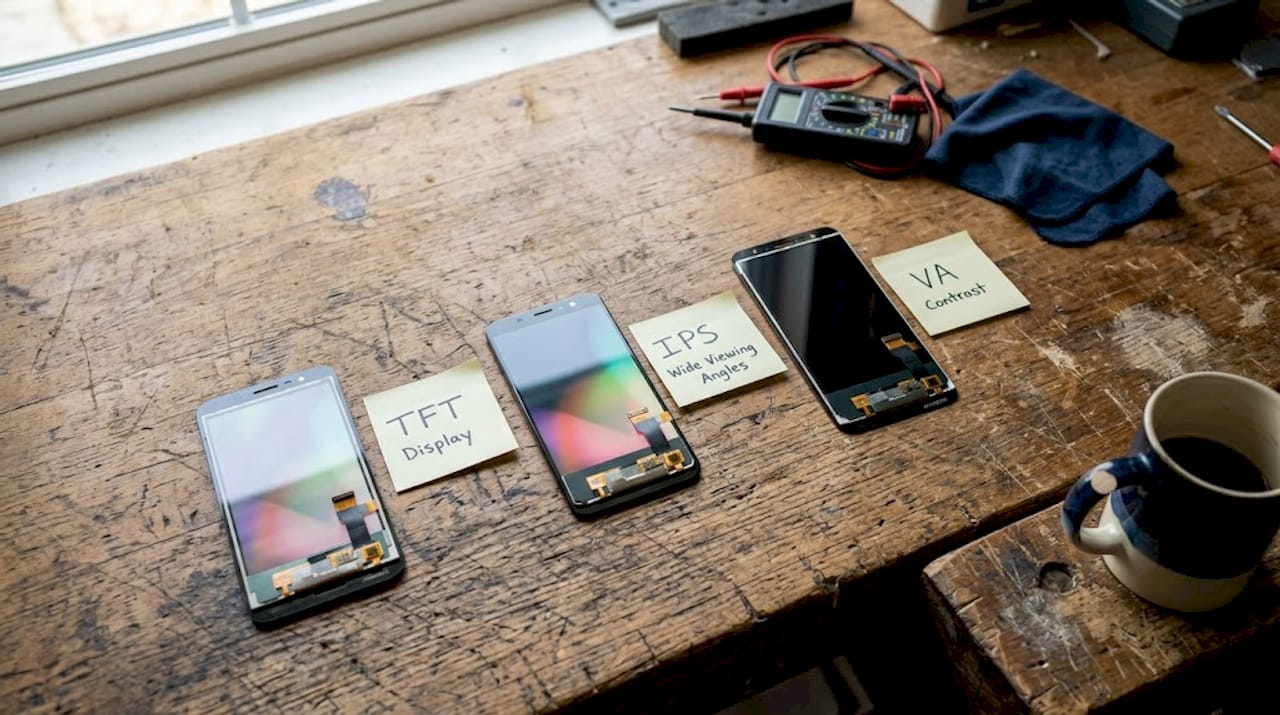
TFT (Thin-Film Transistor): The baseline active-matrix technology. Good brightness and fast response, but viewing angles can be narrow and colour accuracy is average. Common in budget and mid-range phones.
IPS (In-Plane Switching): A refinement of TFT where liquid crystals align horizontally, producing much wider viewing angles and more accurate colour reproduction. Most premium LCD phones use IPS panels. If you are replacing a screen on a higher-end device, IPS is typically what you want.
VA (Vertical Alignment): Liquid crystals align vertically when no voltage is applied, producing better contrast ratios than TFT or IPS. Blacks appear deeper, though response times can be slightly slower. A strong middle-ground option.
Passive-matrix: Rarely seen in modern smartphones. Slower, lower resolution, and generally found only in very basic or legacy devices.
Here is a side-by-side comparison to help you choose:
| Panel type | Colour accuracy | Viewing angles | Contrast ratio | Response time | Common use |
|---|---|---|---|---|---|
| TFT | Moderate | Narrow | Low | Fast | Budget phones |
| IPS | High | Wide | Moderate | Fast | Mid to premium phones |
| VA | Moderate | Moderate | High | Moderate | Mid-range phones |
| Passive-matrix | Low | Very narrow | Very low | Slow | Legacy/basic devices |
When sourcing a replacement, always try to match the original panel type. Fitting a TFT panel into a device that shipped with IPS will result in noticeably worse colour and viewing angles. Your customer or your own experience with the device will suffer. Understanding LCD screen comparison details helps you make the right call before you buy. Also check screen assembly differences if you are unsure whether to order a bare panel or a full assembly with digitiser and frame.
For most DIY repairs, IPS is the safest choice for mid-range and above devices. It offers the best balance of colour quality, viewing angle, and availability.
How LCDs are used in mobile repairs
Knowing the technology is only half the job. The other half is understanding how LCD replacements actually work in practice.
Most modern phone LCD replacements come as a full assembly: LCD panel, touch digitiser, and sometimes the frame, all bonded together. Full assembly replacement means heating and prying adhesive, transferring components, and testing before the final install. Trying to separate a bonded digitiser from the LCD without the right equipment almost always causes further damage.
Here is a general process overview for a typical LCD swap:
- Power off the device completely and remove the SIM tray.
- Apply gentle heat to the back cover or screen edges to soften adhesive (an iOpener tool or heat mat works well).
- Use plastic picks and a spudger to carefully lift the back cover or screen assembly without forcing it.
- Disconnect the battery before touching any other connectors.
- Unclip the LCD flex cable connector from the motherboard.
- Transfer any components from the old assembly to the new one (earpiece, brackets, sensors).
- Connect the new LCD flex cable and power on briefly to test the display before sealing.
- Seal the device with fresh adhesive and reassemble.
Pro Tip: Always test the new display before you seal everything back up. Powering on with the screen loose takes thirty seconds and can save you an hour of disassembly if there is a fault with the part.
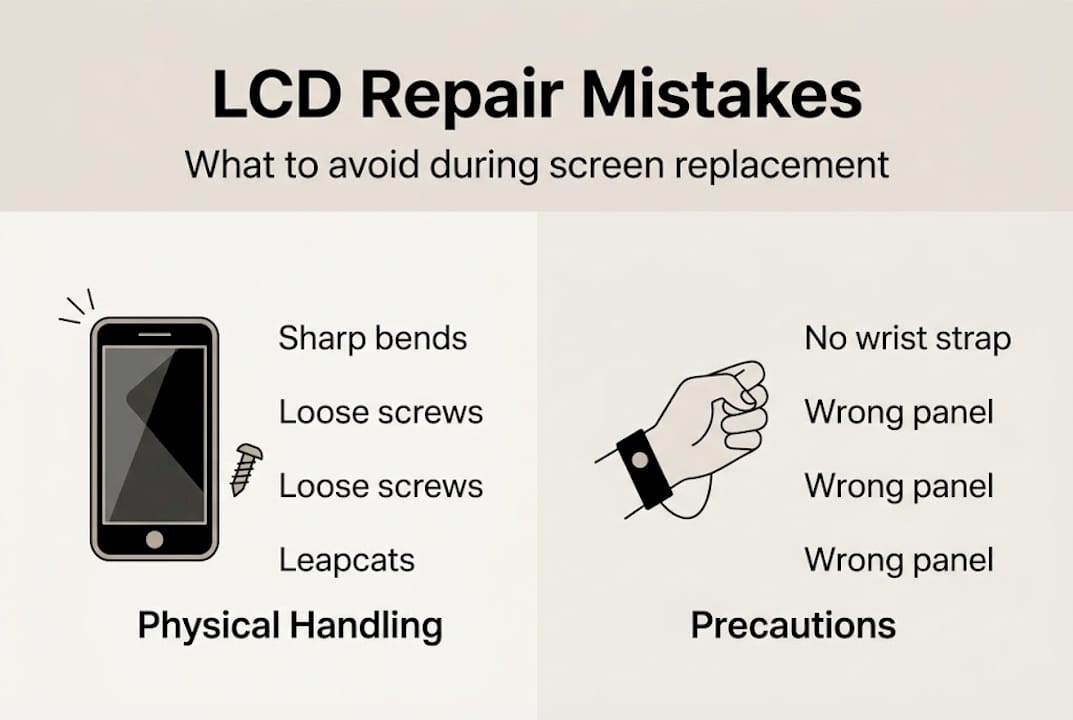
Common mistakes that cause avoidable failures include bending the flex cable sharply, skipping anti-static precautions, and ordering an assembly that does not match the device model precisely. Static discharge can silently damage components, so use an anti-static wrist strap whenever you are handling the internals. For a detailed walkthrough, the DIY screen replacement steps guide covers the process model by model, and the screen replacement guide offers broader advice for different device types.
LCD strengths and limitations for mobile repair
LCDs are the workhorses of the mobile repair world, and for good reason. They are reliable, widely available, and generally more affordable than OLED alternatives. Battery consumption is also predictable because the backlight draws a consistent amount of power regardless of what is displayed on screen. This makes LCDs easier to account for in battery life estimates.
However, they are not without real limitations. LCD backlights produce uniform brightness but cannot achieve true black due to backlight leakage, with VA panels offering the best contrast compromise. You will always see a slight grey rather than a true black in dark scenes. Backlight bleed, where light leaks unevenly around the edges of the screen, is also a common quality issue in cheaper assemblies.
“If perfect blacks matter to you or your customer, an OLED replacement is the honest recommendation. For everything else, a quality IPS or VA LCD will serve most users very well.”
Here is a practical summary of LCD strengths and limitations:
| Factor | LCD performance | Notes |
|---|---|---|
| Brightness uniformity | Excellent | Consistent backlight across screen |
| True black capability | Poor | Backlight always on |
| Battery predictability | Excellent | Consistent power draw |
| Colour accuracy (IPS) | Very good | Matches original in most cases |
| Repair cost | Low to moderate | Cheaper than OLED replacements |
| Durability | Good | Robust in everyday use |
| Backlight bleed risk | Moderate | Quality varies by supplier |
For most everyday repairs, LCD remains the right choice. It is cost-effective, and a quality IPS assembly will satisfy the vast majority of users. If you want to save money with DIY LCD repair, choosing the correct panel type and a reputable supplier matters far more than chasing the cheapest listing.
What most DIYers overlook about LCD repairs
Here is the honest truth that most repair guides skip over: the biggest cause of failed DIY LCD repairs is not technical difficulty. It is underestimating how much panel quality and compatibility matter.
Most people shop on price alone. They find three listings for the same phone model, pick the cheapest, and assume the result will be identical. It will not be. A low-quality TFT assembly fitted to a phone that originally had an IPS panel will look noticeably worse, and the customer will know it even if they cannot explain why.
The second overlooked issue is static damage. Many DIYers skip the wrist strap because the repair seems to go fine without it. But static discharge can cause latent damage that only shows up days or weeks later, making it very hard to trace back to the repair.
With the right information, most people can achieve genuinely professional results at home. The DIY repair guide is a good starting point, but the real edge comes from treating part selection as seriously as the repair itself. Buy the right assembly, not just any assembly.
Find reliable LCD replacements and support
Ready to put your knowledge to work? At Buy2Fix, we stock a wide range of quality-tested LCD screen assemblies for iPhone, Samsung, Huawei, Xiaomi, OPPO, and many more brands. Every part is checked before shipping, and we back our products with a one-year warranty and free UK mainland delivery. Whether you are replacing a cracked IPS panel or sourcing a full assembly with digitiser and frame, we have the parts and the expertise to support your repair. You can also find affordable DIY kits with guidance on tools and techniques to make your next repair as smooth as possible.
Frequently asked questions
What are the signs that my phone needs an LCD replacement?
Common signs include a blank or flickering screen, dead pixels, unresponsive touch areas, or visible cracks that affect the display image. Backlight bleed appearing as bright patches around screen edges is also a sign of LCD damage.
Can I replace an LCD screen on my own?
Yes, with the right tools and guidance, many tech-savvy individuals complete DIY LCD replacements successfully. Full assembly replacement involves heating adhesive, careful prying, and testing before sealing, all of which are manageable with proper preparation.
What is the difference between an LCD and an OLED screen?
LCDs use a backlight and liquid crystals to control light, while OLED screens emit light per pixel, producing deeper blacks and higher contrast. Active-matrix TFT-LCD uses transistors per pixel for sharp images, but cannot match OLED for true black reproduction.
Are all replacement LCD assemblies compatible with my device?
No. You must match the exact device model and verify the connector type and frame dimensions. Even assemblies listed for the same phone model can vary between production batches, so always double-check before ordering.
Why does my new LCD not show true black?
Because LCD backlights are always on, some light leaks through even when pixels should be black. VA panels offer the best contrast compromise among LCD types, but only OLED technology can produce a genuinely true black.
Recommended
- Tablet screen replacement: A practical DIY guide for success – buy2fix
- What Are LCD Screens? Repair and Replacement Essentials – buy2fix
- Types of LCD Screens: A Guide for Repair Experts – buy2fix
- What is LCD display in mobile: essential guide for repairs – buy2fix
- MacBook screen replacement: restore your display in 2026
Let customers speak for us
Great phone case. Good quality. Exactly as described- thank you

Unfortunately after selecting the correct size of iPhone case for my iPhone 14, I without realising when selecting the colour clicked on the iPhone 14 Pro case.
Fortunately the case was slightly bigger so my phone still fits inside but I’ve had to remove the class from the rear so I still use my camera.

very happy with this item didn't take long to come

Potrivit

Battery direct replacement easy fix thanks to supplied tools.


For Samsung Galaxy Watch6 44mm SM-R940/R945 Original LCD Screen with Digitizer Full Assembly

For HMD Skyline 5G imak Shockproof Airbag TPU Phone Case(Matte Black)

Great product! Durable, light weight and easy to use. Stands up in high winds and weather storms. Covers all of my motorcycle and i have a VT1100. Over all im very happy with this.

Arrived in time, works perfectly.


LCD Flex Cable Adhesive Sticker For Apple Watch Series 5 44mm

For Samsung Galaxy S21 Ultra 5G SM-G998B Original 5G Flex Cable

No complaints at all, I got exactly what I needed, which was the genuine back cover of my mobile device. It was a perfect fit, the camera lenses functioning properly and so I now have a brand-new looking device in a perfect colour.

For Motorola Edge 30 Pro Kalebol Metal Hollow Lens Protection Ring
