

Bar type LCD guide for mobile repair experts 2026
Many mobile repair technicians mistakenly assume bar-type LCDs are simply elongated smartphone screens, but these specialised displays serve entirely different industrial and retail purposes. Unlike the rectangular panels found in mobiles and tablets, bar-type LCDs feature ultra-wide aspect ratios designed for space-constrained applications like retail shelving and industrial control panels. Understanding their unique characteristics, manufacturing processes, common faults, and critical specifications empowers you to diagnose issues accurately and select appropriate replacement components. This comprehensive guide walks you through everything from design fundamentals to practical troubleshooting, ensuring you approach bar-type LCD repairs with the precision these specialised displays demand.
Table of Contents
- Understanding Bar-Type LCDs: Design And Applications
- Manufacturing And Technical Considerations In Bar-Type LCDs
- Common Faults And Troubleshooting Bar-Type LCDs
- Key Specifications And Selecting Replacement Bar-Type LCDs
- Enhance Your Mobile Repair Toolkit With Quality LCDs
- FAQ
Key takeaways
| Point | Details |
|---|---|
| Specialised design | Bar-type LCDs use ultra-wide aspect ratios for industrial and retail applications, not standard mobile devices. |
| Manufacturing complexity | Precision cutting, edge resealing, and circuit rerouting distinguish bar-type production from conventional LCD manufacturing. |
| Common faults | Flickering, dead pixels, and connection issues dominate bar-type LCD failures, requiring systematic diagnostic approaches. |
| Critical specifications | Brightness levels, resolution matching, IP sealing, and temperature tolerance determine replacement suitability. |
| Edge vulnerability | Cut edges require meticulous sealing to prevent liquid crystal leakage and contamination during repairs. |
Understanding bar-type LCDs: design and applications
Bar-type LCDs represent a distinct category of thin-film transistor displays engineered specifically for elongated, space-constrained environments. These displays feature ultra-wide aspect ratios like 16:4.5 or 32:9, dramatically different from the 16:9 or 19.5:9 ratios you encounter in smartphones. Typical resolutions include 480x128, 1920x540, or even 3840x540 pixels, stretched across panels ranging from 2.9 inches to 15 inches diagonally. This elongated form factor allows manufacturers to display critical information in narrow spaces where conventional rectangular screens simply cannot fit.
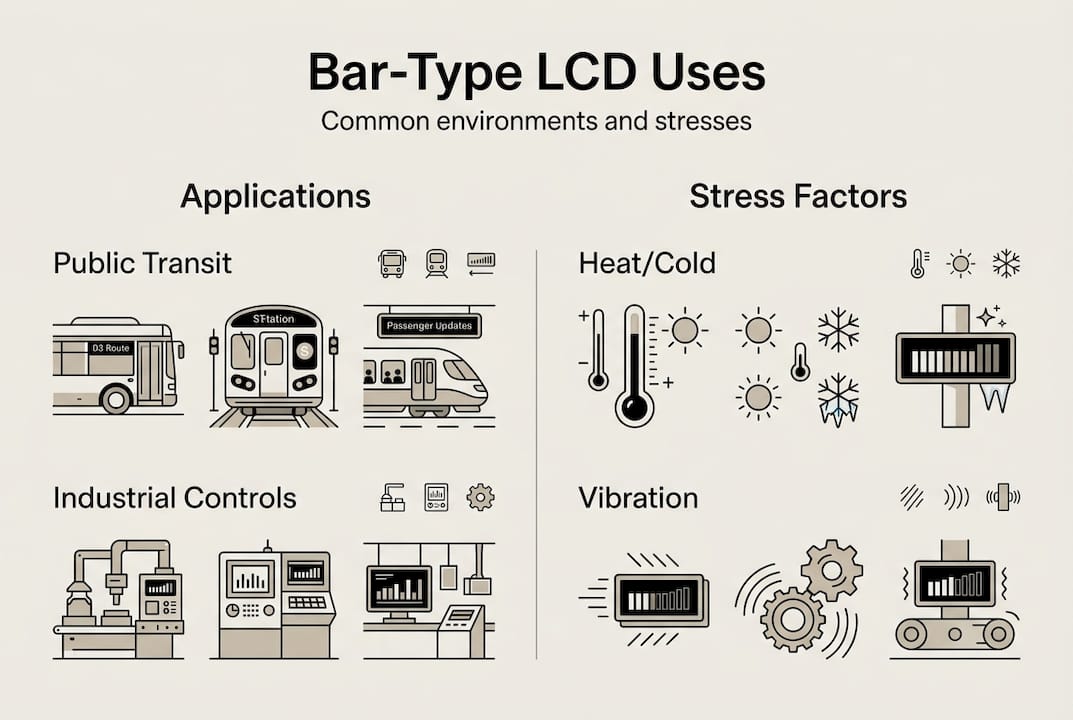
You will not find bar-type LCDs in standard smartphones or tablets because their design serves fundamentally different purposes. Retail environments use these displays for electronic shelf labels, price tags, and product information strips mounted along shelving edges. Industrial settings deploy them in control panels, rackmount systems, and machinery interfaces where horizontal space is severely limited. Transportation applications include vehicle dashboard information strips and train carriage displays. The stretched format maximises information density whilst occupying minimal vertical space, a crucial advantage in applications where every millimetre counts.
Different types of LCD screens serve distinct purposes, and recognising bar-type characteristics prevents misdiagnosis during repair assessments. Common applications include:
- Electronic shelf labelling systems in supermarkets and warehouses
- Industrial control panel status displays
- Rackmount server and networking equipment indicators
- Vehicle dashboard information strips
- Public transport passenger information displays
- Medical equipment monitoring panels
- Point-of-sale terminal customer-facing displays
Understanding these applications helps you anticipate the environmental stresses these displays face, from temperature extremes in industrial settings to constant illumination requirements in retail environments.
Manufacturing and technical considerations in bar-type LCDs
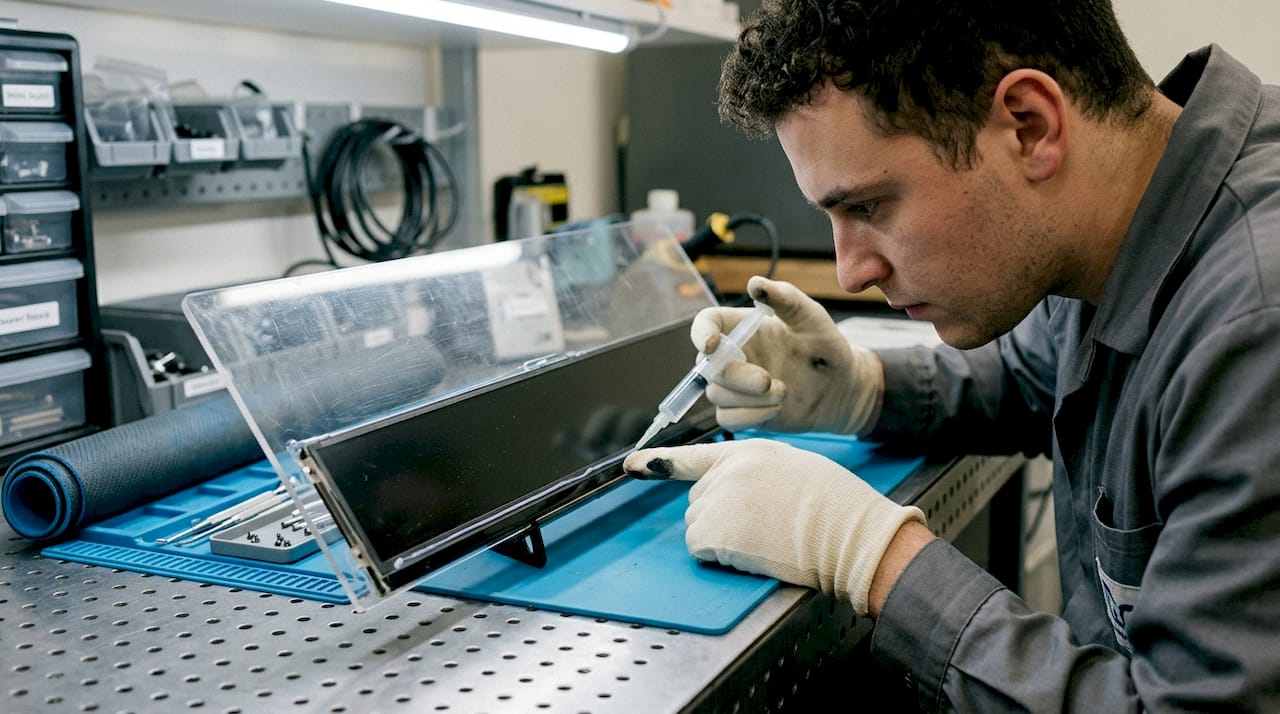
The production of bar-type LCDs involves a specialised manufacturing process that significantly impacts repair complexity and component vulnerability. Manufacturers start with standard rectangular TFT LCD panels, then execute precision cutting to create elongated shapes whilst maintaining display functionality. This cutting process exposes the liquid crystal layer at the newly created edges, creating potential failure points that do not exist in conventional displays. The manufacturing workflow follows these critical steps:
- Source a standard rectangular TFT LCD panel with suitable base specifications
- Map the desired bar-type dimensions and calculate optimal cutting lines
- Execute precision cutting using specialised equipment to minimise edge damage
- Apply edge resealing compounds to protect exposed liquid crystal layers
- Reroute flexible printed circuits and connection points to accommodate the altered geometry
- Test electrical connections and display uniformity across the modified panel
- Apply protective coatings and mount interface components
Edge resealing represents the most critical manufacturing step because cut edges remain vulnerable to liquid crystal leakage and environmental contamination throughout the display’s lifespan. Manufacturers use specialised epoxy compounds and UV-cured sealants to create moisture barriers along these exposed edges. Poor sealing quality leads to premature failures, particularly in high-humidity environments or applications with significant temperature fluctuations. The rerouting of circuitry ensures that driver ICs and connection points remain accessible despite the panel’s altered shape, often requiring custom flexible cables and connector placements.
Pro Tip: When handling bar-type LCDs during repairs, always support the panel along its entire length rather than gripping the ends, as the resealed edges cannot withstand the same mechanical stress as factory-sealed edges on conventional displays.
Different LCD panel types exhibit varying tolerances to the cutting and resealing process, with IPS panels generally offering better post-modification stability than TN panels due to their superior viewing angle characteristics and more robust liquid crystal alignment.
Common faults and troubleshooting bar-type LCDs
Bar-type LCD failures follow predictable patterns that reflect both their unique manufacturing process and typical deployment environments. Flickering, dead pixels, and connection issues dominate the fault spectrum, each requiring distinct diagnostic approaches. Flickering typically originates from unstable power supplies or loose cable connections, particularly at the rerouted circuit points created during manufacturing. Dead pixels appear either as manufacturing defects or develop over time due to electrical stress on the modified panel structure. Irregular brightness patterns often indicate backlight degradation or uneven current distribution across the elongated panel.
Systematic troubleshooting begins with verifying power supply stability and cable connections. Check voltage levels at the panel input using a multimeter, ensuring they match manufacturer specifications typically ranging from 3.3V to 12V depending on panel size. Inspect flexible cable connections for corrosion, particularly at custom connection points created during circuit rerouting. For dead pixel issues, pixel-fixing software can sometimes revive stuck pixels through rapid colour cycling, though this proves less effective on bar-type displays than conventional screens due to their specialised driver configurations.
Bar-type LCDs experience flickering and dead pixel faults at rates approximately 30% higher than conventional rectangular displays due to the additional stress introduced during cutting and circuit modification processes.
When basic troubleshooting fails to resolve issues, professional intervention becomes necessary, particularly for backlight faults. The elongated backlight assemblies in bar-type displays use edge-lit LED configurations that differ significantly from the direct-lit or dual-edge systems in smartphones. Replacing these backlights requires specialised tools and knowledge of the custom light guide plates designed for ultra-wide aspect ratios. Connection problems often stem from incompatible interface protocols, as bar-type displays may use LVDS, RGB, SPI, or proprietary interfaces depending on their intended application.
Pro Tip: Invest in a logic analyser alongside your standard multimeter when regularly servicing bar-type LCDs, as these tools allow you to verify signal integrity on LVDS and SPI interfaces, identifying communication faults that voltage measurements alone cannot detect.
Developing expertise in identifying faulty screens requires understanding how LCD screen technology responds to the unique stresses of bar-type configurations. Common faults include:
- Flickering caused by unstable power delivery or loose connections at rerouted circuit points
- Dead pixels resulting from manufacturing defects or electrical stress on modified panels
- Irregular brightness indicating backlight degradation or uneven current distribution
- Vertical or horizontal line defects suggesting driver IC failures
- Colour distortion from liquid crystal contamination at improperly sealed edges
- Complete display failure due to interface communication breakdowns
- Ghosting or image retention from prolonged static content display
Key specifications and selecting replacement bar-type LCDs
Selecting appropriate replacement bar-type LCDs demands careful attention to specifications that directly impact display performance and longevity in their intended environments. Brightness levels between 450 and 1000+ nits determine visibility under varying ambient lighting conditions, with retail applications typically requiring 450 to 600 nits whilst outdoor or high-ambient-light industrial settings demand 800+ nits. Resolution matching proves critical because aspect ratio mismatches cause severe image distortion on these elongated displays. A 1920x540 panel cannot properly display content formatted for 1920x360 without stretching or letterboxing that defeats the space-saving purpose of bar-type designs.
Environmental tolerance specifications separate reliable components from premature failures. IP-rated sealing becomes essential for bar-type displays because their cut edges remain vulnerable to moisture and dust ingress. Look for minimum IP54 ratings for indoor applications and IP65 or higher for industrial environments with significant particulate exposure. Operating temperature ranges must accommodate the deployment environment, with industrial applications often requiring -30°C to 85°C tolerance whilst retail settings function adequately within 0°C to 60°C ranges. Interface compatibility ensures seamless integration, as bar-type displays utilise LVDS for high-resolution applications, RGB parallel interfaces for simpler implementations, or SPI serial connections for cost-sensitive deployments.
| Specification | Typical Range | Application Notes |
|---|---|---|
| Brightness | 450-1000+ nits | Retail 450-600, industrial/outdoor 800+ |
| Resolution | 480x128 to 3840x540 | Must match aspect ratio exactly |
| Aspect Ratio | 16:4.5 to 32:9 | Defines physical proportions |
| IP Rating | IP54 to IP67 | Higher ratings for harsh environments |
| Temperature | -30°C to 85°C | Industrial requires wider range |
| Interface | LVDS, RGB, SPI | LVDS for high-res, SPI for simple |
| Viewing Angle | 160° to 178° | IPS panels offer superior angles |
Understanding LCD screen replacement fundamentals ensures you select components that match both technical requirements and environmental demands. Key selection criteria include:
- Verify exact resolution and aspect ratio match to prevent image distortion
- Confirm brightness specification meets ambient lighting conditions
- Check IP rating adequacy for deployment environment
- Validate operating temperature range covers expected conditions
- Ensure interface type compatibility with existing control hardware
- Assess viewing angle requirements based on user positioning
- Review warranty terms and quality certifications from suppliers
These specifications work together to determine overall suitability, and compromising on any critical parameter leads to suboptimal performance or premature failure.
Enhance your mobile repair toolkit with quality LCDs
Sourcing reliable replacement components separates successful repairs from recurring failures and dissatisfied customers. Buy2Fix specialises in providing mobile repair professionals and DIY enthusiasts with quality LCD screens and comprehensive repair parts backed by rigorous quality control. Our extensive inventory covers diverse display technologies, from conventional smartphone screens to specialised components for unique applications. Browse our catalogue to find certified aftermarket and genuine parts that meet professional standards, supported by our technical team who understand the nuances of different display technologies. We ship globally with free UK mainland delivery, ensuring you receive components quickly when repair deadlines loom.
Pro Tip: Always source replacement LCDs from suppliers offering quality certifications and warranty coverage, as the specialised manufacturing process for bar-type displays creates higher variability in component quality compared to mass-produced smartphone screens.
FAQ
What is a bar-type LCD and how does it differ from standard mobile screens?
Bar-type LCDs are elongated displays with ultra-wide aspect ratios like 16:4.5 or 32:9, designed specifically for industrial control panels, retail shelving, and space-constrained applications. Unlike the 16:9 or similar ratios in smartphones and tablets, these displays maximise horizontal information density whilst minimising vertical space. They undergo specialised manufacturing involving precision cutting and edge resealing that conventional mobile screens do not require.
What are the common faults to check for when repairing bar-type LCDs?
Flickering caused by unstable power supplies or loose connections at rerouted circuit points represents the most frequent issue. Dead pixels and irregular brightness patterns also occur commonly, often resulting from electrical stress on the modified panel structure. Use systematic diagnostics starting with power verification, cable inspection, and pixel-fixing software before escalating to backlight or driver IC troubleshooting.
How important is edge sealing in bar-type LCD repair?
Edge sealing proves critical because the cutting process exposes liquid crystal layers that remain vulnerable to leakage and environmental contamination throughout the display’s lifespan. Proper resealing with specialised epoxy compounds and UV-cured sealants protects these exposed edges from moisture and dust ingress. Compromised sealing leads to premature failures, particularly in high-humidity or temperature-variable environments, making it essential to verify seal integrity during repairs.
Which specifications matter most when sourcing replacement bar-type LCDs?
Brightness levels, resolution, and aspect ratio matching take priority because mismatches cause severe performance issues that cannot be corrected post-installation. Verify brightness meets ambient lighting requirements, typically 450 to 600 nits for retail and 800+ for industrial applications. Confirm exact resolution and aspect ratio match to prevent image distortion. Check IP rating adequacy for environmental protection and validate interface type compatibility with existing control hardware.
Recommended
Let customers speak for us
The acid test of any company is how they respond when things go wrong. The Buy2Fix team were efficient in dealing with my emails and resolved the issue to my complete satisfaction

For Samsung Galaxy A26 SM-A266B Original Earpiece Speaker with Cable

Very good communication throught. Good product

Well made part very strong easy to fit great value for the money

Well packed, with fast shipping :)

Exactly what the doctor ordered…great color, comfort, and durability. Trust this watch band!

Brilliant strap, second purchase, bought bracelet before. Excellent value. Thank you

Great item for splitting your Audio signal

Outstanding product!
Next level customer service.

Very satisfied but the delivery needs to get more faster...

Good price,quick delivery

Best phone case ever! This is my second one as I broke my first. Would defo recommend

Great fitting Apple Watch bands

For Apple Watch Ultra 3 / 2 / 1 49mm RedPepper Armor Metal Case Integrated Silicone Watch Band(Steel Black White)

Good price and quick postage
