

Bar type LCD display guide: reliability and cost for UK repairs
TL;DR:
- Bar type LCDs are elongated panels used in commercial displays and slim mobile devices.
- Proper sourcing, compatibility checks, and careful installation are essential for successful repairs.
- Choosing reputable UK suppliers with warranties reduces risks and improves repair outcomes.
Many technicians assume that swapping out a bar type LCD display is no different from replacing any standard smartphone screen. That assumption costs real money. Bar type LCD displays are a distinct category of panel, and getting the sourcing, compatibility, and installation wrong leads to failed repairs, unhappy customers, and wasted stock. This guide cuts through the confusion by explaining exactly what bar type LCD displays are, how they compare to conventional panels, what to look for when sourcing them in the UK, and how to install them correctly the first time. Whether you’re a seasoned technician or a careful DIY repairer, the following breakdown will sharpen your approach.
Table of Contents
- What is a bar type LCD display?
- Key features and advantages for mobile repair
- Comparing bar type LCDs: quality, compatibility, and price
- Installation tips, common pitfalls, and troubleshooting
- Sourcing bar type LCD displays in the UK
- Why repair success with bar type LCD displays depends on preparation, not luck
- Find high-quality bar type LCDs for your next repair
- Frequently asked questions
Key Takeaways
| Point | Details |
|---|---|
| Bar type LCD basics | Bar type LCDs are slim, elongated screens ideal for certain modern devices and retail uses. |
| Key features for repair | Their unique shape and specs require careful compatibility and installation checks for repairs. |
| Smart sourcing | Buying from trusted UK suppliers prevents costly returns, ensuring quality and support. |
| Avoid installation errors | Most repair failures are avoidable with proper testing and careful, stepwise installation. |
| Preparation pays off | Planned, informed repairs with the right bar type LCD yield better results and fewer reworks. |
What is a bar type LCD display?
A bar type LCD display is a liquid crystal display panel with an elongated, narrow aspect ratio. Where a standard smartphone screen might have a 16:9 or 20:9 ratio, bar type panels are significantly longer relative to their width, often resembling a wide strip rather than a conventional rectangle. This shape makes them well-suited to certain form factors where space is tightly constrained.
You’ll typically find these panels in commercial display panels such as retail shelf-edge price tags, point-of-sale (POS) terminals, and industrial control units. They also appear in secondary screen sections of foldable smartphones and in niche mobile devices where a conventional panel simply wouldn’t fit. As noted in the Bar type LCD guide for mobile repair experts 2026, bar type LCDs are used in slim, elongated device formats and digital signage applications.
Understanding the types of LCD screens in circulation helps you recognise where bar type panels fit. They differ from standard panels in several measurable ways:
| Feature | Bar type LCD | Standard LCD |
|---|---|---|
| Aspect ratio | Typically 3:1 to 8:1 | 16:9 or 20:9 |
| Common width | 50 to 200 mm | 60 to 160 mm |
| Typical use | POS, shelf display, secondary screens | Primary smartphone screens |
| Connector type | Custom FPC ribbon | Standard ZIF ribbon |
| Repair frequency | Specialist/niche | High volume |
For UK repair technicians, bar type LCD encounters tend to arise in boutique or commercial device repairs rather than everyday handset replacements. That said, as foldable and dual-screen devices grow in popularity, these panels are appearing more often in mobile contexts. Reading up on understanding LCD display screens is an excellent starting point if you’re new to the category.
- Elongated form factor designed for tight device housings
- Often paired with a dedicated controller board
- Brightness levels can exceed standard panels due to ambient viewing conditions
- Custom connectors require exact sourcing to avoid incompatibility
Key features and advantages for mobile repair
Bar type LCD displays are not simply miniaturised standard panels. Their architecture is purpose-built. Here are the technical attributes that matter most when evaluating them for a repair job:
| Attribute | Bar type LCD | Standard smartphone LCD |
|---|---|---|
| Brightness (typical) | 700 to 1500 nits | 400 to 800 nits |
| Power consumption | Lower per active area | Moderate to high |
| Response time | 5 to 20 ms | 10 to 30 ms |
| Viewing angle | Up to 170 degrees IPS | 160 to 170 degrees IPS |
| Panel thickness | Often under 3 mm | 3 to 5 mm |
As highlighted in the LCD panel types comparison, bar type LCD displays offer slim profiles for tight device housing. This compactness is the single biggest reason manufacturers choose them for secondary displays or commercial signage applications.
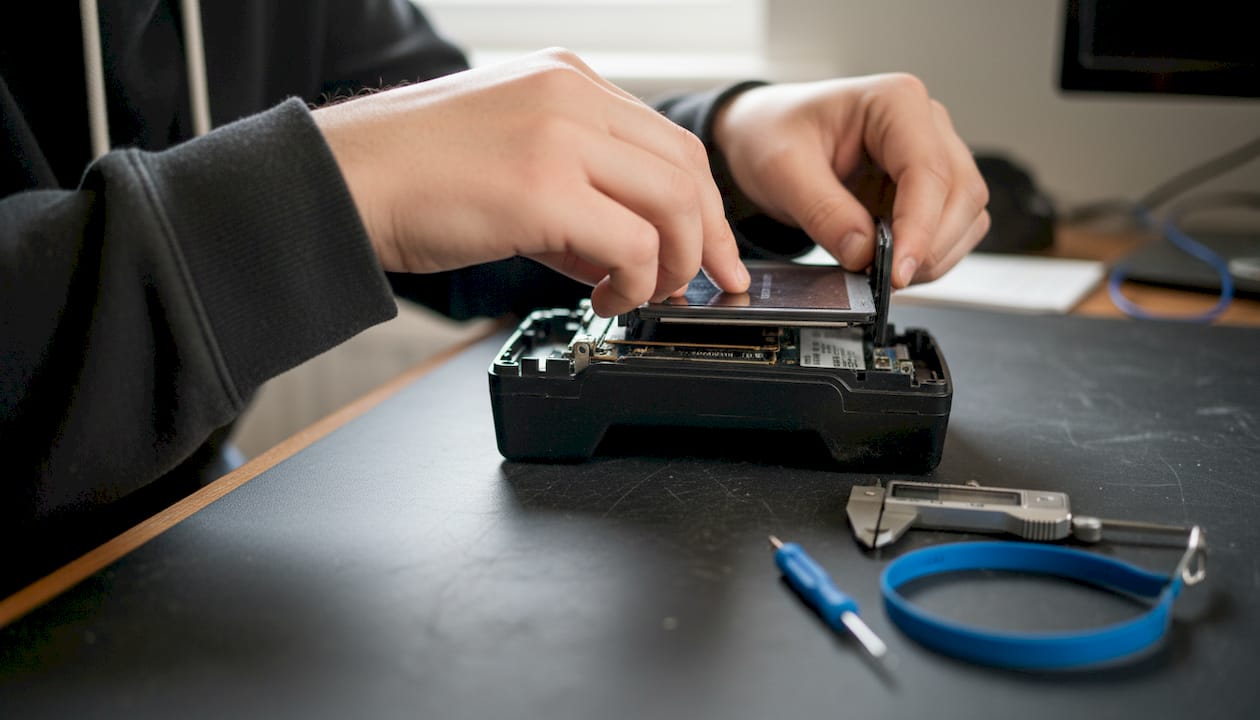
For a repair technician, the advantages translate directly into practical benefits. Lower power consumption means the replacement panel places less strain on the device’s battery, reducing the risk of thermal complaints post-repair. Thinner profiles allow you to work within the original housing tolerances without resorting to modifications.
Cost is another factor. Because bar type LCDs serve niche applications, aftermarket options are often available at lower price points than OEM equivalents. The key is sourcing responsibly, which is covered in a later section. Understanding how LCDs in mobiles function mechanically helps you assess whether a replacement panel meets the device’s original specification.
Beyond cost, bar type LCDs often use IPS (In-Plane Switching) technology, offering consistent colour accuracy and wide viewing angles. This matters in commercial repair contexts where device owners expect display quality to match the original. For more technical context on what differentiates modern panels, review these key facts for LCD replacement before committing to a source.
Key advantages for repair technicians:
- Lower weight and thickness simplify reassembly
- High brightness maintains visibility in retail display environments
- Aftermarket availability keeps repair costs competitive
- IPS technology delivers reliable colour output post-repair
Pro Tip: During initial device assessment, measure the display’s visible area with a calliper. If the width-to-height ratio exceeds 2.5:1, you’re almost certainly looking at a bar type panel. This saves you from ordering the wrong part before disassembly.
Comparing bar type LCDs: quality, compatibility, and price
Not all bar type LCD panels are equal. Quality and compatibility vary widely across OEM and aftermarket bar type LCD panels. Understanding the sourcing landscape prevents costly rework.
| Source type | Typical price range | Warranty | Compatibility risk | Support |
|---|---|---|---|---|
| OEM (original) | High | 12 months+ | Very low | Manufacturer |
| Aftermarket (quality) | Medium | 3 to 12 months | Low to medium | Supplier dependent |
| Recycled/pulled | Low | Rarely included | High | Minimal |
The sourcing decision is a triangle: price, reliability, and speed of delivery. Recycled panels save money upfront but introduce unpredictable failure rates. OEM panels guarantee compatibility but carry premium pricing that squeezes repair margins. Quality aftermarket panels from reputable UK suppliers hit the balance for most professional repair environments.
Before purchasing any bar type panel, work through this compatibility checklist:
- Confirm the exact connector type (FPC pin count and pitch measurement)
- Verify physical dimensions against the original panel removed from the device
- Check the backlight driver voltage matches the device’s power board
- Confirm the panel’s firmware interface (SPI, MIPI, or parallel RGB) matches the host controller
- Review supplier documentation for that specific model number
Rushing the compatibility check is the most common reason for a second repair visit. Five minutes of verification before ordering can prevent an hour of rework on the bench.
For a deeper understanding of the technology behind your choices, the guide on LCD risks and technology covers what can go wrong at the panel level. It’s also worth reviewing the AMOLED vs LCD comparison to understand when an LCD repair is genuinely the right recommendation versus upgrading a customer to an OLED alternative. Consider also reviewing commercial LED lighting options if your repair work extends into commercial signage installations.
Installation tips, common pitfalls, and troubleshooting
With your display sourced, installation is where most costly errors occur. Incorrect installation of bar type panels is a common cause of device return or repair failure. A disciplined process eliminates most of these issues.
Step-by-step replacement process:
- Power off the device completely and remove the battery if accessible
- Ground yourself using an ESD wrist strap before touching any panel component
- Apply controlled heat (around 60°C) to soften the adhesive around the original panel
- Use a plastic spudger to lift the panel gradually, working from one corner
- Disconnect the ribbon cable by releasing the ZIF (Zero Insertion Force) lock before pulling
- Position the replacement panel and reconnect the ribbon cable before securing with adhesive
- Power on for pre-adhesive testing before final assembly
Pro Tip: Always test the replacement panel while the device is still partially open. If vertical lines or flickering appear at this stage, the problem is in the connector seating, not the panel itself. Reseating takes seconds. Delaminating a fully assembled device takes much longer.
Common mistakes to avoid:
- Pulling ribbon cables without releasing the ZIF lock (causes immediate pin damage)
- Using liquid adhesive near the connector zone
- Skipping ESD precautions on sensitive panel controllers
- Applying too much heat during removal, warping the panel frame
Troubleshooting common faults:
- Vertical lines: Usually a ribbon cable seating issue or pressure damage to the panel flex
- Dead zones: Often caused by adhesive contamination on the panel surface or touch layer
- Flickering: Check the backlight driver connection and confirm voltage compatibility
The full bar type LCD installation guide provides device-specific advice. For context on how display efficiency relates to broader installation choices, saving with LED and LCD displays is a useful reference for commercial scenarios.
Sourcing bar type LCD displays in the UK
Securing the right panels is often as important as installing them correctly. Not all suppliers meet UK standards for reliability and after-sales support, so knowing where to look matters.
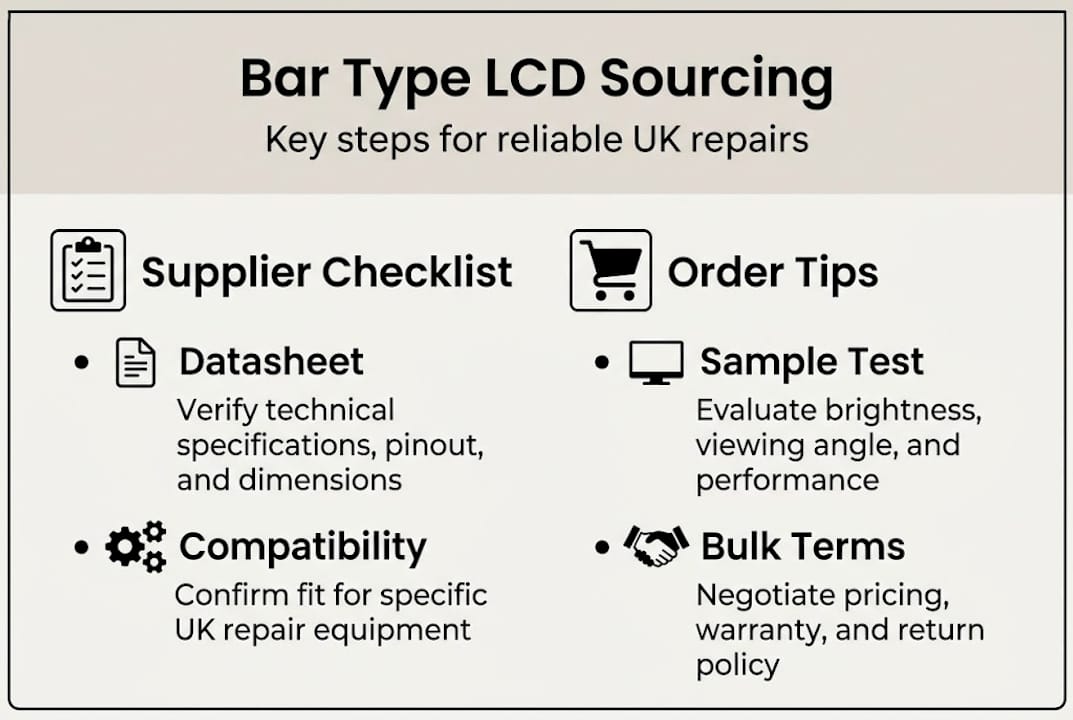
UK-based supply channels include authorised distributors, specialist repair parts retailers, and established online marketplaces. Each has trade-offs in terms of speed, price, and accountability. UK-based suppliers offer a major practical advantage: faster returns, easier warranty claims, and stock that typically meets UK consumer expectations.
Red flags to watch for when sourcing:
- No warranty or less than 30 days stated
- Vague or missing panel specifications
- No UK returns address
- Suspiciously low prices with no quality documentation
- No customer reviews or independent ratings
Before committing to a supplier, ask these questions. Does the supplier provide a datasheet for the specific panel model? Is there a UK-based returns process? Can they confirm OEM or aftermarket grade? What is the lead time for replacement if the panel is faulty on arrival?
For bulk orders, negotiate a sample test run before placing large volumes. A single batch of 10 units lets you assess build quality and connector reliability before committing to 50 or more. The guide to choosing the right LCD panel outlines the specification points to confirm with your supplier before any order. For commercial projects involving display installations, energy efficiency in retail displays adds useful context on long-term running costs.
For ongoing repair work, establishing a relationship with one or two trusted UK suppliers is far more efficient than hunting for the cheapest price on each order. Consistency in sourcing leads to consistency in repair outcomes.
Why repair success with bar type LCD displays depends on preparation, not luck
After years of working in the UK repair parts industry, one pattern stands out clearly. The technicians who rarely need a second visit are not the most experienced. They are the most prepared. The misconception that cheaper parts or fast sourcing decisions lead to quick savings is genuinely damaging. A recycled bar type panel saved £8 at the point of purchase can generate a £40 rework job two weeks later.
Preparation means confirming compatibility before ordering, not during installation. It means testing the replacement panel before closing up the device. And it means keeping a repair log. For more on building that foundation, more on LCD repair essentials is worth bookmarking.
A personal log of installation outcomes, including which panels failed, which suppliers delivered consistent quality, and which connector types caused problems, turns individual repairs into a repeatable, improving process. This is what separates a one-person repair operation that grows from one that stays stuck fixing the same mistakes repeatedly.
Pro Tip: After every bar type LCD repair, record the panel source, model number, and outcome. After 20 entries, patterns become obvious and your sourcing decisions will improve significantly.
Find high-quality bar type LCDs for your next repair
If you’re ready to put this knowledge into practice, here’s where to find reliable UK-sourced bar type LCD displays for your next job. Buy2Fix stocks a wide range of LCD display assemblies and components compatible with modern mobile devices, including bar type configurations for specialist repairs. With free UK mainland shipping, a one-year warranty, and a 30-day return policy, every order carries genuine peace of mind.
Our team understands the pressures technicians face: tight turnaround times, demanding customers, and the need for parts that work first time. Browse the full selection at Buy2Fix and use the product filters or contact support to identify the exact panel for your device. Whether you’re ordering a single screen or building bulk stock, we’re set up to support professional repair operations across the UK.
Frequently asked questions
What devices commonly use bar type LCD displays?
Bar type LCD displays are mainly found in smartphones with slim secondary screen sections, POS devices, and retail shelf signage. As noted in the bar type LCD guide, bar type LCDs are used in slim, elongated device formats and digital signage applications.
How do I know if a replacement bar type LCD is compatible?
Check the connector type, physical dimensions, and backlight voltage before purchasing. Quality and compatibility vary widely across OEM and aftermarket bar type LCD panels, so always request a datasheet from your supplier.
Why do bar type LCD repairs fail most often?
Most failures trace back to installation errors, particularly ribbon cable damage from improper ZIF lock release or incorrect adhesive placement. Incorrect installation of bar type panels is a documented common cause of device return or repair failure.
Are aftermarket bar type LCD panels reliable?
Quality aftermarket panels from reputable UK suppliers are reliable and cost-effective, provided they come with warranty and clear specifications. Always verify the supplier meets UK after-sales standards before ordering, as covered in the Bar type LCD guide for mobile repair experts 2026.
Recommended
Let customers speak for us
The acid test of any company is how they respond when things go wrong. The Buy2Fix team were efficient in dealing with my emails and resolved the issue to my complete satisfaction

For Samsung Galaxy A26 SM-A266B Original Earpiece Speaker with Cable

Very good communication throught. Good product

Well made part very strong easy to fit great value for the money

Well packed, with fast shipping :)

Exactly what the doctor ordered…great color, comfort, and durability. Trust this watch band!

Brilliant strap, second purchase, bought bracelet before. Excellent value. Thank you

Great item for splitting your Audio signal

Outstanding product!
Next level customer service.

Very satisfied but the delivery needs to get more faster...

Good price,quick delivery

Best phone case ever! This is my second one as I broke my first. Would defo recommend

Great fitting Apple Watch bands

For Apple Watch Ultra 3 / 2 / 1 49mm RedPepper Armor Metal Case Integrated Silicone Watch Band(Steel Black White)

Good price and quick postage
