

Mobile tech in 2026: Essential insights for UK repair technicians
TL;DR:
- The mobile repair industry is rapidly evolving due to advanced AI processors and legislative changes, requiring technicians to update diagnostic methods. On-device AI now influences fault diagnosis, making understanding NPU activity essential for accurate repairs and troubleshooting. UK legislation extending the Right to Repair will improve parts access and documentation, enabling faster, fairer, and more professional device servicing.
The mobile repair industry is changing faster than most technicians realise. Today’s devices are not simply assemblies of glass, chips, and battery cells — they are intelligent systems running dedicated AI processors, sophisticated power management firmware, and increasingly complex software stacks. For UK repair professionals, keeping pace with these shifts is no longer optional. From AI-driven diagnostics to landmark legislative changes and updated repair workflows, the knowledge gap between yesterday’s technician and tomorrow’s is widening rapidly. This guide breaks down what matters most right now.
Table of Contents
- How on-device AI is transforming mobile diagnostics
- Policy revolution: The UK Right to Repair extension and its impact
- Modern repair approaches: Advanced diagnostics and safe repair workflows
- Practical applications: Staying ahead with training, tools, and policy
- The real challenge: Why repair expertise now means lifelong learning
- Upgrade your repairs with trusted UK resources
- Frequently asked questions
Key Takeaways
| Point | Details |
|---|---|
| AI hardware influences repair | On-device AI now requires technicians to consider new sources of faults beyond traditional hardware. |
| Right to Repair changes | Upcoming UK legislation will make battery and parts access easier for independent shops. |
| Component-level diagnostics essential | Advanced electrical testing and safe battery protocols are critical for modern repairs. |
| Continuous learning is crucial | Future-proof technicians proactively train and adapt to every technology and policy shift. |
How on-device AI is transforming mobile diagnostics
With the growing complexity of modern smartphones, the starting point for any diagnostic conversation in 2026 must be on-device artificial intelligence. The latest flagship devices from Apple, Samsung, Huawei, and Xiaomi all ship with dedicated AI processing hardware known as NPUs (Neural Processing Units). These chips run machine learning workloads locally on the device rather than sending data to the cloud, which improves speed, privacy, and battery efficiency. But they also introduce a new category of fault that many technicians are not yet trained to identify.
On-device AI is increasingly implemented via hardware acceleration across CPU, GPU, and NPU subsystems, meaning that performance and thermal issues in repair shops may now be directly tied to AI workload behaviour rather than classic component failure. A phone that overheats under seemingly light use, drains its battery unusually fast, or throttles performance without obvious cause could be experiencing NPU-driven thermal stress, not a failing battery or a damaged charging port.
| Symptom | Traditional cause (pre-AI era) | Likely AI-related cause (2026) |
|---|---|---|
| Rapid battery drain | Aged battery cells or rogue app | NPU running background AI tasks |
| Excessive heat | Damaged thermal paste or CPU fault | Sustained AI inference on-device |
| Performance throttling | Ageing SoC or thermal limits | AI workload competing with core processes |
| Intermittent crashes | RAM failure or software corruption | AI model memory conflicts |
| Camera slowdown | ISP fault or corrupted firmware | Real-time AI processing overload |
Understanding this table is not just academic — it directly shapes how you approach diagnosing advanced phone faults in a professional setting. If you automatically replace a battery in a phone that is draining fast, but the root cause is an AI model running unchecked in the background, your customer will return with the same complaint within weeks.
“The NPU is not a background accessory. It is a primary processing unit in 2026 devices, and any diagnostic protocol that ignores AI activity is incomplete.” — Buy2fix technical team
Pro Tip: Use performance profiling tools such as Android’s built-in developer options or third-party apps that expose SoC core activity. Look specifically for sustained NPU load that persists even when the screen is idle. This pattern often points to a misbehaving AI feature rather than hardware failure.
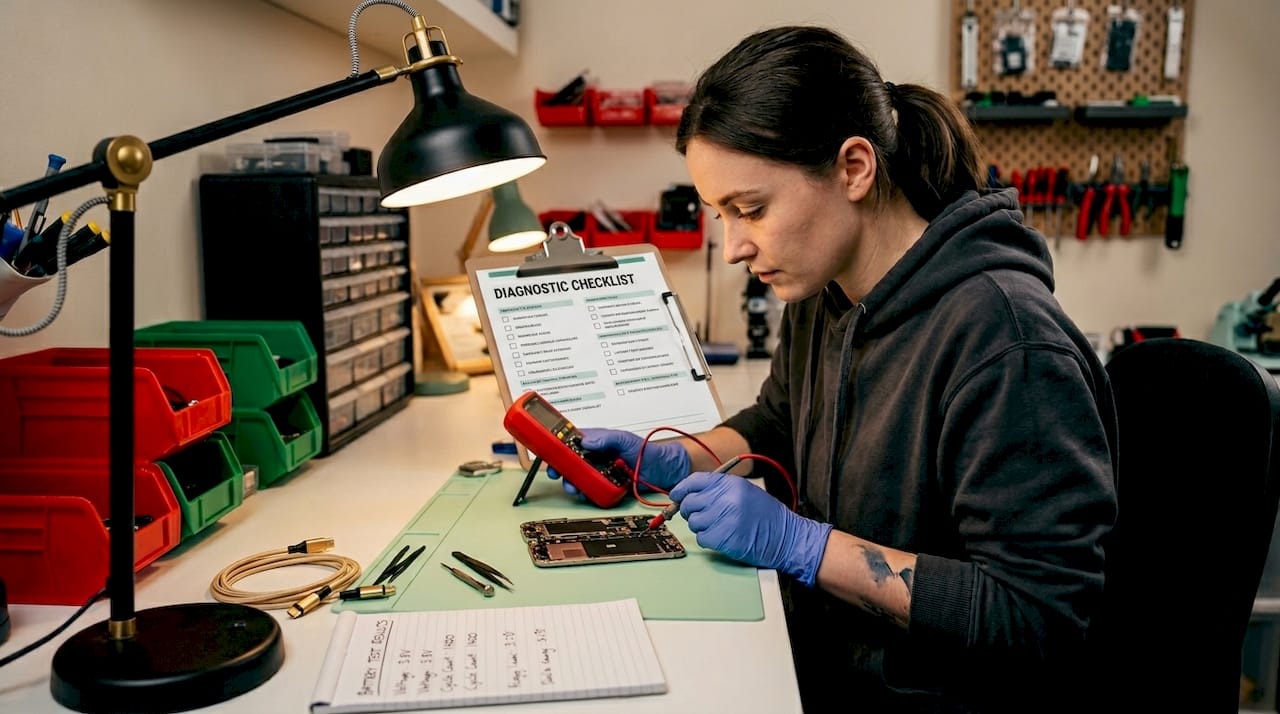
The practical shift for repair shops is significant. Technicians must broaden their diagnostic checklists. Battery, screen, charge port, and speaker checks remain essential — but in 2026, a thermal imaging step combined with an AI core activity check should sit alongside those basics. Training your team to think in terms of software-hardware interaction, not just component-by-component replacement, is now a genuine competitive advantage.
Policy revolution: The UK Right to Repair extension and its impact
With technology pushing the boundaries of repair, UK policy is also evolving — fundamentally changing the business of mobile repair. The legislative landscape is shifting in your favour as a repair professional, though preparation is essential to make the most of it.
The UK government has confirmed plans to extend Right to Repair legislation to cover smartphones and tablets. UK repair technicians should expect more permissive access to parts, documentation, and battery-replacement requirements under this extension, which is planned to come into force from 1 July 2027. That gives you roughly a year to prepare your business, retrain your team, and update your supplier relationships.
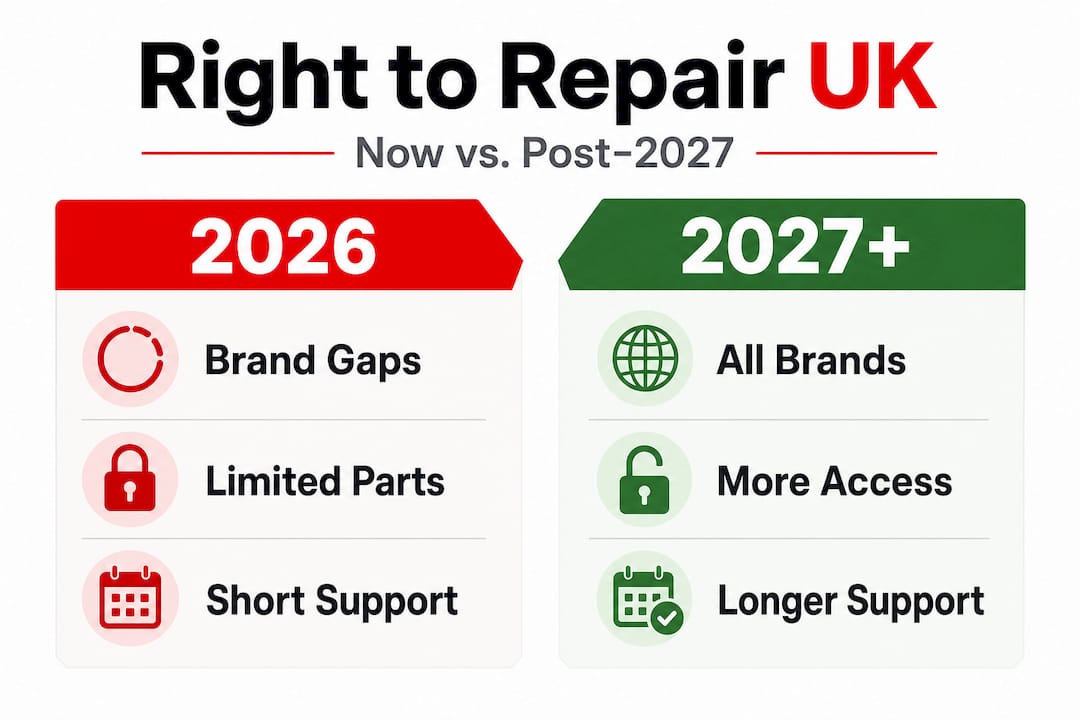
Here is what the new framework will mean in practice:
| Aspect | Current situation (2026) | Post-July 2027 |
|---|---|---|
| Parts availability | Varies by brand; often OEM-controlled | Minimum 7 years after last sale |
| Software support | Inconsistent across brands | Minimum 5 years mandated |
| Service manuals | Rarely shared with independents | Must be made accessible |
| Battery supply | Often restricted or expensive | Regulated availability for independents |
| Repair documentation | Fragmented or proprietary | Standardised access required |
The Right to Repair Directive implications are substantial for any business in the repair chain. Manufacturers will be legally required to make spare parts available to independent technicians at fair prices, removing one of the biggest barriers repair shops currently face — particularly for popular batteries and camera modules that are often simply unavailable outside of authorised service networks.
Key benefits for UK repair technicians:
- Faster turnaround times. When parts are guaranteed to be available, you stop losing jobs to “part not in stock” delays.
- Fairer pricing. Regulated supply chains reduce the premium on OEM-adjacent parts, improving your margins.
- Access to service documentation. Official repair manuals mean fewer guesswork scenarios, particularly for complex logic board faults.
- Battery accessibility. Understanding UK battery replacement changes becomes especially important as the new rules make battery replacement a regulated right for customers.
- Customer confidence. Shops that communicate these legislative protections to customers will build stronger trust and loyalty.
A statistic worth noting: according to repair industry analysts, over 60% of independent UK repair shops report that parts unavailability is their primary reason for turning away customers. The Right to Repair extension directly targets this problem. For technicians who also want to review how they currently source and advise customers on components, the top replacement parts tips resource is a practical starting point.
Modern repair approaches: Advanced diagnostics and safe repair workflows
Keeping pace with legislation and evolving device design means repair methodology itself must become more disciplined and data-driven. The “swap and pray” approach — replacing parts based on symptom guesswork — is increasingly ineffective with modern devices that are tightly integrated and expensive to disassemble incorrectly.
One of the most critical workflow updates in 2026 concerns liquid and moisture damage. Water damage remains one of the most common and most mishandled repair scenarios in UK shops. Empirical diagnostic-style repair guidance now firmly emphasises component-level electrical triage rather than symptom-based replacement as the correct first step. Getting this sequence right can be the difference between a successful data recovery and a total board loss.
Step-by-step workflow for water-damaged phones:
- Do not power on the device. Applying power to a wet board causes oxidation and short circuits that destroy data and components permanently.
- Disconnect the battery flex immediately. This is the single most important action. Cut off the electrical supply to prevent secondary damage spreading across the board.
- Perform continuity and diode checks. Using a multimeter, check for shorts across key rails on the logic board before doing anything else.
- Clean thoroughly with isopropyl alcohol (90% or above). Use an ultrasonic cleaner where available for maximum efficacy, particularly around connectors and shielding.
- Dry completely before reconnecting power. Air drying is insufficient. Use controlled heat (under 50°C) or a desiccant chamber.
- Test individual components before full reassembly. Screen, battery, cameras, and charging should all be individually verified before the device is sealed again.
- Document your findings. A clear repair record protects you legally and professionally, particularly as Right to Repair legislation tightens accountability.
Pro Tip: Calibrate your multimeter and ESD (electrostatic discharge) mat regularly. An uncalibrated tool gives false readings that lead to misdiagnosis. ESD-safe workspaces are not optional on high-end devices in 2026 — a static discharge on a modern SoC can cause faults that appear days after the repair, making diagnosis nearly impossible.
Safe battery handling is also becoming a professional differentiator. With lithium-polymer batteries becoming thinner and more energy-dense, mishandling during removal is a genuine fire risk. Technicians who demonstrate proper battery protocols — including temperature checks, swelling assessment, and correct adhesive removal — are increasingly distinguishing themselves from less careful competitors. Reviewing a basic repair skills refresher can help standardise your team’s approach, and staying current with latest repair trends ensures you are not falling behind on evolving best practice.
Practical applications: Staying ahead with training, tools, and policy
Having mapped the landscape of new tech and policy, the practical question is: how do you, as a technician, stay ahead and excel? The answer lies in treating your professional development as a continuous process rather than a one-time qualification. The most successful repair shops in 2026 are structured around ongoing learning.
AI acceleration and modern repair diagnostics are converging, and repair technicians who understand this connection will increasingly treat performance anomalies — battery drain, throttling, unusual heat — as potentially tied to on-device AI or NPU activity, not only classic hardware faults. This mindset shift alone will save significant diagnostic time and improve first-fix rates for your business.
Practical steps to upgrade your repair capability in 2026:
- Enrol in modular CPD (Continuing Professional Development) courses focused on AI hardware, NPU behaviour, and modern SoC architecture. Organisations such as the CTIA and independent UK training providers now offer targeted courses for working technicians.
- Invest in updated test equipment. Specifically, look for diagnostic tools with thermal imaging capability and software that surfaces AI core activity. Standard multimeters remain essential but are no longer sufficient on their own.
- Review your stock and supplier lists in light of Right to Repair requirements. Identify which brands you currently struggle to source parts for, and plan to establish direct supplier relationships as the legislation comes into force.
- Build a battery diagnostics workflow. Customers increasingly ask about battery health before committing to repair. Having a structured battery diagnostics guide process in place builds credibility and trust.
- Update your customer communications. As Right to Repair extends, educating customers about their rights will build loyalty and position your shop as an authority.
- Invest in ESD-safe infrastructure. Grounding mats, wrist straps, and anti-static storage should be standard across every workbench.
- Join UK repair trade networks. Peer learning through trade associations keeps you updated on legislative changes, supplier intelligence, and emerging fault patterns before they become widespread.
The technicians who thrive are not simply waiting for problems to walk through the door. They are actively upskilling, retooling, and repositioning their service offer every quarter. That discipline is what separates a growing repair business from one that is slowly overtaken by better-prepared competitors.
The real challenge: Why repair expertise now means lifelong learning
Our look at practical tools for staying ahead leads naturally to a deeper question: what does it truly mean to be a future-ready technician in 2026?
There is an uncomfortable truth that the repair industry rarely discusses openly. The old playbook — swap the screen, replace the battery, update the software, and send the customer home — still works for a shrinking category of jobs. But the devices arriving in your workshop today are fundamentally different systems to those of five years ago. They carry dedicated AI processors, ultrathin folding displays, multi-layer battery management systems, and firmware that interacts with hardware in ways that are not visible to the naked eye or even a basic diagnostic tool.
The technicians who are genuinely future-proof are not necessarily the most experienced solderers or the fastest at a screen swap. They are the professionals who treat every new device generation as a reason to update their mental model of how phones work. They study NPU behaviour not because a customer specifically asked for it, but because they understand it will appear in a fault within six months. They read the Right to Repair updates not because they enjoy regulatory documents, but because they know it will change how they source a battery next year.
Understanding battery essentials is a good example of this mindset in action. Batteries have always been a bread-and-butter repair, but the chemistry, form factors, and safety requirements around them have evolved enormously. A technician who stopped learning about batteries five years ago is now routinely underprepared for what walks through the door.
Technical agility — the willingness and discipline to continuously retrain and adapt — is the most valuable skill in your kit in 2026. It cannot be bought off a shelf. It is built through habits, curiosity, and a refusal to assume that last year’s knowledge is sufficient for this year’s problems.
Upgrade your repairs with trusted UK resources
Taking continuous action on the latest advancements means having the right support and suppliers behind you. At Buy2fix, we stock certified replacement parts for all major brands including iPhone, Samsung Galaxy, Huawei, Xiaomi, and OPPO, backed by quality checks before every dispatch, free UK mainland shipping, and a 30-day return policy. Beyond parts, our blog and resource library are updated regularly to help professional technicians stay current with the latest repair methods, legislative changes, and diagnostic approaches. Whether you are sourcing a battery for a flagship device or looking for guidance on a complex fault, Buy2fix is built to support your practice at every stage.
Frequently asked questions
How does on-device AI impact mobile diagnostics in UK repair shops?
On-device AI increases the need for repair technicians to consider thermal, battery, and performance anomalies as possibly linked to AI or NPU activity rather than assuming a straightforward hardware fault in every case.
What will change for battery replacements under the UK Right to Repair extension?
From July 2027, independent technicians will have regulated access to batteries and official parts for at least 7 years after device sale, making battery swaps simpler, faster, and more competitively priced for UK repair shops.
What is the best first step when a phone suffers water or liquid damage?
Disconnect the battery flex immediately to prevent secondary electrical damage, then proceed with electrical short checks and a thorough cleaning process before any attempt to power the device.
How can repair shops upskill for AI-based diagnostics in 2026?
Technicians should pursue modular CPD focused on NPU architecture, invest in diagnostic tools that surface AI hardware activity, and regularly consult updated technical guides to stay ahead of emerging fault patterns.
Recommended
Let customers speak for us
Well made part very strong easy to fit great value for the money

Well packed, with fast shipping :)

Exactly what the doctor ordered…great color, comfort, and durability. Trust this watch band!

Brilliant strap, second purchase, bought bracelet before. Excellent value. Thank you

Great item for splitting your Audio signal

Outstanding product!
Next level customer service.

Very satisfied but the delivery needs to get more faster...

Good price,quick delivery

Best phone case ever! This is my second one as I broke my first. Would defo recommend

Great fitting Apple Watch bands

For Apple Watch Ultra 3 / 2 / 1 49mm RedPepper Armor Metal Case Integrated Silicone Watch Band(Steel Black White)

Good price and quick postage

Perfect fit.

Absolutely necessary

Second Purchase and still a very happy customer. Keep up the good work.
